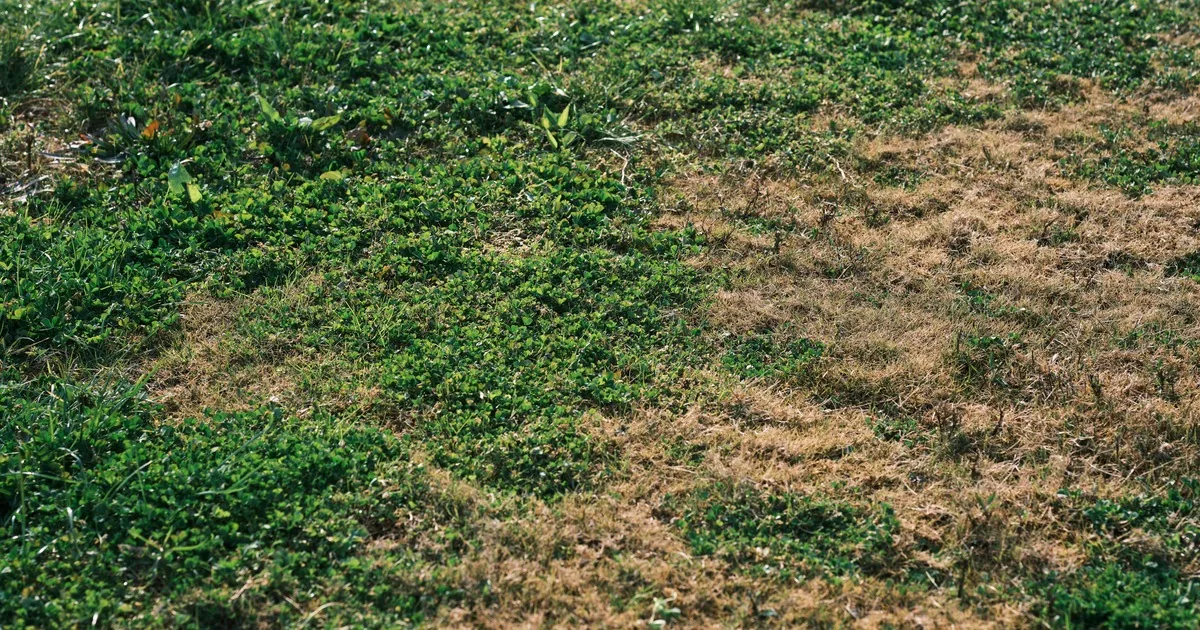
“My lawn turned brown this week. Can you bring it back?”
The caller wants a yes. The lawn-care office needs a better record first: the address, grass type if known, recent heat and rainfall, watering history, irrigation behavior, mowing and treatment history, the shape and location of the brown areas, traffic, and the date the customer hopes to see improvement.
Book an assessment when the company serves the address and the lawn is safe to inspect. Do not diagnose dead turf, promise green-up, prescribe fertilizer, or quote a renovation from the phone. Brown blades can reflect dormancy, drought stress, irrigation gaps, compacted soil, heat beside pavement, disease, insects, chemical injury, or a mix of conditions.
Start with the change the customer noticed
Ask when the lawn last looked normal and what changed before the color shifted. Was there a stretch of hot, dry weather? Did the irrigation controller stop, lose power, or receive a new schedule? Was the lawn recently mowed short, fertilized, sprayed, seeded, sodded, trenched, driven across, or used for an event?
Record the caller's observations in plain language. “Front lawn is straw-colored except for a green strip beside the driveway” is useful. “The whole yard is dead” is the caller's conclusion, not an inspection result.
Get the service address and ask which areas are affected: front, back, side yard, boulevard, slope, fenced area, or a single irrigation zone. Note whether the change appeared quickly or spread over days. Ask whether the grass is uniformly brown, patchy, ringed, streaked, or greener near sprinkler heads and downspouts. Wide photos from each corner can preserve the pattern before anyone walks through it.
The customer may know the grass type. Capture it without correcting them. Species respond differently to heat and drought, and mixed lawns can show several colors at once. University of Minnesota Extension explains that Kentucky bluegrass can brown as it enters drought-induced dormancy while the base and roots remain alive. Its guidance also notes that fescues can remain green longer under the same dry conditions.
That is why the office should avoid a confident verdict based on color.
Map the brown pattern against the property
Where the stress appears often tells the technician what to inspect first. Ask the caller to stand where the whole lawn is visible and describe the boundaries. Does brown turf follow the curb, driveway, patio, south-facing wall, hilltop, footpath, dog run, play area, tree canopy, or edge of an irrigation zone?
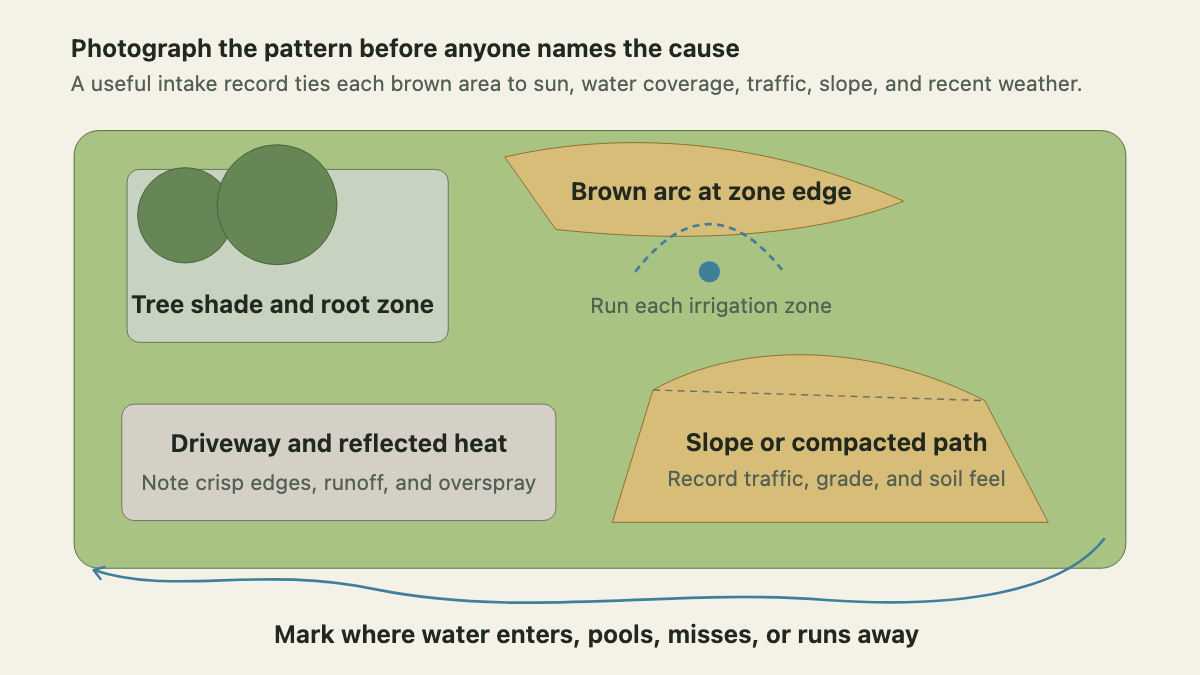
A sharp line between green and brown may line up with sprinkler coverage, a soil change, shade, or recent work. A dry arc can point the inspector toward a rotating head or zone boundary. Brown grass along pavement deserves notes about reflected heat and runoff. Stress on a slope may involve drainage, exposure, or water moving past the root zone. These are inspection leads, not diagnoses.
Ask whether the customer can run each irrigation zone before the appointment. If company policy permits that test, record heads that do not rise, spray that stops short, misting, pooling, runoff, broken components, controller errors, and zones that fail to start. A caller who reports an obvious irrigation fault may need a separate irrigation repair intake before turf recovery work is discussed.
Do not tell the customer to open valve boxes, handle electrical controls, enter standing water, or work around damaged equipment. Photos and a normal controller test are enough for the call record.
Capture watering without writing a prescription
“What is your watering schedule?” rarely produces a complete answer. Ask how the lawn receives water, which days and start times are programmed, how long each zone runs, when the last successful cycle occurred, and whether local restrictions apply. If the customer uses hoses or portable sprinklers, ask how they move them across the property and which areas are hard to reach.
Then ask about rainfall. A controller schedule that worked in spring may not describe the water that reached the soil during a hot week. Recent storms can also be deceptive when rain was brief, localized, or mostly ran off.
Illinois Extension lists wilting, darker color, and footprints that remain as early drought-stress signs. It also explains that cool-season turf can use dormancy as a defense. Once a cool-season lawn is dormant, forcing it back into active growth during continued hot, dry weather can drain plant reserves.
That regional guidance should not become a universal phone script. Water needs vary with grass species, soil, temperature, rooting depth, shade, slope, irrigation equipment, municipal rules, and the customer's maintenance goal. The technician or turf specialist should apply the company's local protocol after seeing the site.
Ask what happened on the lawn
Drought exposes weak areas that were less visible in mild weather. Ask about repeated foot traffic, parked vehicles, delivery routes, children's play, pets, recent construction, utility work, soil fill, and heavy equipment. Note whether the ground feels unusually hard, cracked, spongy, or wet when the caller steps near the affected area. Do not ask them to dig around utilities or pull up turf.
Mowing history matters too. Capture the last mowing date, approximate cutting height if known, whether clippings were removed, and whether the mower crossed the lawn after it had browned. University of Minnesota Extension advises minimizing traffic and postponing mowing during hot, dry stress because equipment can damage vulnerable turf.
Ask about fertilizer, weed control, insect treatment, fungicide, lime, seed, sod, compost, or other products applied recently. Record the product name, applicator, date, area treated, and label or invoice availability. Do not speculate about chemical injury. If a spill, misapplication, or exposure concern is reported, follow the company's safety and escalation policy.
Keep brown, dormant, damaged, and dead separate
A call handler sees the leaf color through someone else's description. The site assessment can look at the pattern, crowns, roots, soil moisture, irrigation coverage, recent weather, management history, pests, disease signs, and recovery potential.
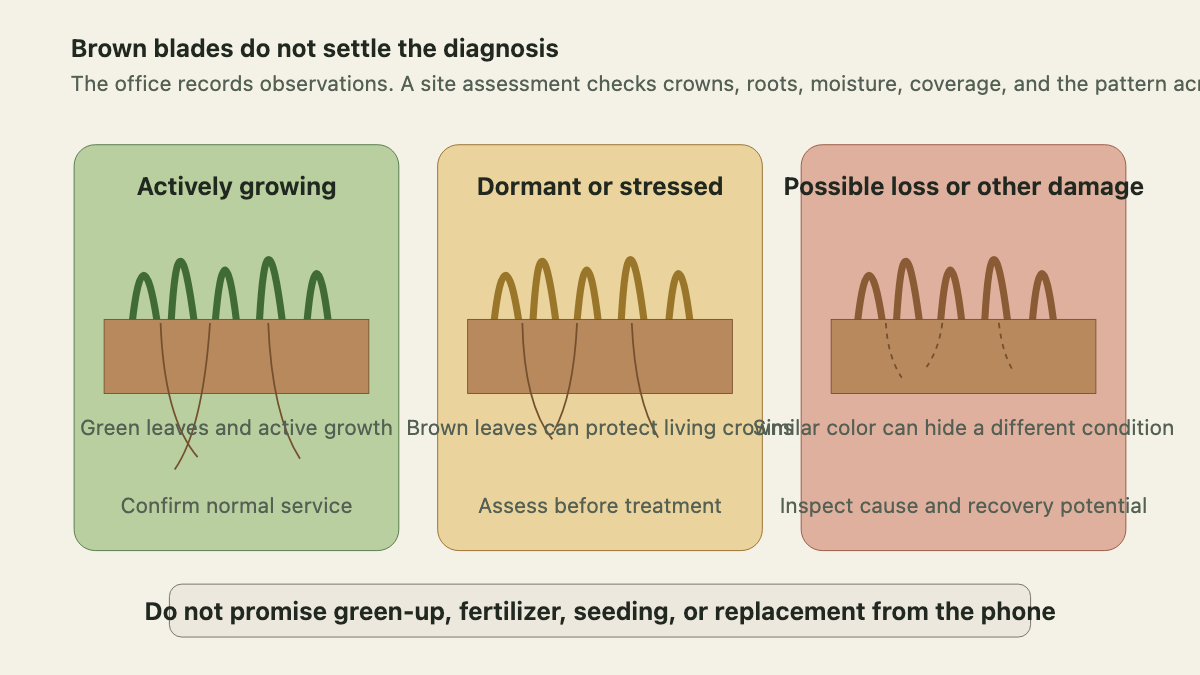
The words used on the call should preserve that uncertainty. Try: “Brown turf can have several causes, and some grasses go dormant during dry weather. We will record what you are seeing and schedule the right assessment. The technician can discuss condition and next steps after inspecting the lawn.”
Avoid promising a treatment before that visit. Fertilizer does not solve every brown lawn. University of Minnesota and Illinois Extension both advise against fertilizing drought-stressed or dormant turf during hot, dry conditions. Seed, aeration, sod, irrigation repair, soil work, pest control, and a change in mowing practice answer different problems.
If the caller asks for immediate aeration or overseeding, create a separate aeration and overseeding intake only after company policy says the lawn is ready. Weak turf under active heat or drought stress may need another sequence.
Set the appointment and the expectation
Before offering a slot, confirm the service area, lawn size under company policy, access, gates, pets, irrigation controls, and whether the decision-maker can attend. Ask if the technician may walk all affected areas and operate the irrigation controller. Record hazards such as steep slopes, unstable ground, construction zones, exposed wires, broken irrigation, or treatment warning signs.
Tell the customer what to prepare. Useful items include wide photos, close photos with a common object for scale, the irrigation schedule, recent water bills if they want to share them, product labels, service invoices, treatment dates, and any lawn or irrigation plan. They should avoid applying a new product simply to make the lawn look different before the visit.
Penn State Extension recommends assessing area, soil, drainage, grade, shade, traffic, irrigation, and causes of deterioration before lawn renovation. That supports a clear booking boundary: an assessment comes before a renovation promise.
Close by reading back the record. “I have browning across the sunny front slope, with a green band near the sidewalk. It began after the last hot week. Zone three runs, but two heads do not rise. The lawn was fertilized four weeks ago, and no new product has been applied since. You will send four wide photos and keep the controller information available for Tuesday's assessment.”
An AI receptionist can collect the same fields after hours when it follows the lawn company's service area, safety rules, and routing policy. The useful handoff is specific enough that the technician arrives looking for a real pattern, not a note that says only “customer wants dead lawn fixed.”