A homeowner calls and says, “I need new sod in the backyard. It’s about 2,000 square feet. Can you give me a price?” That sounds like a clean estimate request. Then the details arrive: an old lawn still covers half the yard, a six-foot gate opens into a narrow side path, a maple shades the back corner, and the only hose bib is beside the garage.
The first call should establish seven facts: the area to be sodded, the current surface, grade and drainage, sun exposure, crew access, turf preference, and how the customer can water the new lawn. Those answers tell the estimator what to inspect and keep the office from treating a preparation job as a simple turf delivery.
Start with the area and its edges
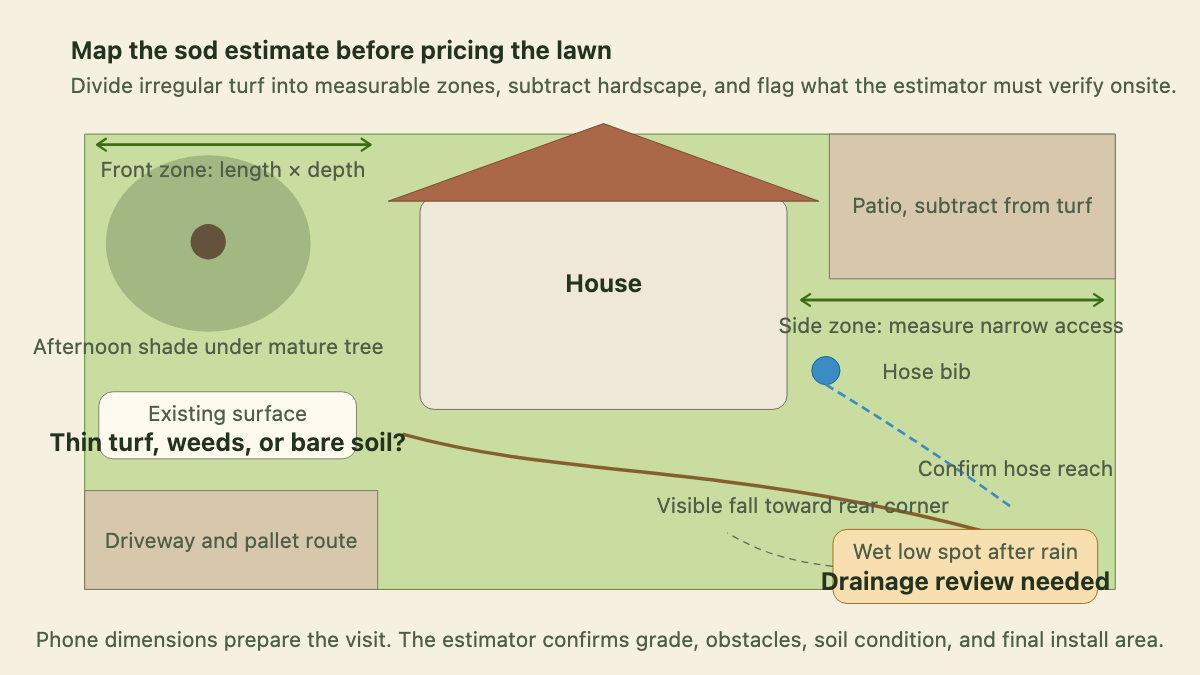
“About 2,000 square feet” is useful as a starting point. It is not a final material quantity. Ask the caller to describe each separate lawn section and what borders it. A rectangular front lawn can be measured with length and depth. A backyard that wraps around a patio may need two or four smaller zones. Driveways, decks, planting beds, sheds, pools, and walkways are exclusions.
Penn State Extension recommends measuring the planting area, subtracting structures, and marking obstacles before lawn establishment. Site size affects material, labor, and equipment planning. That is why the office needs more than a single rough number.
Ask:
- Which areas are getting sod: front, side, back, boulevard, or selected patches?
- What are the approximate dimensions of each area?
- Which patios, beds, paths, tree rings, and structures sit inside those dimensions?
- Are the boundaries straight, curved, or broken into narrow strips?
- Can the caller send one wide photo from each corner and a simple sketch with measurements?
A phone measurement prepares the estimate. The crew or estimator should confirm the billable area under company policy, especially when curves, slopes, narrow strips, or changing grades make a homeowner’s rectangle misleading.
Find out what sits there now
The most important scope question may be six words: “What is on the ground today?”
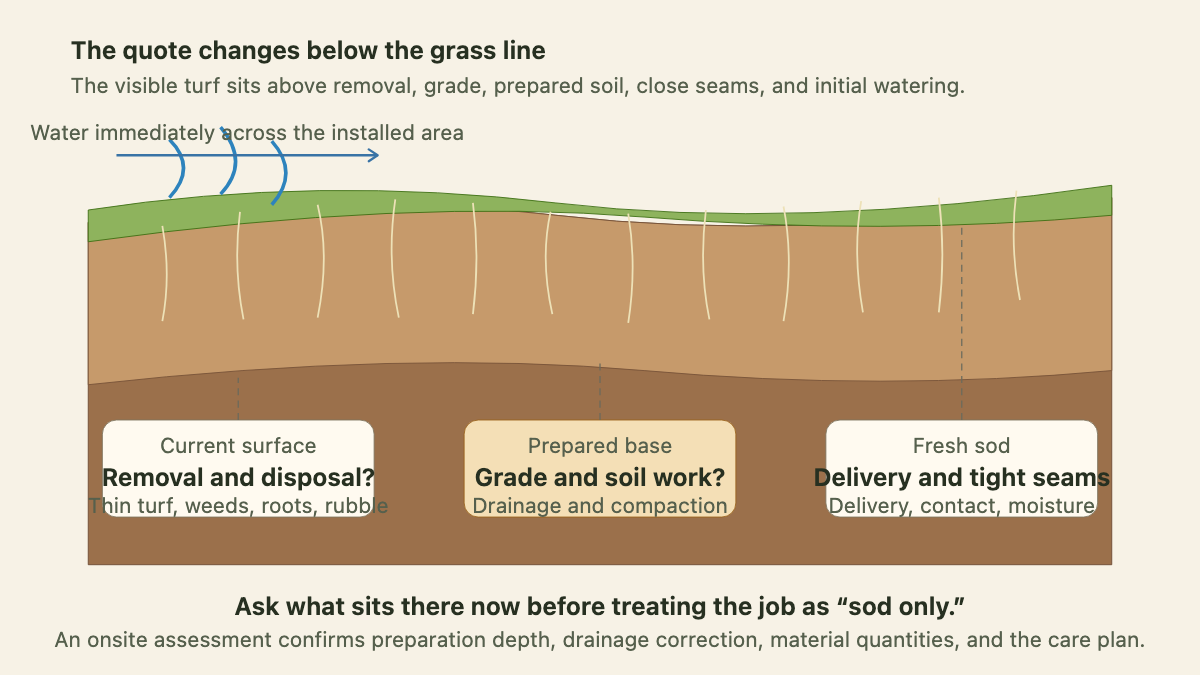
Bare, recently graded soil is a different starting point from established turf. A thin lawn can still have a dense root layer. Construction soil may hide rubble or severe compaction. Weeds, exposed roots, stones, depressions, and standing water all change what must happen before fresh sod is placed.
University of Minnesota Extension and Penn State Extension both put soil preparation ahead of installation. They recommend soil testing for amendment decisions because appearance alone cannot show which nutrients or changes the soil needs. The office does not need to prescribe an amendment on the call. It does need to record whether testing has been done and whether removal, grading, topsoil, or drainage work may belong in the estimate.
Use plain questions. “Is this bare soil, an old lawn, weeds, or a mix?” works better than asking whether the site is “ready.” Most homeowners have no shared definition of ready.
Then ask whether another contractor recently completed excavation, utility work, a pool, a patio, or home construction. Fresh-looking soil can still be compacted by equipment. Ask where water collects after rain and whether runoff moves toward the house, a neighbor, or the street. Treat those answers as observations for the estimator, not a drainage diagnosis.
Record sun, slope, and how the lawn will be used
A caller may ask for the same grass as a neighbor without knowing that the neighbor’s yard receives far more sun. Record the conditions before discussing a turf option.
Ask when the area receives direct sun and where trees or buildings create lasting shade. The answer can be simple: “full morning sun, shade behind the garage after lunch.” Note steep banks, gentle slopes, low spots, and any place where mowing is awkward. Penn State’s lawn-establishment guidance treats shade, drainage, soil, grade, and expected traffic as site-selection inputs. Minnesota Extension likewise distinguishes turf choices for sunny, shaded, worn, and lower-maintenance areas.
Use matters too. A front lawn viewed from the street has a different job from a play area used by two large dogs. Capture children, pets, regular foot traffic, backyard games, and any planned fence or construction work. Avoid promising that one grass will tolerate every condition. Turf availability and suitability vary by region, grower, season, and site.
This is where a routine quote can become a landscape design consultation. If the customer is also moving beds, changing drainage, adding irrigation, or redesigning traffic routes, route the project according to the company’s design process.
Confirm delivery and crew access
Fresh sod arrives heavy and time-sensitive. University of Minnesota Extension advises laying it as soon as possible after delivery and maintaining good contact with the prepared soil. The office should learn whether the delivery and installation path can support the planned equipment and schedule.
Ask for the narrowest gate opening on the route, not the widest gate on the property. Note steps, retaining walls, tight turns, soft ground, septic components, irrigation heads, low branches, overhead wires, and parking limits. Find out whether a pallet can be staged near the work or whether pieces must be carried through a side yard.
Utilities and irrigation deserve their own line in the call note. Ask whether the customer knows of buried irrigation, invisible dog fencing, landscape lighting, drain lines, or recent utility markings. The office should never imply that a homeowner’s memory replaces required utility-location procedures.
Confirm who will move furniture, toys, planters, pet waste, play equipment, and other loose items. A photo of the access route often answers more than five minutes of description.
Make water access part of the estimate
New sod needs prompt, consistent moisture while it establishes. Minnesota Extension advises keeping sod moist without saturating it until it has rooted. EPA WaterSense notes that watering needs depend on climate, plant needs, and soil, and that runoff or overspray should be avoided. A universal minutes-per-zone promise does not belong on an intake call.
The office can still establish whether a workable method exists. Ask where the hose bibs are, whether hoses reach every install zone, and whether an irrigation system covers the area. If sprinklers exist, ask whether they were tested recently and whether any zones are under repair. A known system problem may need a separate irrigation repair visit before installation day.
Record who will handle watering after the crew leaves and how the company delivers care instructions. For rental property, identify the owner, tenant, or property manager responsible. For a vacant home, “the buyer will water it” is not a plan unless the buyer has access before closing.
Do not turn the call handler into an irrigation designer. Capture reach, equipment, responsibility, and known faults. The installer can set the project-specific schedule after considering turf, soil, weather, slope, and system performance.
Read back a quote-ready record
Before booking, summarize the job in a form the estimator can use:
“Backyard and side yard, homeowner estimate of 1,850 square feet before patio and bed exclusions. Existing thin turf with weeds. One shaded corner under a maple. Water collects near the rear fence after heavy rain. Access is through a 44-inch side gate with two steps. Hose bib at the garage reaches the front half; irrigation coverage for the rear is unconfirmed. Two dogs use the yard. Customer will send zone measurements, four wide photos, the gate photo, and a picture of the low spot.”
Then state what happens next. If the company requires an onsite measure, say so. If photos receive office review first, give the submission method and a realistic response window. Explain whether removal, soil preparation, grading, delivery, installation, cleanup, and early-care instructions are included in the estimate or listed as separate scope items.
A consistent intake system helps when calls arrive during a crew meeting or after hours. A trained receptionist or AI receptionist can capture the same property fields and route the record for review. The useful result is the note itself: a measured set of observations, a clear list of unknowns, and an estimator who arrives knowing where the pallet has to go.