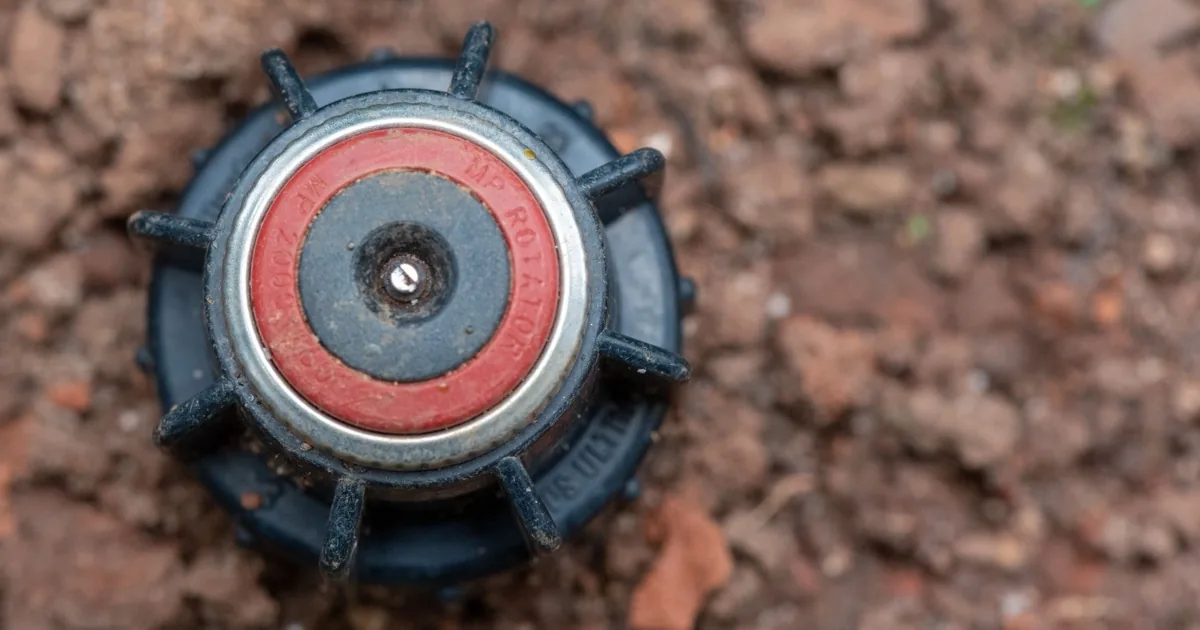
The first cold-week forecast hits, and the phone starts repeating one sentence: “I need my sprinklers blown out.” One caller has a six-zone residential system with an accessible shutoff in the basement. The next manages three buildings, a pump, shared controls, locked mechanical rooms, and a backflow assembly nobody can locate.
Those requests should not land in the same appointment slot with the same note.
A useful irrigation winterization booking record identifies the property, water source, number of zones, irrigation shutoff, backflow assembly, downstream service connection, controller, pumps or sensors, access conditions, and known damage. Reception gathers those facts and photographs. A qualified technician decides the drain method, connection, equipment, pressure, and component procedure.
Confirm the property before counting zones
Start with the service address and determine whether the caller is responsible for one house, a rental, an association, or a commercial site. Search the customer record while the caller is on the line. A returning address may already have a system diagram, prior invoice, zone count, gate note, controller model, or warning about a difficult shutoff.
Then ask what the irrigation serves. A front lawn and two planting beds suggest a different visit than a retail center with medians, drip beds, and remote valves across several parcels. Record every area the caller expects the service to cover. If the property has detached buildings, road crossings, athletic fields, rooftop planters, or a second controller, say so in the work order.
Ask for the caller’s zone count, but mark it as reported. People often count controller programs, visible valve boxes, or groups of sprinklers and call each one a zone. A controller photograph with the door open is more useful than confidence over the phone. Capture the brand, model, displayed zone capacity, and any handwritten labels without asking the caller to run the system.
Water source belongs near the top of the record. Ask whether the system uses municipal water, a well, reclaimed water, a pond, or a dedicated pump. If the caller is uncertain, record that. Do not convert a guess into a standard residential booking.
Locate the shutoff, backflow assembly, and service port
“Everything is by the side of the house” leaves the technician searching. Ask the caller to separate the components they can identify safely.
The irrigation shutoff may be indoors, in a basement or crawlspace, in a utility room, or inside an exterior valve box. Record the location in ordinary directions: “basement ceiling above the water heater” beats “inside.” Confirm whether the technician can reach it and whether the customer, tenant, superintendent, or building engineer controls access.
Next, ask about the backflow assembly. It may be above ground near the building, inside a mechanical space, or in a protected enclosure. A wide photograph and a close label photograph are useful. Reception does not need to name the device from a blurry image. The point is to show the technician what is present and where it sits in the water path.
Finally, ask whether there is a separate service or blowout connection downstream of the backflow assembly. Colorado State University Extension and Hunter Industries both distinguish the system connection from the backflow device in their winterization guidance. Hunter warns that compressed air should not be blown through a backflow device. That boundary is a strong reason to collect component photos before dispatch, and an equally strong reason to keep valve instructions off the phone.
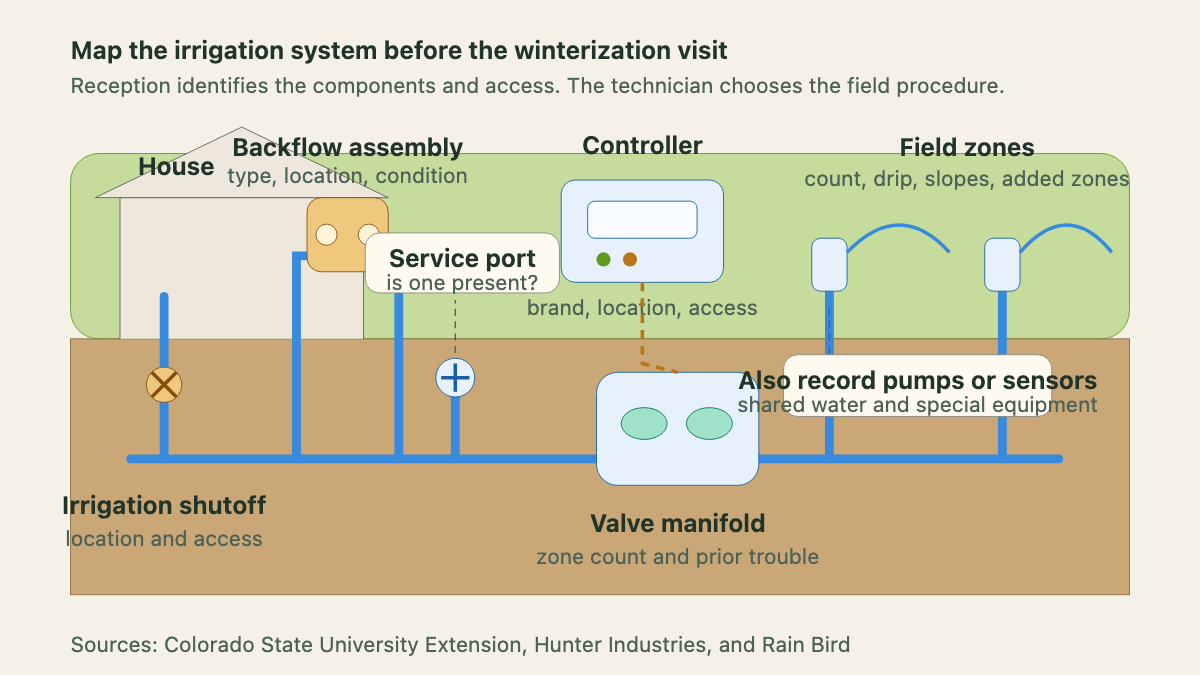
The diagram gives reception a visual order for the call: supply, shutoff, backflow assembly, downstream service port, valve manifold, and field zones. The controller follows a separate control path. Pumps, flow sensors, and shared water sources deserve their own note because they can change the field review.
Ask about the parts that make a standard visit nonstandard
Winterization methods depend on system design. Rain Bird describes manual drains, automatic drains, and compressed-air blowout as distinct ways systems may be drained. Hunter also separates manual-drain and blowout systems and publishes different considerations for controllers, flow sensors, pumps, valves, and backflow devices.
That does not mean the receptionist should identify the correct method. Ask what the caller knows and route uncertainty to someone who can review it.
A compact intake covers the following:
- How many zones does the caller report, and are any drip zones included?
- Is there more than one controller, meter, shutoff, backflow assembly, or service connection?
- Does the system use a pump, well, reclaimed water, flow sensor, master valve, or booster equipment?
- Were zones added, abandoned, capped, or rebuilt since the last winterization?
- Is there an active leak, broken head, damaged valve box, failed controller, or exposed pipe now?
- Did a prior winterization leave a zone wet, damage a component, or require a return visit?
- Are any portions shared with an association, neighboring unit, tenant, or commercial water system?
The answers define the next review. They do not prove that the system is ready.
If the caller reports an active leak, a zone that will not shut down, or a controller fault, link the record to the separate irrigation repair call intake. Seasonal service and active repair can share a visit only after operations confirms the scope, parts, and time.
Book access as carefully as the service
A perfect component list still fails if the shutoff is behind a locked basement door.
Confirm who will be present and which areas require entry. Ask about gates, lockboxes, alarm instructions, mechanical rooms, crawlspaces, garages, tenants, pets, and parking. On a managed property, identify the person who can authorize water shutoff and provide access to every controller and service area. If the property requires a certificate of insurance or a scheduled escort, capture that before offering a date.
Request photographs through the company’s normal secure channel. Useful images include the controller with its door open, the irrigation shutoff in context, the backflow assembly, the suspected downstream service port, any pump or sensor, and a wide view of unusual access. A close-up without context can show a brass fitting while hiding that it is behind a fence or below a low deck.
Do not ask a caller to open test cocks, move valve handles, connect air, remove sensors, or stand over irrigation components. Hunter warns that compressed air can cause serious injury from flying debris and recommends qualified contractor work. Rain Bird also points homeowners toward an irrigation specialist because compressed-air methods carry safety risks. The office can solve the information problem without turning the call into a field procedure.
Set a scheduling policy the office can defend
Customers often ask for the exact last safe date. The honest answer depends on local weather, installation depth, exposed components, pipe material, site conditions, and company practice. Keep the calendar tied to the shop’s service area and written policy. Do not promise that a generic temperature threshold protects every system.
Explain what can move an appointment. Severe weather, frozen ground, unsafe access, a system that cannot be isolated, or missing authorization may require review or rescheduling. Say whether someone must be home, how arrival windows work, and whether the office will contact the customer if conditions change.
Commercial and multi-site properties need a wider scheduling record. Capture operating hours, pedestrian traffic, loading restrictions, water-use limits, site contacts, and any area that cannot be taken offline during business hours. The commercial grounds maintenance bid-call guide is useful when the winterization request is part of a larger property-services scope.
A seasonal rush makes vague notes tempting. They cost time later. “Eight zones, customer home” tells the technician very little. “Eight zones reported on one Hunter controller; municipal water; irrigation shutoff in locked basement utility room; above-ground backflow at east wall; downstream service port visible in photo; no pump reported; one drip zone added this summer; owner present after 2 p.m.; prior spring leak at zone six” is a dispatchable record.
Route exceptions before they reach the truck
Pause ordinary booking when the caller cannot identify the service address or responsible party, the system spans several properties, water comes from a pump or reclaimed source, the shutoff or backflow assembly is unknown, access depends on a third party, or the caller reports active damage. The same applies when a prior contractor could not complete the work or when the customer wants a guarantee that winterization will prevent every spring repair.
Colorado State University Extension explains that water left in pipes and components can freeze and damage fittings, valves, sprinklers, pumps, and backflow equipment. That supports the reason for winterization. It does not support a blanket guarantee. Components can already be damaged, inaccessible, altered, or configured outside the assumptions of a routine visit.
An AI receptionist can collect the same booking fields during the evening rush and send exceptions to an operations lead. It should never choose the field method, invent a zone count, identify a backflow device from an uncertain photo, or coach a caller through compressed-air work.
The strongest handoff lets the technician picture the site before loading the truck: which door leads to the shutoff, where the backflow assembly stands, whether a downstream port is visible, how many zones the controller reports, and who can open the gate. That is what the winterization call is for.
Sources
- Colorado State University Extension: Preparing Your Sprinkler System for Winter
- Hunter Industries: Winterizing Your Irrigation System
- Rain Bird: How Do I Winterize My Irrigation System?