A homeowner calls after the mower blade struck a raised root beside a mature maple. Grass has thinned under the canopy, one root crosses the usual mowing path, and the caller wants the landscaping crew to “cut it flat and put down new sod.” The office can book a consultation, but it should not promise root removal or a turf fix.
Start by mapping what is visible. Record where the roots sit relative to the trunk, canopy, lawn edge, path, irrigation, and any recent digging. Ask what changed, when the caller first noticed it, whether the tree or soil looks different, and what result the caller wants. Fresh root cuts, lifted soil, a new lean, storm damage, pavement displacement, or utility work can change who should review the site first.
Separate the lawn complaint from the tree concern
“Roots are ruining my yard” can mean several things. The caller may be frustrated by thin grass, a rough mower route, a trip point, exposed roots, or a patch that will not hold seed. They may also be looking at a freshly cut root, soil heaving near the trunk, or a tree that changed after a storm.
Ask the caller to describe the problem without naming the cause. Useful notes sound like “three roots visible in grass on the north side, one crosses the mower path about eight feet from the trunk” or “grass has thinned beneath most of the canopy for two summers.” Avoid writing “roots killed lawn” unless a qualified professional has already documented that conclusion.
University extension guidance explains why restraint matters. Wisconsin Extension says most tree roots grow horizontally near the soil surface. Compaction, poor drainage, thickening roots, and erosion can contribute to visible roots. A phone description cannot tell the office which factor controls the site.
The first routing question is simple: does the caller report a routine lawn-use conflict, or a recent change that may affect the tree? Thin turf and difficult mowing may fit a landscape consultation. A fresh root cut, new lean, lifted soil, storm damage, or rapid change deserves review under the company’s tree-care procedure.
Map the roots, turf, and daily route
Give the crew a map they can picture before arrival. Start at the trunk and work outward. Ask where each visible root begins, which direction it runs, and where it disappears beneath the soil. Use fixed references such as the patio corner, north fence, irrigation box, front walk, or downspout.
Then define the lawn conflict. Is grass thin in a ring around the trunk, beneath one side of the canopy, or only along the exposed roots? Does the mower deck strike a specific root? Do wheels lose traction on a slope? Is there a walking route to a gate, play area, mailbox, or trash enclosure? Ask whether anyone has tripped, but do not turn a reported trip point into a tree-risk rating.
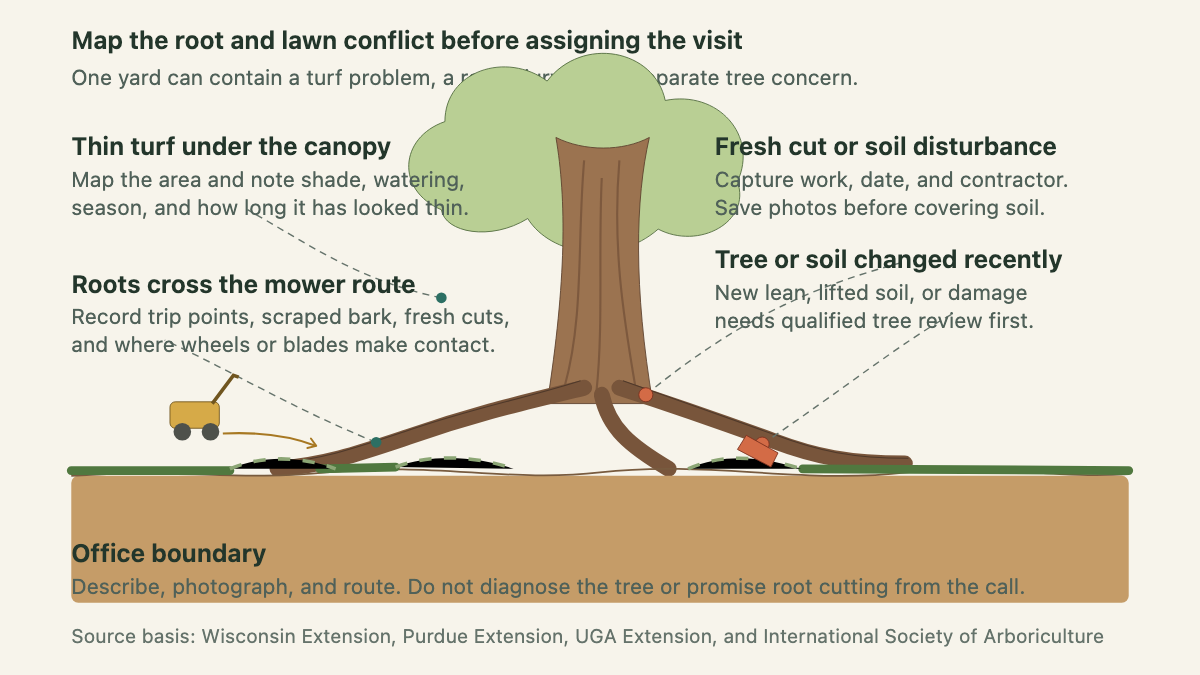
Photos help when they preserve scale and context. Request one wide view showing the whole tree and affected lawn, another showing the root pattern relative to the trunk, and close views of any fresh cut, scraped bark, disturbed soil, or mower contact. The caller should take them from safe standing positions. Do not ask anyone to dig, probe beneath a root, climb, or stand near a tree that appears unstable.
Include the canopy edge in the record. Tree and turf conditions interact above and below ground. The International Society of Arboriculture’s Trees and Turf guide describes competition for light, water, nutrients, and rooting space. It also warns that treatment aimed at one plant can affect the other.
Preserve the recent-work timeline
Recent work often matters more than a guess about species. Ask what happened in the root area during the weeks and months before the call. The answer may include trenching, irrigation repair, cable installation, edging, aeration, grading, soil delivery, stump grinding, new sod, herbicide use, heavy equipment, parked vehicles, or repeated mower strikes.
Record the date, work area, approximate depth if known, contractor, and purpose. Ask whether photographs exist from before the work was covered. If a utility locator marked the site or a permit was involved, note the record without claiming that it proves the roots were unharmed.
Surface-root guidance from Purdue Extension warns against cutting or grinding visible roots, adding a heavy layer of topsoil, and creating raised planting areas over them. Wisconsin Extension also cautions against rototilling around roots. Those sources support a firm intake boundary: reception should not tell the caller to prepare the site by cutting, burying, cultivating, or exposing roots.
Mower contact belongs in the same timeline. Ask whether the bark was scraped, a piece was cut away, or the root was hit repeatedly. Capture the location and a clear photo. Leave the effect on tree health or stability to a qualified reviewer.
Ask what the caller is trying to accomplish
A caller who says “fix the roots” may want a smoother mowing route. Another wants green grass beneath dense shade. A property manager may need to reduce a trip concern near a common path. Someone planning a new bed may want to keep the tree and stop mowing the area altogether.
Ask for the preferred outcome in plain terms. Then ask which parts are nonnegotiable: keeping the tree, preserving lawn area, maintaining path width, retaining irrigation coverage, avoiding soil changes, meeting an HOA requirement, or completing work before an event. The request does not determine the safe method, but it tells the reviewer which tradeoffs need discussion.
Mulch and carefully planned non-turf areas appear often in extension guidance. Purdue recommends wood mulch for troublesome surface roots, while Wisconsin discusses shallow topsoil in limited circumstances, mulch, and hand-planted groundcover. UGA Extension also favors mulch and warns against cutting structural roots. The details differ because sites differ. Reception should book the evaluation and avoid prescribing a universal depth, radius, soil blend, or planting method.
For a broader project that includes beds, drainage, hardscape, lighting, or a new use for the yard, route the caller through the landscape design consultation intake. Keep the root-and-lawn ticket attached so the designer sees the constraint before drawing over it.
Route infrastructure claims to the right owner
A landscaping call can cross into another scope quickly. If the caller reports a raised sidewalk, cracked driveway, damaged retaining wall, slow drain, sewer concern, foundation crack, or disputed property line, record the observation and the owner of the affected item. Do not agree that the tree caused it.
The tree root damage consultation guide covers those infrastructure claims in detail. It helps the office separate visible damage from alleged cause and identify whether a municipality, utility, neighbor, plumber, engineer, arborist, or property owner may need to participate.
Underground work needs its own boundary. If the proposed landscaping includes digging, trenching, staking, irrigation changes, or equipment near marked utilities, follow the company’s utility-location and excavation procedures. Never assume a root is the only buried conflict.
Build an inspection-ready ticket
Before assigning the visit, collect the facts in one consistent record:
- Service address, property type, caller’s authority, and access instructions
- Tree location, number of trees involved, known species if documented, and one wide site photo
- Visible root directions, distance from fixed features, thin-turf area, mower route, and walking conflict
- First-noticed date, rate of change, storm history, recent digging, soil addition, irrigation work, equipment traffic, or root contact
- Any new lean, lifted soil, fresh cut, exposed wound, canopy change, pavement issue, utility concern, or reported injury
- The caller’s desired outcome and which site features must be preserved
- The reviewer needed first, such as landscaping, an arborist, a utility, or the owner of affected infrastructure
Read the central facts back. “Mature maple in the rear lawn. Three roots are visible on the north side, and one crosses the mower route near the gate. Turf has thinned under the canopy for two seasons. The caller reports a fresh scrape from last week’s mowing but no new lean, lifted soil, or storm change. They want safer mowing and prefer to keep the tree. Wide and close photos are attached.”
That note gives the reviewer a place, pattern, timeline, use conflict, recent injury, and desired outcome. It does not promise sod, root removal, grading, or a tree assessment that the assigned crew is not qualified to provide.
An AI receptionist can collect the same fields after hours and route the record under company rules. The script should preserve one hard stop: any request to cut, grind, bury, trench through, or diagnose roots waits for qualified review.
Leave the crew a map, not a verdict
The best final ticket lets the field reviewer find every reported condition without repeating the phone call. Mark the trunk, canopy edge, exposed roots, thin turf, mower path, recent-work area, irrigation components, nearby pavement, and safe access point. Attach the caller’s photos in that order.
When the crew opens the job, they should see the root crossing beside the north gate, the scrape from last week, the shaded turf under the canopy, and the property manager’s request to keep the tree. That is enough to begin a real consultation without asking the front desk to practice arboriculture over the phone.