A homeowner calls and says, “Your tree roots cracked my sewer line.” Another says a maple lifted the front walk. A third has a basement crack near an oak and wants the tree removed before the crack grows.
The office should resist deciding the cause. Start with the affected structure, its exact location, what changed, when it changed, and what evidence already exists. Then record recent digging or construction, visible roots, drainage symptoms, utilities, safe access, and the decision the caller needs. Tree condition and root work belong with a qualified arborist. Pipe condition, pavement repair, soil movement, and structural questions may need separate professionals.
That boundary matters. A nearby tree is a fact. So is a lifted slab or a plumber's camera report. The claim that one caused the other still needs evidence from the site.
Name the damaged thing before naming the cause
“Root damage” can describe several different calls. The caller may be looking at a raised sidewalk edge, slow drains, a cracked retaining wall, a foundation concern, or roots exposed by recent excavation. Each one requires a different follow-up.
Ask the caller to identify the damaged item and point to its location using fixed references: the front-walk slab nearest the porch step, the sewer cleanout beside the garage, or the basement-wall crack below the dining-room window. Record who owns that item. A city sidewalk, shared drive, private sewer lateral, and neighbor's wall can involve different permissions and contacts.
Next, establish the timeline. When was the condition first noticed? Has it changed? Was there a recent repair, trench, driveway replacement, drainage change, flood, drought, or construction project nearby? Ask whether anyone has already inspected it and what written evidence exists. Preserve the caller's wording. “Plumber reports roots visible at a pipe joint on camera” is useful. “Tree destroyed sewer” reaches beyond the evidence.
The U.S. Forest Service review of tree-root conflicts with sidewalks and curbs describes a mix of contributing factors, including tree size and species, restricted rooting space, soil conditions, irrigation, proximity, and sidewalk construction. Distance alone does not settle the question.
Sidewalk calls need a surface and pedestrian record
For a sidewalk, driveway, patio, curb, or path, ask what the surface is made of and what changed. Is one slab lifted, cracked, tilted, or separated? Is the problem close to the trunk, farther under the crown, or beside a visible surface root? Has the area been patched before?
The trip exposure deserves its own note. Ask whether the route serves a public sidewalk, front entrance, wheelchair ramp, school pickup area, or another place people use now. Reception should follow the company's urgent-hazard policy when a caller reports an immediate pedestrian danger. Do not ask anyone to grind, cut, or uncover a root while waiting for an appointment.
Wide photos help. Request one view showing the tree and the full affected path, then a closer view that includes a ruler or familiar object only if it can be placed safely. Photograph both ends of the displaced slab. Avoid a tight picture that shows cracked concrete but hides the tree, slope, curb, downspout, and surrounding grade.
Pipe calls need plumbing evidence
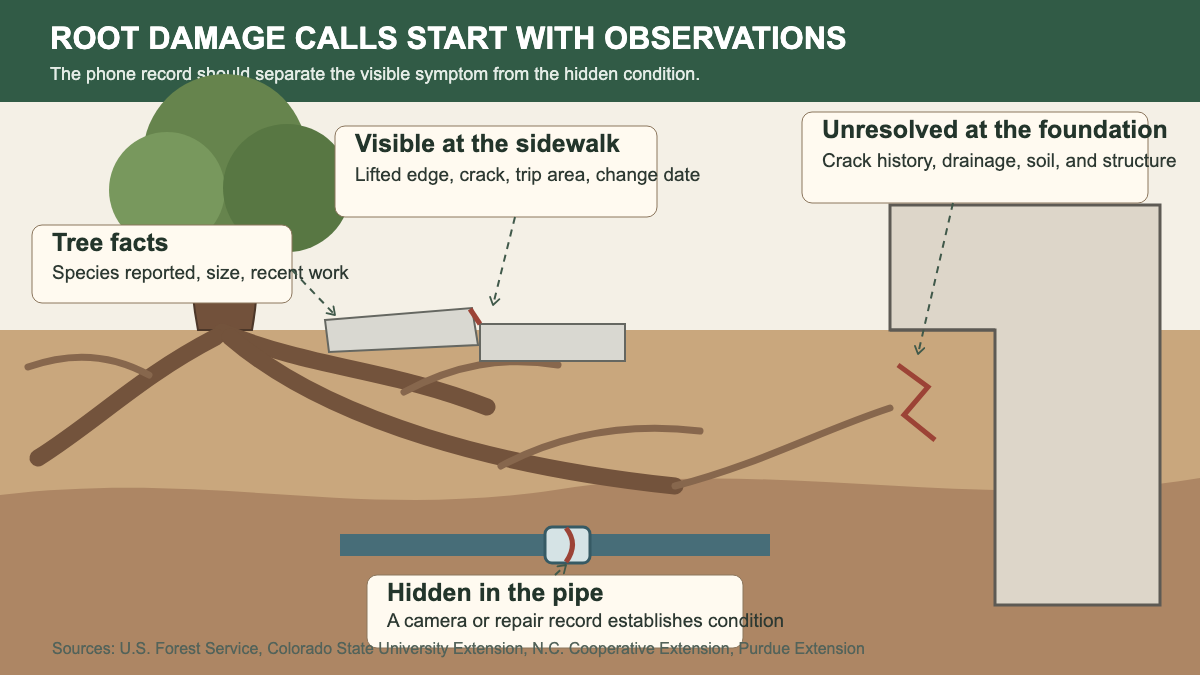
A caller who sees roots in a sewer camera image has useful evidence, but the work order still needs the pipe story. Ask which line is affected, who inspected it, what material and defect the plumber reported, and whether the office can obtain the video, still images, written notes, or marked location.
North Carolina Cooperative Extension explains that roots can exploit cracks, gaps, and faulty joints where moisture is available. A root inside a line does not establish that an intact pipe was crushed from the outside. The pipe condition belongs in the investigation.
Document current symptoms: slow drainage, repeated blockage, backup, odor, wet ground, or a marked leak location. If sewage is backing up or the site has another immediate sanitation hazard, use the company's emergency and contamination protocol. A tree-service receptionist should not recommend drain chemicals, root killers, cutting, excavation, or pipe repair.
The sewer-line camera inspection intake guide gives plumbing offices a fuller record for access points, symptoms, previous work, and the inspection objective. For a tree company, the useful handoff is simpler: attach the plumbing evidence, mark the line if it has been located, identify the tree in question, and explain whether the caller wants an arborist to assess root work, tree retention, or site protection before excavation.
Foundation calls need disciplined language
A foundation concern often arrives as a conclusion: “The roots are pushing the house.” Record the crack or movement first.
Ask where the condition appears, whether it is inside or outside, and when it was first documented. Has a structural engineer, foundation contractor, drainage contractor, or insurer inspected it? Are there dated photos or monitoring marks? Note nearby grading, downspouts, standing water, plumbing leaks, additions, retaining walls, and excavation. Do not tell the caller that a crack is cosmetic, active, caused by roots, or safe.
Purdue Extension notes that roots often redirect around solid, impervious surfaces but may exploit cracks, voids, and loose backfill near a foundation. That makes an on-site investigation more useful than a confident phone theory. An arborist can assess the tree and proposed root work. A structural professional addresses the building. Soil and drainage questions may require another scope.
Treat root cutting and excavation as tree-safety questions
Visible roots tempt people to reach for a saw. Stop there.
Colorado State University Extension describes the root system as part of a tree's anchorage and explains that mature roots may spread beyond the canopy. Root depth and distribution vary with soil texture, oxygen, water, species, and compaction. A root's position or diameter does not tell reception whether cutting it is safe.
Ask whether anyone has already cut roots, trenched, ground a stump, installed utilities, changed grade, or operated heavy equipment near the tree. Record the date, approximate location, and work performed. Then ask about changes in the tree: a new lean, lifted soil near the trunk, exposed or torn roots, trunk cracks, hanging limbs, sparse foliage, or recent storm movement.
A reported new lean or moving root plate belongs in the leaning-tree assessment workflow. Keep people away from an area where the caller reports active movement or falling material. Utility contact, downed conductors, arcing, smoke, or fire requires the relevant emergency route, not a normal estimate slot.
Before any digging, the field team also needs the local utility-location process and site markings required for that address. Reception should never tell a caller where a buried line “probably” runs.
Build a photo set the field team can use
Ask for context before close-ups. The best starting image shows the whole tree, damaged feature, house or street, and enough ground to understand their relationship. A second angle can show grade and access. Close views can document a slab edge, pipe-camera screen, visible root, or crack label.
Photos should be named so they survive a busy inbox: “front maple and walk, view from driveway,” or “basement north wall below dining window.” Keep inspection reports and plumbing images with the job record. If several trees or defects are involved, mark them on a simple site plan.
Safety controls every request. The caller should stay on stable ground and away from traffic, open excavations, sewage, unstable trees, and electrical equipment. Skip any photograph that requires entering a hazard area.
Route each decision to the right specialist
One address can require coordinated visits, but each professional needs a defined question.
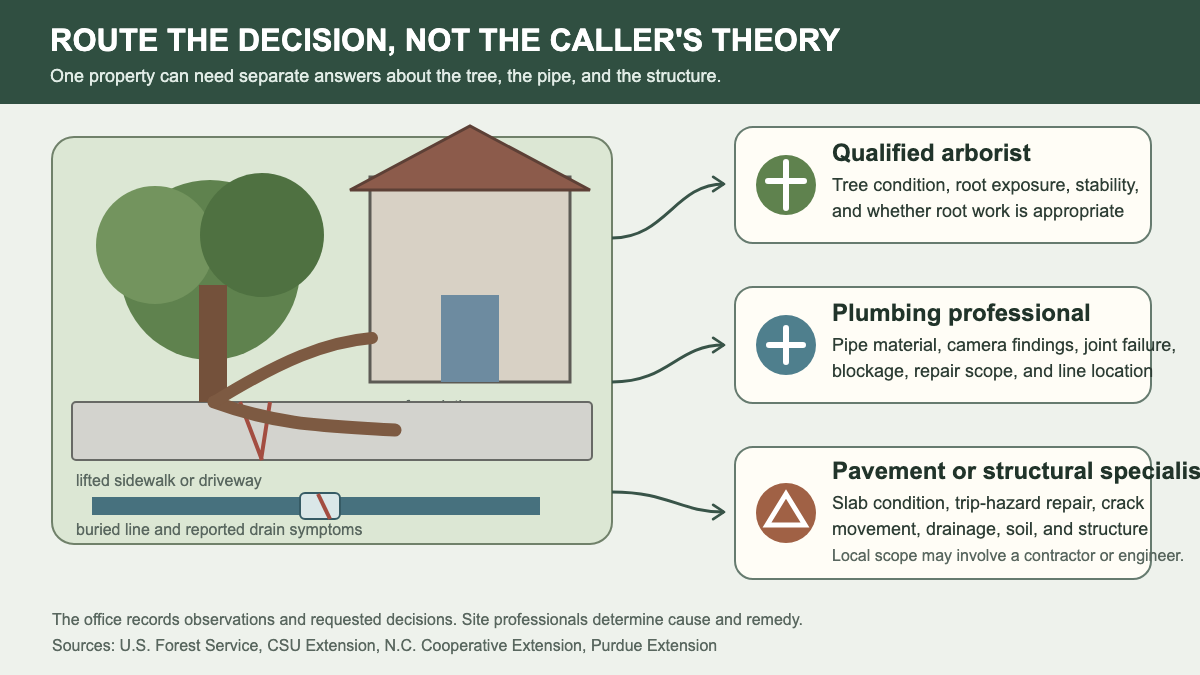
The arborist's question might be: What is the tree's condition, what roots are exposed or likely involved, and what effect could proposed excavation or root work have? The plumbing question concerns pipe material, defect location, camera findings, blockage, and repair scope. A concrete contractor can assess a walking surface and repair options. Foundation movement, load, and structural repair belong with the appropriate qualified building professional, which may include an engineer under local practice.
Ask what decision the caller needs next. They may want to preserve the tree during a sewer repair, evaluate the tree before replacing a walk, coordinate access for an excavation, or understand whether removal is even under consideration. That answer shapes the visit better than “Please look at the roots.”
The tree-service resource hub covers related intake for pruning, removal, storm damage, and risk assessments. Keep this appointment labeled as a consultation until a qualified person defines the work.
Read back a field-ready note
A useful record sounds like this:
“Owner reports one lifted concrete walk slab beside the front red maple. Species is caller-reported. The outer slab edge rose after the walk was replaced last spring, according to the owner; no dated comparison is attached yet. Public foot traffic uses the path to the porch, and the owner placed a visible barrier under the property's safety procedure. No root cutting or excavation has occurred since the paving work. A plumber separately found roots at a sewer joint near the driveway and supplied a camera still, but the line has not been marked on the property. No new lean, soil lifting at the trunk, hanging branches, utility contact, or active excavation is reported. Caller wants an arborist to assess tree condition and coordinate with the sidewalk contractor and plumber before anyone cuts roots. Wide property, sidewalk, and tree-base photos attached.”
Read it back. Correct the uncertain parts. An AI receptionist can collect the same fields after hours, provided the script preserves the boundary between observation and diagnosis.
The arborist arriving tomorrow should know what changed, what has already been inspected, who owns each decision, and where the hidden uncertainties remain. That is enough for a good first call.
Sources
- U.S. Forest Service: A review of tree root conflicts with sidewalks, curbs, and roads
- Colorado State University Extension: Understanding Tree Roots
- North Carolina Cooperative Extension: Tree Roots and Sewer Lines
- Purdue University Extension: Can tree roots cause damage to a home's foundation?