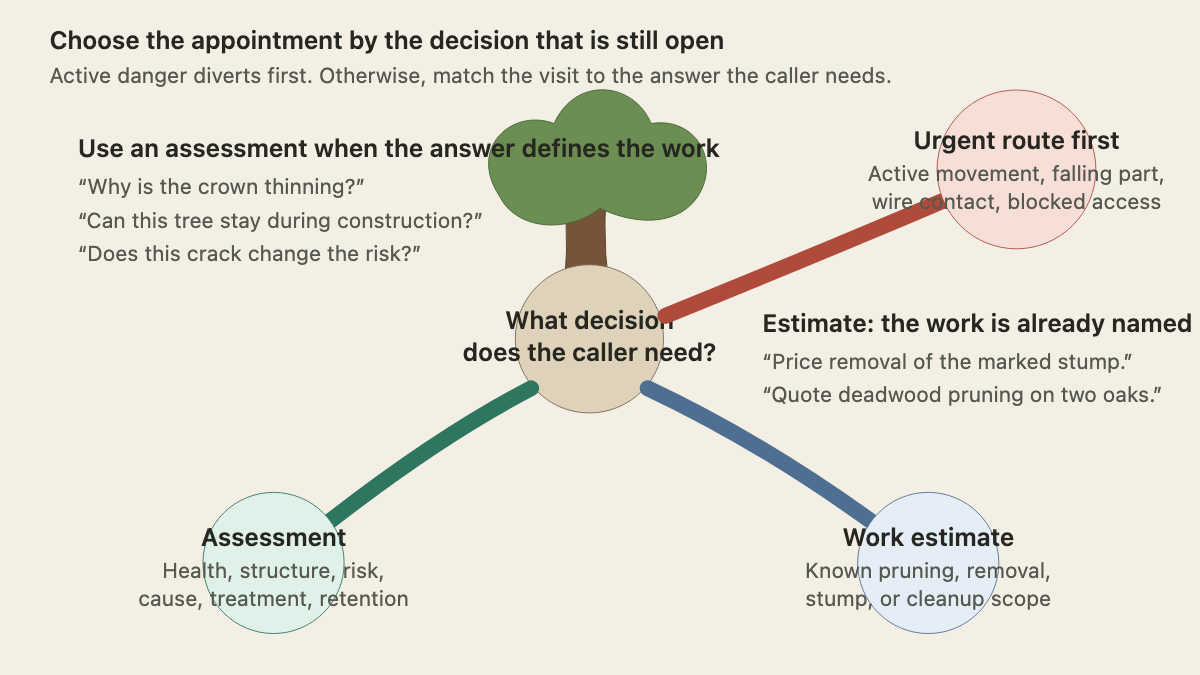
A homeowner calls about a declining oak and asks, “Can somebody come tell me what is wrong with it?” The next caller wants a price to remove a stump marked with orange paint. A third says a branch is moving above the driveway during a windstorm.
Those are three different routes. The first caller needs a qualified arborist assessment because the professional answer will define the work. The second has a known job that may go straight to an estimate. The third needs the company's urgent-hazard protocol before anyone discusses an appointment type.
Reception can make that distinction without diagnosing a tree. Ask what decision the caller needs, what changed, what can be observed safely, what could be affected, and whether any prior report or planned project shapes the visit.
Start with the decision the caller needs
The fastest opening question is simple: “What would you like the arborist to help you decide?”
An assessment is usually the right starting point when the caller needs a professional conclusion about health, structure, risk, treatment, preservation, or the likely source of a symptom. Typical requests sound like these:
- “Why is the top thinning while the lower branches still look green?”
- “Can this maple stay while we replace the driveway?”
- “Does the crack where the two trunks meet need attention?”
- “Which of these trees should we plan to prune over the next few years?”
- “Could roots be involved in the lifted walk, and who else should inspect it?”
A work estimate fits when the requested service is already defined: grind one marked stump, remove a fallen tree after the site has been made safe, or quote deadwood pruning described in an existing arborist recommendation. Even then, keep the label provisional. The field lead may find that the scope or work method needs another review.
Virginia Cooperative Extension describes arborists as professionals who can diagnose tree disorders, preserve trees during construction, evaluate structure, assess hazardous conditions, and recommend ways to reduce risk. Those services involve judgment. A call taker should not convert an open professional question into a pruning or removal order because a calendar slot needs a label.
Route active danger before choosing the appointment
Some reports change the order of the call. Ask whether anything is falling now, whether the trunk or surrounding soil appears to be moving, whether a broken part is hanging above people or property, and whether a tree or branch has contacted electrical lines. Also ask if a tree blocks a public road, the only building exit, or emergency access.
Follow the company's emergency and utility procedures for those reports. Keep the caller away from the affected area. Reception should not ask someone to walk under a branch, touch a wire, climb onto a roof, pull debris, or stand beside a moving root plate for a photograph.
Wisconsin Extension lists large broken branches, trees near structures or electrical lines, root damage, marked decline, and suspected disease among situations where a certified arborist may help. Purdue's tree-risk guidance adds a point that belongs in every urgent intake: a reported defect is only part of the record. The field professional also needs to know what could be struck or disrupted, such as a bedroom, sidewalk, playground, parked vehicle, service line, or occupied work area.
If the caller reports a new lean or soil lifting around the trunk, use the leaning-tree assessment intake. A call about a branch over a house has its own roof and limb relationship questions. Those narrower records help the office collect the right facts without making a remote risk rating.
Build a four-zone observation record
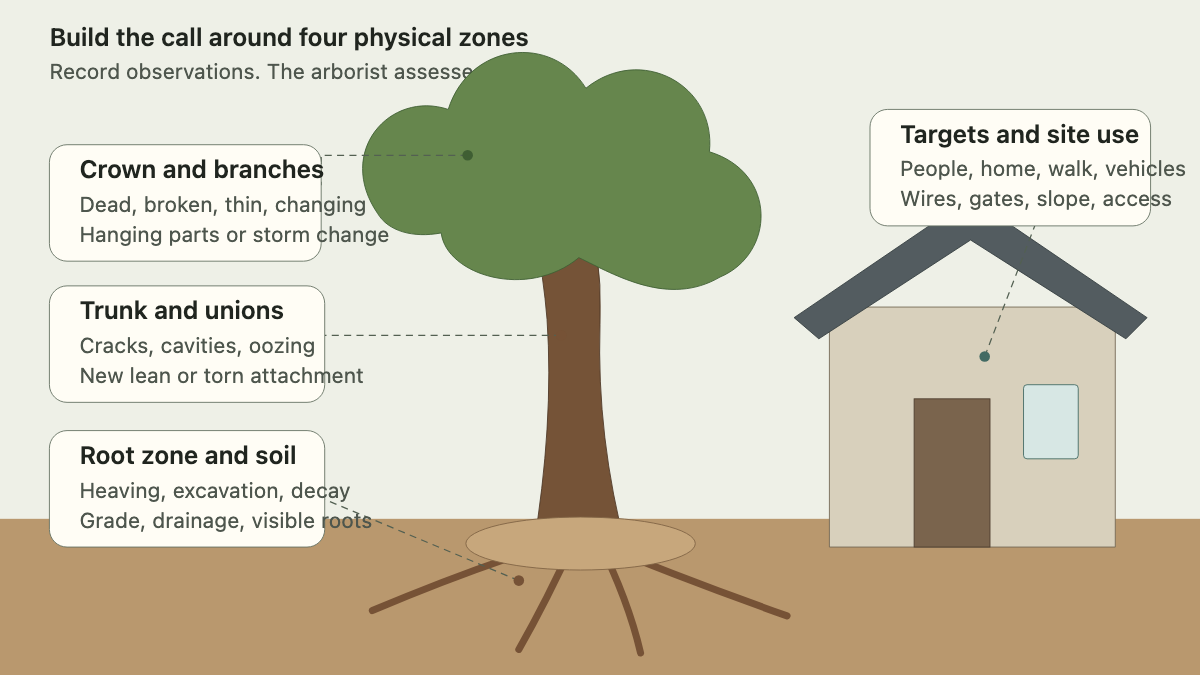
After immediate hazards are handled, move through the tree in a fixed order. Purdue recommends a systematic inspection of the canopy, branches, trunk, and root zone. Reception is collecting caller-reported observations in those same physical zones, not performing the inspection.
Start with the crown and branches. Ask whether the change affects one branch, one side, the top, or the whole crown. Record dead or broken limbs, thinning foliage, unusual color, early leaf drop, hanging material, and the date the caller first noticed the change. For pest or disease concerns, ask for wide crown photos and close views taken from safe ground. Wisconsin Extension also recommends tracking whether symptoms improve or worsen over time.
Move to the trunk and major branch unions. Ask about cracks, cavities, peeling or missing bark, oozing, mushrooms, torn attachments, old pruning cuts, or a new lean. Preserve uncertainty in the note. “Caller sees a vertical opening on the south side of the trunk” is useful. “The trunk is splitting” is a conclusion unless a qualified person has already documented it.
Then cover the root zone and surrounding soil. Has the grade changed? Was a trench, patio, driveway, utility, irrigation line, or foundation project installed nearby? Ask about exposed roots, cut roots, soil heaving, standing water, compaction, and recent equipment traffic. If the call concerns pavement, pipes, or a foundation, the tree-root damage consultation guide explains how to separate visible damage from an unproven cause.
Finish with targets and site use. Identify the house, path, play area, parking space, neighboring property, wires, or business operations near the tree. Note gates, slope, pets, locked areas, parking limits, and who can authorize access. One wide photograph that shows the whole tree and nearby property often gives dispatch more context than five close pictures of bark.
Ask what evidence already exists
A caller may already have an arborist report, municipal notice, landscape plan, pest diagnosis, utility ticket, insurance request, engineering report, or contractor proposal. Ask for the document and its date. Record who prepared it and what decision remains open.
This prevents duplicate appointments. It also reveals when the caller needs a particular deliverable, such as a verbal walk-through, a written tree inventory, a construction-preservation plan, a risk assessment, or a proposal for specified work. Do not promise that every arborist or every appointment produces the same document. Confirm the company's service options before scheduling.
Property authority matters too. Ask whether the caller owns the tree or represents the owner, property manager, association, municipality, or contractor. A disputed boundary or neighbor-tree question needs careful routing and may require a survey or legal advice outside the tree company's role. Reception can document the uncertainty and avoid deciding ownership.
Match the credential and consultation scope
“Arborist” can describe different roles, and companies do not all offer the same services. University of Minnesota Extension advises callers to ask about certification, education, experience, insurance, references, and written scope. It identifies International Society of Arboriculture certification as an industry-standard credential, while noting that professional membership does not guarantee work quality.
Virginia Cooperative Extension explains that ISA Certified Arborists meet eligibility requirements, pass a competency exam, complete continuing education, and follow a code of ethics. A certification still needs to match the assignment. A company may route plant-health questions, construction planning, appraisal, formal risk work, climbing inspections, or pesticide applications to different people based on credentials, licenses, experience, and local rules.
Ask what the caller expects to receive and tell them what the booked service includes. If a written report costs more than a verbal consultation, say so using the company's current terms. If the visit is diagnostic only and a work proposal comes later, make that clear. If the company does not provide legal opinions, appraisals, laboratory testing, or reports for disputes, name that boundary before the truck rolls.
Send a useful photo set, not a scavenger hunt
Request only photographs the caller can take from stable, permitted ground. A practical set includes the whole tree with nearby structures, the full crown from another angle, the trunk and root flare, and one close view of the reported symptom. Ask the caller to identify the tree if several appear in the frame.
Dates matter. An older image can show whether a lean, canopy gap, crack, or construction disturbance changed. Keep original files when possible, along with the caller's labels: “back-yard oak viewed from patio, September 3” says more than “IMG_4821.” Skip any image that requires entering traffic, climbing, approaching wires, crossing a barricade, or standing beneath unstable material.
Read back a field-ready appointment note
A complete record might sound like this:
“Homeowner requests an on-site assessment of one mature red oak beside the west driveway. Species is caller-reported. The upper crown has thinned since spring, and one lower limb has dead leaves; no branch fall or active movement is reported. Caller sees an old cavity on the driveway side but reports no new trunk crack, soil lifting, exposed roots, or mushrooms at the base. A driveway replacement is planned for October, and the paving contractor marked an excavation edge about six feet from the trunk. The house, driveway, and daily parking area are within the tree's surroundings. No wire contact is reported. The owner wants advice on tree condition and preservation steps before approving excavation. They request a written summary and understand the office must confirm whether that deliverable is included. Wide crown, trunk, root-zone, and driveway-plan photos are attached. Gate is unlocked; one dog will be indoors.”
Read it back and correct any assumption that slipped into the note. An AI receptionist can capture these fields after hours, but the script should preserve words such as “caller reports” and “caller requests.” The consultation starts with a clean record. The arborist supplies the professional judgment at the tree.
Sources
- University of Minnesota Extension: How to hire a tree care professional
- Virginia Cooperative Extension: Hiring an Arborist to Care for Your Landscape Trees
- University of Wisconsin-Madison Extension: Finding the Right Certified Arborist for You
- Purdue Extension: Tree Risk Management