A homeowner calls at 4:40 on a wet Friday afternoon: “The maple is leaning toward our bedroom. Can someone tell me if it is going to fall?” The office cannot answer that question from an angle described over the phone. It can establish what changed, what might be struck, whether the tree or soil appears to be moving, and whether wires or immediate danger change the route.
A lean alone does not set urgency. Some trees have grown at an angle for decades. A recent lean after wind, saturated soil, excavation, or root damage is a different call. Ask when the caller first noticed it, whether the angle changed, and what new conditions appeared at the base, trunk, or crown. Then arrange an on-site assessment by a qualified arborist.
Ask what changed before judging the angle
“About 20 degrees” sounds precise, but a caller's estimate rarely tells an arborist how the tree developed. History is more useful.
Ask whether the tree has always leaned that way. Old photos can help. A real-estate listing, a family picture in the yard, or a street-view image may show the same trunk position several years earlier. Record the date and source of the comparison. Do not declare the tree stable because the lean appears old. A long-standing lean can still have decay, root trouble, a weak union, or a new target beneath it.
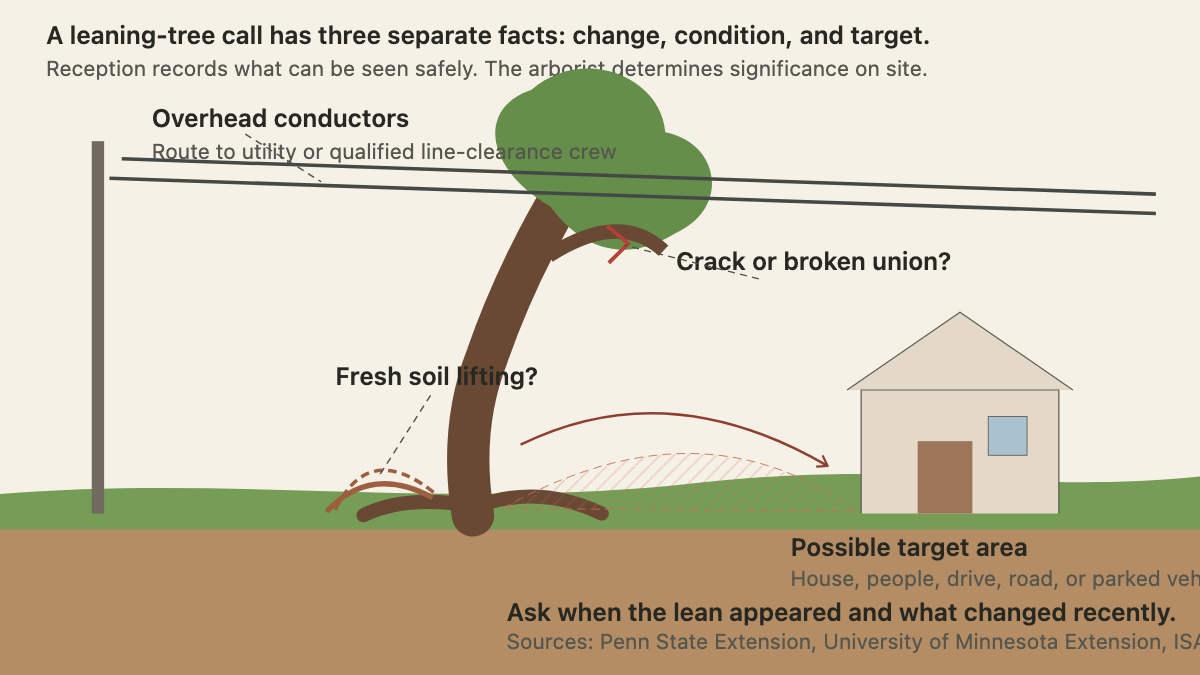
For a recent change, ask what happened beforehand. Wind and heavy rain are obvious prompts. Add flooding, irrigation changes, trenching, grading, driveway work, utility excavation, vehicle impact, and removal of a nearby tree. University of Minnesota Extension identifies saturated soil, confined rooting areas, inadequate root systems, decay, wounds, and structural defects among conditions that can contribute to failure.
Keep the questions observable. “Is the root plate failing?” asks the homeowner to diagnose. “Do you see fresh soil lifting, a new gap around the trunk, exposed roots, or roots pulling upward?” gives the arborist usable facts.
The same rule applies above ground. Ask about a new trunk crack, a split where major stems join, hanging branches, a broken top, cavities, fungal growth, or dead sections of crown. Record “caller reports a fresh six-inch opening at the main union” if that is what was said. Leave the meaning to the field assessment.
Identify every target in the possible fall area
A tree defect becomes a different operational problem when people, buildings, traffic, or utility equipment may be struck. Tree-risk guidance calls these potential targets. The office needs a plain inventory of them before choosing a routine slot or urgent handoff.
Ask what lies in the direction of the lean and around the rest of the tree. Include bedrooms, entrances, decks, play areas, neighboring property, parked vehicles, sidewalks, roads, fences, service drops, and overhead distribution lines. A tree can shed a limb outside the direction its trunk points, so the intake should cover the whole crown.
Occupancy matters. “The trunk points toward the house” is incomplete if that wall contains a nursery or an unused garage. Ask whether people are inside now, whether the area can be avoided, and whether a public path or road stays busy. Reception should not invent a fall radius or tell a caller that a room is safe. It can advise the caller to follow emergency and local authority instructions and keep people away from an area where active movement or falling material has been reported.
Penn State Extension advises assessing leaning trees in relation to nearby people or property. International Society of Arboriculture consumer guidance also treats targets as part of tree-risk management and reserves evaluation of defect seriousness for a professional arborist.
A useful note is specific: “Tree leans toward east bedroom wall. Bedroom normally occupied overnight. Driveway and neighbor's walkway also pass beneath outer crown. No public road beneath canopy.” That gives the arborist a real site picture.
Route wires and active movement before routine scheduling
Stop ordinary estimate scheduling when the caller reports active movement, falling material, a person in danger, blocked emergency access, or contact with electrical equipment. Follow the company's emergency protocol and local emergency-service guidance.
Treat every conductor as potentially energized. Ask whether a tree or branch is touching a line, whether a line is down, and whether arcing, sparking, smoke, or fire is visible. Do not ask the caller to identify voltage, touch a cable, stand under the crown, or walk closer for a measurement.
OSHA describes line-clearance tree trimmers as workers with specialized training for work near energized power lines and equipment. Utility guidance commonly directs the public to stay clear and report tree hazards near electrical facilities. PG&E, for example, tells people to keep themselves and tools at least 10 feet from power lines when tree hazards are present. The caller's local utility may use a different reporting process, so route by address and current provider.
This intake differs from the broader storm-damage emergency call workflow. The tree may still be standing and the weather may be calm. Recent movement, exposed roots, a widening crack, falling branches, or electrical exposure can still make the call time-sensitive.
Request photos that preserve distance and context
Photos help when they show scale, targets, and access. A close picture of bark with no location rarely does.
Ask for a wide view that includes the full tree and the building, road, or other target. A second view from another clear side can show the trunk base and surrounding soil. If the caller already has an older photo, attach it with the date. Photos of the driveway, gate, slope, septic area, retaining wall, and overhead lines can help dispatch prepare equipment and access questions.
Safety controls the request. The caller should remain on stable, open ground and should never cross beneath the lean, hanging wood, or conductors for a better angle. Zoom is better than approach. If the only useful view requires entering the possible fall area, skip the photo and document why.
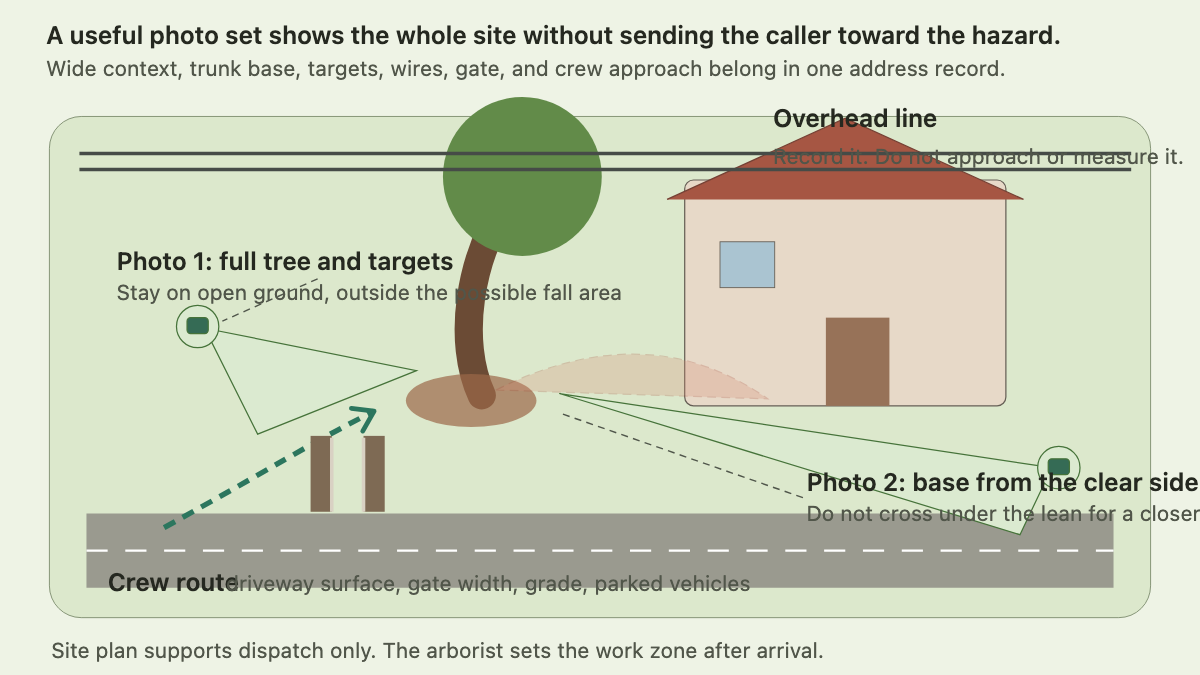
Name each image by address, tree number, direction, and date. “124 Oak, tree 2, view from driveway, Sept. 3” survives a busy inbox better than IMG_8472. If several trees are involved, mark them on a simple site sketch.
Book an assessment without promising the remedy
Call intake can choose the right professional and time window. It cannot establish whether the tree should be monitored, pruned, supported, or removed.
Ask what the caller wants from the visit. Some need a documented risk assessment. Others want an estimate for work if the arborist recommends it. A property sale, neighbor dispute, municipal notice, or insurance request may require a report with particular credentials or scope. Record that requirement before assigning the job.
Confirm the service address, property owner or authorized contact, access permission, pets, locked gates, parking limits, slope, and equipment route. Ask whether the tree is on private property, a street verge, shared land, or an uncertain boundary. The office should avoid legal conclusions about ownership and responsibility.
If the request is mainly planned crown work, use the tree trimming and pruning scheduling guide. If the caller already seeks a removal quote, the tree removal intake guide covers size, access, debris, stump work, and estimate scope. A leaning-tree assessment should remain an assessment until a qualified person sees the site.
Send the arborist a field-ready note
A weak work order says, “Leaning tree, customer worried.” A useful note preserves facts, timing, targets, uncertainty, and access:
“Red maple in rear yard, caller identification unconfirmed. Owner says trunk has leaned toward house since purchase in 2019, but comparison photo suggests additional movement after two days of rain. Fresh soil ridge reported on west side of base. No visible trunk crack from caller's safe position. East bedroom, deck, and neighbor walkway are beneath or near crown. Bedroom unoccupied until tonight. Overhead service drop runs along north edge; no reported contact, downed line, arcing, smoke, or fire. Caller told not to approach line or cross beneath tree for photos. Driveway access to six-foot side gate; backyard slopes toward house. Wants arborist assessment and written work recommendation. Two current wide photos and one 2021 listing photo attached.”
That note lets the arborist prepare without turning the receptionist into a remote inspector. An AI receptionist can collect the same fields after hours, but the boundary should stay firm: document the change, identify targets, route electrical or immediate hazards, and leave the tree's condition and treatment to the professional standing in the yard.