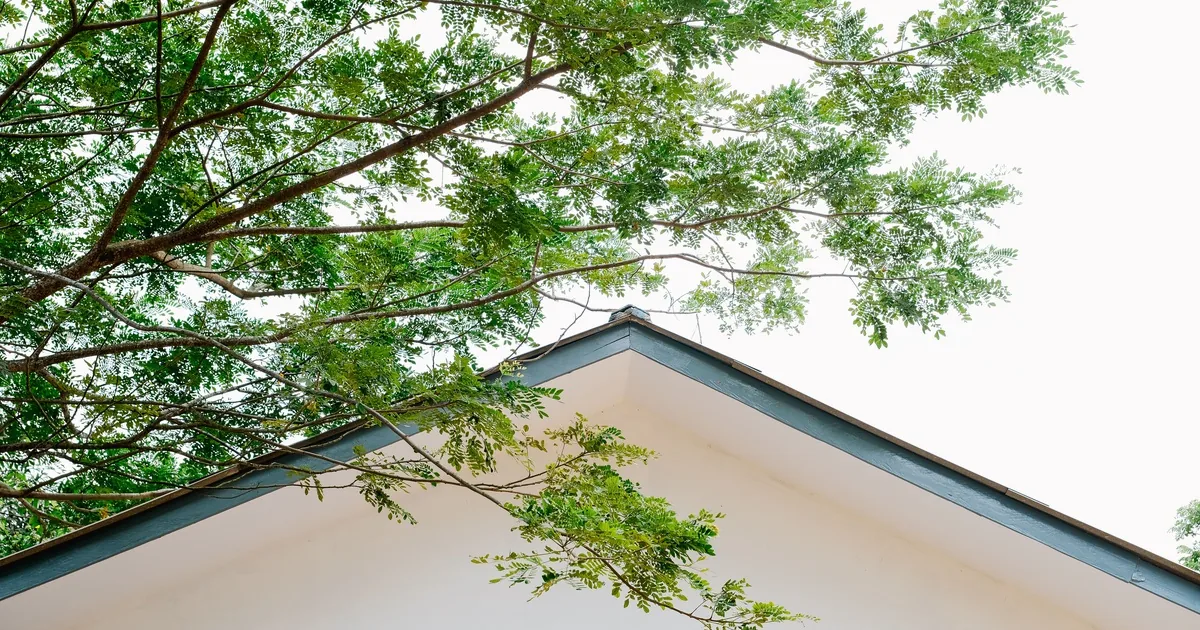
A caller says, “There is a huge branch over my roof. Can you get it down today?” That description could mean healthy limbs growing several feet above the shingles. It could mean a cracked leader caught in the canopy, a heavy branch resting on the ridge, or wood already through the roof over an occupied bedroom.
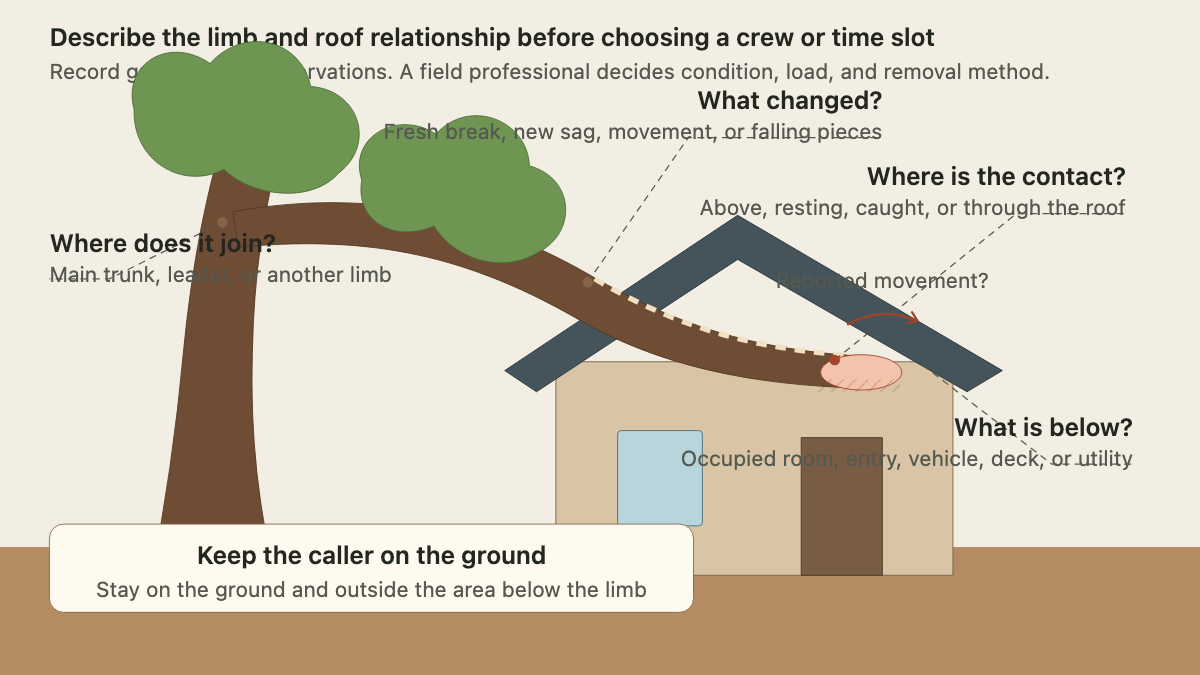
The office needs to define the scene before choosing a time slot. Ask whether the limb is suspended, touching, resting, caught, or through the roof. Record what changed, what lies below it, whether pieces are falling, whether any wire is involved, and how a crew can reach the work area. Keep the caller on the ground. Condition, load, roof integrity, and removal method belong to the field professional.
Replace “over the roof” with a physical description
Start with the caller's location and point of view. Someone looking through an upstairs window may see a branch near the eave but miss its attachment. Someone standing at the curb may see the crown but not the point where wood meets the roof. Ask where the caller is standing and what part of the house they can see.
Then pin down the relationship. “Is there open air between the branch and the roof?” is more useful than “Is it close?” If the branch touches the building, ask where: gutter, eave, roof surface, ridge, chimney, skylight, wall, or another feature. Record the caller's words. “Branch appears to rest on the rear slope above the kitchen” is an observation. “The rafters are damaged” is a conclusion the office cannot support by phone.
Ask whether the branch is still attached to the tree. If yes, find out whether the caller can see a fresh crack, torn wood, a split union, a broken end, or a branch caught on another limb. Do not ask them to walk under it for a closer look. If it is detached, ask whether it lies fully on the roof or remains partly supported by the tree.
Time matters too. A limb that has grown above the roof for years is a planned pruning inquiry until other facts change that route. A branch that dropped after wind, sagged since yesterday, started scraping the roof, or shed pieces during the call needs faster review. The leaning-tree assessment guide uses the same discipline for trunks: preserve the history and observable change, then leave significance to the arborist.
Route active danger before ordinary scheduling
Some answers should interrupt the normal estimate workflow. Ask whether anyone is injured or trapped, whether wood is moving or falling now, whether the branch blocks an exit or emergency access, and whether the caller reports smoke, fire, sparking, arcing, or a downed line. Follow the company's emergency procedure and local emergency-service guidance when immediate danger is reported.
Electrical exposure needs its own question. Ask, “Is any part of the tree or branch touching or close to an overhead line, the service wire to the house, or a downed wire?” People often focus on the hole, gutter, or bedroom below and fail to mention a cable running through the canopy.
OSHA lists overhead power lines and falling branches among the potentially fatal hazards in tree-care work. Reception should never ask a caller to identify a wire by type, move a branch, touch a cable, climb for a photo, or approach the area to estimate a clearance. A local utility may need to control electrical exposure before tree work begins.
Utility rules vary. National Grid's storm guidance tells customers in its territory to consider downed wires energized and dangerous. Use the service address and current electric provider. Do not turn one utility's process into a promise for every caller.
A branch on a roof after a large weather event may belong in the broader storm-damage emergency intake workflow. This article still helps when the weather is calm, the tree is standing normally, and one branch creates the concern.
Ask about the building without diagnosing it
The branch may create two separate scopes: tree work and building assessment. Keep those records separate.
Ask what the caller can observe indoors. Is water entering? Is a ceiling bulging, stained, cracked, or shedding material? Is the room below occupied? Has anyone heard new cracking or scraping? If a ceiling or part of the structure appears unstable, follow the company's safety script and local emergency guidance. Do not tell the caller to enter the room, inspect the attic, or climb onto the roof.
Outside, ask whether the limb struck a gutter, chimney, vent, skylight, solar array, service mast, deck cover, or attached structure. The tree crew may need this context even when it does not repair that component. Use careful wording: “Caller reports a bent rear gutter and water near the kitchen window.” Avoid “Tree destroyed gutter and caused roof leak” unless a qualified person has established both points.
Insurance questions often follow. The office can explain its own estimate, documentation, payment, and scheduling process. It should not promise coverage, claim approval, reimbursement, or a particular insurer response. Record whether the caller wants photographs or an itemized work description and who may authorize the work.
Request photos that show context from safe ground
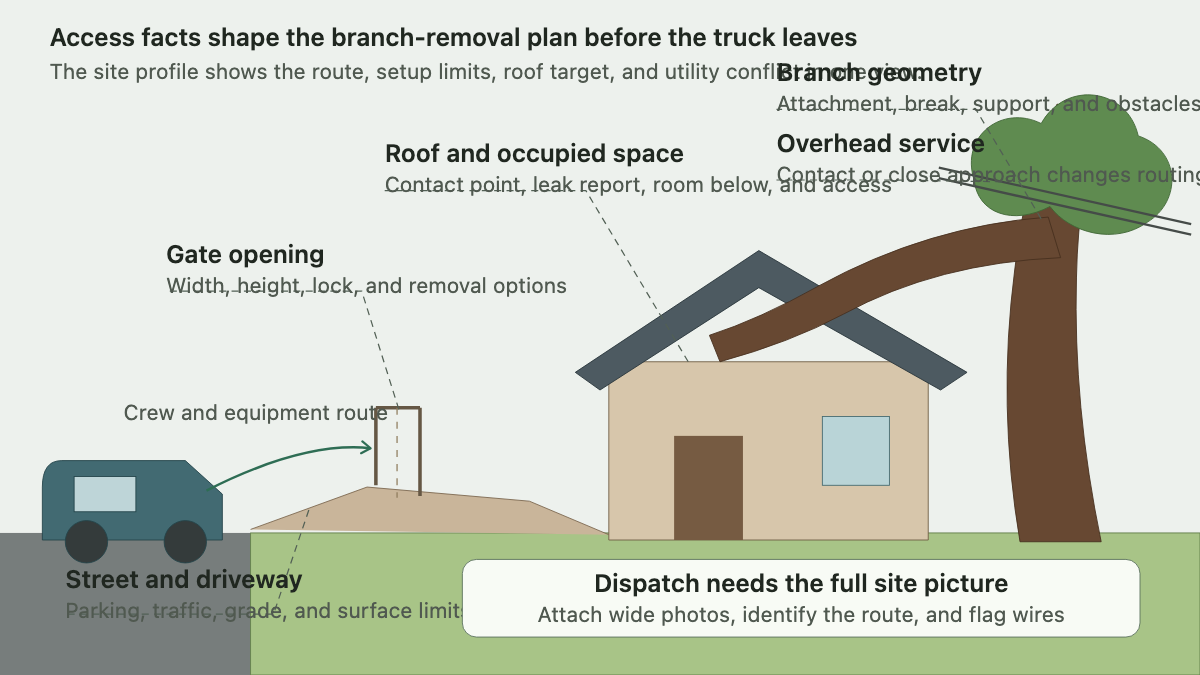
Ask for a wide photo that includes the tree, branch, roof, and surrounding ground. A second view from another safe, open position may show the attachment and the side of the house. Photos of the driveway, gate, slope, and any visible overhead line can help with assignment.
Safety controls the request. The caller should stay on stable ground and outside the space beneath the branch. Zoom is better than approach. Skip any photo that would require roof access, a ladder, crossing under hanging wood, entering a damaged room, or moving toward a conductor.
Name the files so they survive a busy inbox: service address, tree number if there are several, view direction, and date. “18 Pine rear tree from driveway Sept 3” is much easier to match than IMG_5821.
Collect the site facts that affect assignment
A tree company cannot choose a climber, aerial lift, crane, rigging plan, or crew size from a phone script. The office can expose the constraints so the field lead knows what still needs review.
Capture these facts in plain language:
- Street width, parking restrictions, traffic, and whether a truck can stop near the property
- Driveway width, grade, surface, overhead clearance, and any weight or access concern reported by the owner
- Gate opening, fence height, locks, removable panels, and the narrowest point on the route
- Slope, retaining walls, soft ground, septic areas, gardens, pools, sheds, and fragile surfaces
- Distance and route between the street or driveway and the tree
- Occupied rooms, entries, decks, vehicles, neighbor property, and public areas beneath or beside the work
- Overhead conductors, service drops, communication lines, and electrical equipment visible near the branch
- Pets, access permission, tenant or neighbor coordination, and the person authorized to approve work
Ask where debris could be lowered or staged, but do not promise that open lawn is a safe drop zone. A roof, fence, glass room, narrow side yard, or neighboring property may require controlled handling that only the field team can plan. The broader tree-removal quote intake guide covers whole-tree access, debris, and stump scope when the request expands beyond one limb.
Separate assessment, temporary response, and final work
The caller may ask for a price and same-day removal in the first sentence. The honest next step depends on what the company can safely establish.
A planned limb-clearance request may fit a normal estimate or pruning visit. A broken limb suspended above the roof may need urgent field review. A branch in contact with electrical equipment may require utility coordination before a tree crew can proceed. A branch already on the building may also require a roofer, contractor, emergency service, or insurer, but reception should not assign those roles without company policy and site facts.
University of Minnesota Extension advises professional help when tree work requires a chainsaw or ladder, when potentially energized lines are present, and when unsupported branches could cause personal or property damage. That gives the office a clear boundary. Do not coach the caller through cuts, ropes, ladders, tarps, or branch movement.
Explain the appointment accurately. Say whether the first visit is an assessment, an estimate, emergency stabilization, or scheduled work. Confirm whether the field lead must approve the method and price on site. If the company cannot repair roofing, say so early and describe what documentation it can provide.
Read back a work order the crew can picture
A weak note says, “Big branch on roof, wants ASAP.” A field-ready note preserves the actual scene:
“Rear-yard oak, branch over north roof slope above kitchen. Caller reports branch was clear of roof last week and dropped after wind this morning. It remains attached at a major limb; fresh torn wood is visible in a zoomed photo. Outer end appears to rest near the gutter. No reported penetration, indoor water, ceiling change, smoke, fire, sparking, arcing, or falling pieces during call. Kitchen occupied now. Service wire runs from rear pole to east wall; caller cannot confirm branch clearance and was told not to approach. Wide photos taken from driveway attached. Truck can stop in driveway; six-foot side gate reported, backyard slopes toward house, and a glass sunroom narrows the route. Owner will be present and can authorize assessment. First visit described as urgent field assessment, with method, price, and timing subject to site review.”
Read it back. Correct the tree, roof side, room, utility detail, access route, appointment type, and decision-maker while the caller is still on the line. An AI receptionist can collect the same fields after hours, but the safety boundary should remain unchanged. The office documents the scene. The person standing on site decides what the branch and roof require.