A caller opens with, “My neighbor’s oak is over my garage, and I want those limbs gone.” She has photos, a fence she believes follows the lot line, and a neighbor who has stopped returning messages. She wants a crew on Saturday.
The office should slow this call down. Identify the tree, the caller, the requested service, what could be struck, where the trunk and branches appear to sit, who controls access, and whether the boundary is documented or disputed. Schedule an arborist assessment when the company can inspect from a place it has permission to enter. Do not tell the caller who owns the tree, who must pay, what may legally be cut, or whether a fence proves the boundary.
That separation matters. The tree-service company can assess tree condition, possible work, equipment access, and site hazards. Property rights and liability depend on the address, the facts, and local law.
Separate the tree request from the neighbor dispute
Start by asking what the caller wants the company to do. “I need the tree handled” could mean a risk assessment, a written report, pruning over one structure, complete removal, storm cleanup, root evaluation, or an estimate that two owners plan to discuss together.
Then establish the caller’s role. Are they the property owner, tenant, property manager, homeowners association representative, buyer under contract, or concerned neighbor? Ask who owns the parcel where the trunk appears to stand and mark that answer as caller-reported. If the trunk appears to cross a line or the location is disputed, leave the ownership field open.
A fence, hedge, mowing edge, online parcel layer, or old landscaping plan can help the arborist understand the caller’s concern. None should be presented by reception as a surveyed boundary. Ask whether the caller has a current survey or another boundary document and whether the neighbor disputes it.
The City of Durham’s urban forestry FAQ shows why location changes the route. Its staff distinguish city trees and rights-of-way from private trees, and they determine whether a tree near a street falls within the city-maintained area. For intake, the lesson is narrow: record the address, apparent trunk location, nearby public space, and agency contacts already made.
Map one tree across two parcels
A close photo of leaves over a fence hides most of the job. Ask for a wide image that includes the trunk, full crown, both sides of the apparent line when the caller can photograph them from authorized and safe locations, and the targets below. Useful targets include a roof, driveway, parked vehicle, play area, shed, pool, walkway, service line, and public street.
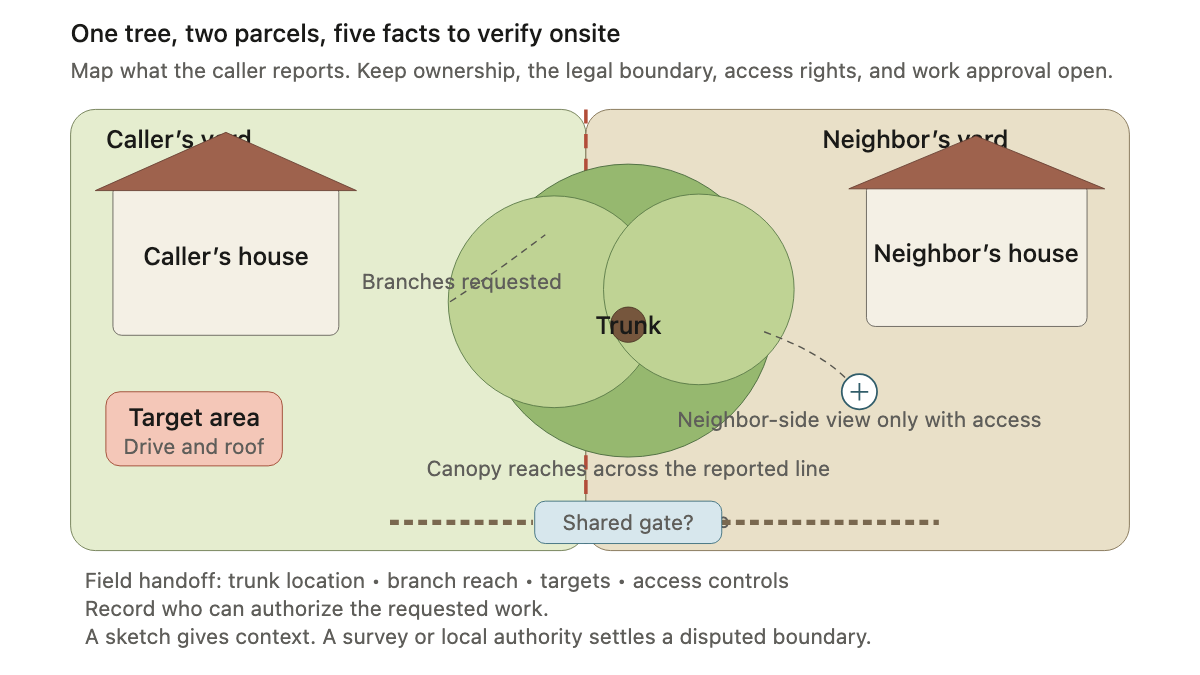
Locate the requested work in ordinary language. The caller might say, “two large limbs extend over the west half of my garage,” or “the whole crown leans toward the shared drive.” Keep those as observations. The arborist will decide what can be assessed, whether a defect is present, and which work may be appropriate.
Access needs its own line in the record. Can the estimator see the trunk from the caller’s property? Would anyone need to open the neighbor’s gate, enter a shared drive, cross an HOA tract, stand in a public right-of-way, or place equipment on land the caller does not control? A caller’s willingness to schedule does not provide access permission for every part of the site.
Ask who can be present for the visit and who can approve the eventual scope. If two owners are already cooperating, record both names and contact details. If communication has broken down, offer only the assessment or estimate the company can lawfully and safely perform from authorized space under its policy. The office should never volunteer to “sort it out onsite” by sending a crew into a live dispute.
Screen danger before discussing dates
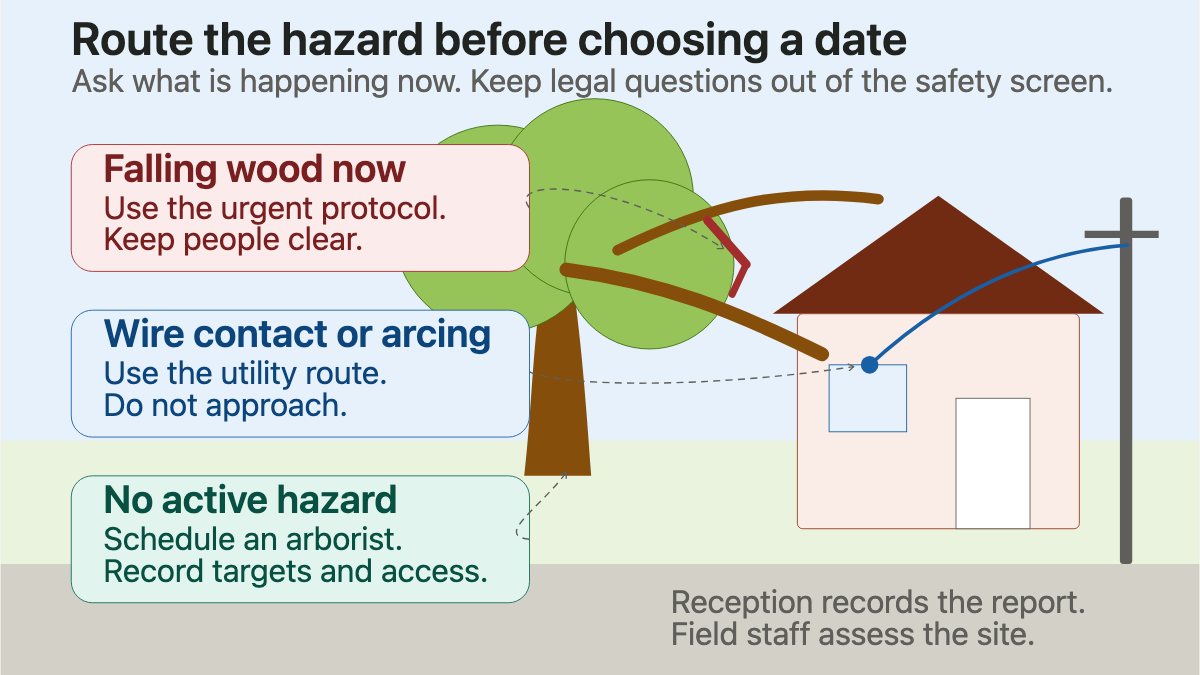
Neighbor tension can distract from the tree itself. Run the same hazard screen you would use on any tree call.
Ask whether a branch is falling now, newly broken, hanging, or resting on a structure. Ask about a fresh trunk crack, sudden lean, lifting soil, storm damage, blocked road, and people in the possible fall area. If the caller reports active movement or falling material, use the company’s urgent protocol. The leaning-tree assessment guide covers recent changes, targets, and urgent routing in more detail.
Electrical exposure is a separate stop. Ask whether branches touch a wire, whether a line is down, and whether the caller sees arcing, sparks, smoke, or fire. Do not ask anyone to approach the tree, identify a conductor, or measure clearance. Follow the local utility and emergency process for the service address.
OSHA identifies falls, struck-by objects, and energized power lines among the hazards in tree-care work. It also says employers need to assess the tree and worksite before operations begin. New York State DEC advises the public to contact the power company about branches near power lines and to use professional tree care for branches that are too large or high to handle from the ground.
Those sources support hazard screening. They do not decide whether this caller may trim a neighbor’s limb.
Ask for photos without creating trespass or exposure
Give the caller a safe, limited photo request. One wide image from their house or driveway may show the full tree, roof target, and reported line. Another from a side yard may show the trunk and crown. Existing photos taken before a storm or before new construction can show change over time.
Do not ask the caller to enter the neighbor’s yard, climb a ladder, walk beneath hanging wood, step into traffic, or move toward a utility line. Skip any image that requires questionable access or a dangerous position. Write “neighbor-side view unavailable” or “line contact reported, no closer photos requested” in the file.
Label every image with the address, tree number, viewpoint, and date. If the caller draws a line on a photo, preserve the label “caller-marked boundary.” A field estimator can then compare the sketch with visible monuments and any survey supplied without mistaking the annotation for a legal finding.
Keep legal answers out of the call script
The fastest way to create a bad work order is to let a practical scheduling question turn into a legal opinion. Calls often include versions of these questions:
- “Can I cut everything that hangs over my yard?”
- “Does my neighbor have to pay because the trunk is on their side?”
- “Can your crew go through their gate if nobody is home?”
- “The fence has been there for years, so that is the line, right?”
- “If your arborist says the tree is dangerous, are they liable?”
Reception should use one stable answer: “We can document the tree, targets, access, and the service you want assessed. We cannot determine ownership, trimming rights, liability, or permission over the phone. Those rules vary by location and circumstances. If the boundary or authority is disputed, you may need a surveyor, local authority, insurer, or attorney before work can be approved.”
Do not cite another city’s FAQ as the caller’s law. Durham, for example, directs a resident worried about a private neighbor’s tree toward a private arborist assessment and documentation. That is useful evidence for offering an assessment service. It does not establish what notice, access, payment, or liability rule governs an address elsewhere.
The work description needs the same restraint. Write “caller requests assessment of two limbs extending over garage” instead of “customer has the right to remove encroaching limbs.” Write “fence appears near trunk; no survey supplied” instead of “tree is on neighbor’s property.”
Build the visit around the decision the caller needs
A neighbor-tree appointment should name the deliverable. Some callers need a verbal assessment and estimate. Others need a written tree-risk report, photos, credentials for an insurer or association, or a proposal that separates work on each parcel. Ask before assigning the visit because report requirements may affect which arborist attends and how much site time is reserved.
If the request is planned canopy work and authorization is clear, use the tree trimming and pruning scheduling guide to capture the objective, tree count, debris plan, and equipment access. If removal is already being considered, the tree removal quote-call guide adds stump scope, haul-away, size, and landing-area questions.
Confirm the company’s estimate policy without promising a remedy. The arborist may recommend monitoring, pruning, cabling, removal, a more formal assessment, utility involvement, or no work by this company. Reception books the right evaluation. It does not select the outcome.
Read back a neutral field note
A useful handoff could read:
“Caller owns 18 Sample Oak Lane and requests an arborist assessment of one mature oak whose trunk appears to stand in the rear yard of 20 Sample Oak Lane. Ownership and boundary location are unverified. Caller reports two limbs over the west half of an attached garage and wants to know whether pruning is appropriate. No active movement, falling material, trunk crack, or storm damage reported. An overhead service line runs behind both lots; caller reports no branch contact, downed line, arcing, smoke, or fire. Estimator can view the crown and caller-side trunk base from 18 Sample Oak. Access through the neighbor’s gate has not been granted. Caller has a 2018 survey but has not confirmed whether it marks this tree. Wide photos from the caller’s driveway and rear patio are attached and labeled. Caller asks for a written assessment and estimate. Field staff must verify tree condition, targets, access, work scope, and authorization. Office made no statement about ownership, trimming rights, payment, liability, or permission.”
Read it back. The caller can correct the address, target, viewpoint, or requested deliverable while every disputed point remains visible.
An AI receptionist can collect the same record after hours if its script blocks legal conclusions and routes active hazards under the tree company’s rules. The best final question is practical: “What can our arborist inspect from property you are authorized to provide access to?” That answer gives the field team a real starting point.
Sources
- City of Durham: Urban Forestry Frequently Asked Questions
- New York State DEC: Caring for Urban Trees
- OSHA: Enforcement Inspection Guidance for Tree Care and Tree Removal Operations