A homeowner calls with a request that sounds simple: “I need the oak trimmed.” The tree may have one dead limb over a driveway. Its crown may scrape the roof. A neighbor may want more light. Or branches may be growing beside overhead conductors, which changes who can assess and perform the work.
The front desk should define the objective, screen immediate hazards, and map the work site. Ask which tree, what the caller wants changed, what sits below and beside it, whether any branch is broken or hanging, whether wires pass through or near the crown, and how a crew could reach the area. Book an assessment when the cuts, equipment, or electrical qualification cannot be established from safe ground-level information.
Screen hazards before discussing the calendar
Start with the condition now. Ask whether a limb has broken, is hanging, or has fallen onto a roof, road, vehicle, fence, or utility line. Keep people, pets, and vehicles away from a suspended limb or an unstable tree. Do not ask the caller to pull a branch, climb a ladder, stand below the crown, or approach a wire for a better photo.
A storm-damaged tree belongs in the company’s emergency route. The storm-damage call intake guide covers blocked access, active failures, public hazards, and urgent handoff. Planned pruning can wait for a controlled assessment.
Wires need their own gate. Ask whether conductors pass through the crown, touch branches, or run close enough that a worker, branch, ladder, rope, lift, or tool might approach them. Record what the caller can see from a safe position. Never ask for a distance measurement near a line.
OSHA defines line-clearance tree trimming as pruning and related tree work near energized power lines, specifically within 10 feet in the cited federal framework. Its guidance distinguishes unqualified workers from line-clearance tree trimmers who have specialized training. The office should route any electrical exposure under company policy to the utility or properly qualified personnel. A normal pruning crew should never be assigned because the caller says the wire “looks insulated” or “is probably just cable.”
Give the request a pruning objective
“Trim it back” describes motion, not an outcome. Ask what prompted the call and what the customer wants to be different afterward.
The common answers are concrete. A dead branch hangs above the drive. Limbs rub the roof in wind. The crown blocks a sign or light. Low branches interfere with mowing. Two branches cross. The homeowner wants an arborist to assess structure and condition. Another caller wants the tree made smaller, but has no safe or tree-appropriate plan for doing that.
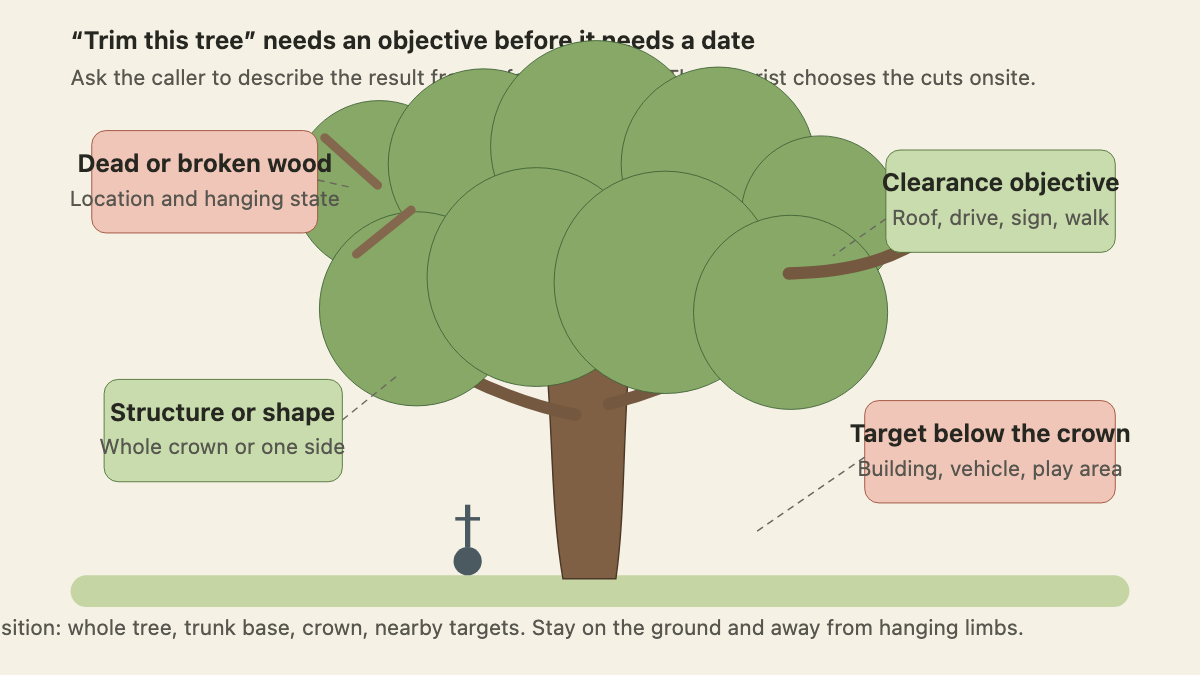
Capture the objective in the caller’s words. Then locate it on the tree: street side, house side, upper crown, lower limbs, trunk union, or one named branch above a fixed landmark. If several trees are involved, number them on a simple property sketch or label the photos before upload.
Ask for wide photos of the entire tree, trunk base, crown, and nearby targets. A close shot of leaves rarely establishes scale or access. The photographer should stay on the ground, outside any drop area, and away from hanging wood and conductors.
Do not promise a cut type or final crown shape by phone. Purdue University Extension notes that pruning decisions depend on tree health, environmental conditions, season, desired effect, and purpose. The International Society of Arboriculture likewise treats pruning as objective-led tree care. The arborist needs to see species, condition, branch attachment, defects, targets, and site constraints before choosing cuts.
Identify the tree without pretending certainty
Ask how many trees need attention and where each one stands. Record the caller’s species identification as reported, such as “maple,” “oak,” or “unknown evergreen.” A photo may help the estimator prepare, but the office should not convert an uncertain phone description into a confirmed species.
Useful size references include the roofline, a one-story garage, a standard fence, or a parked vehicle shown in the same wide photo. Avoid asking a caller to stretch a tape around a damaged trunk, walk under a hanging limb, or estimate crown height from a ladder.
Add what changed. Was there a recent storm, construction, trenching, soil work, lightning strike, vehicle impact, or sudden lean? Are leaves sparse on one side? Is there a cavity, split union, fungus at the base, fresh crack, or detached bark visible from the ground? Record observations without diagnosing decay or stability.
If the customer is already asking whether the tree should come down, keep the pruning request separate from removal intent. The tree removal quote-call guide covers targets, access, stump work, utilities, debris, and authorization for a removal assessment.
Map access and the work zone
The tree can be easy to see and hard to reach. Ask where a truck could park, whether the crew enters through a gate, and what surface lies between parking and the tree. A narrow side yard, soft lawn, septic field, retaining wall, stairs, slope, pool, overhead service drop, low eave, or fresh paving may affect equipment and site protection.
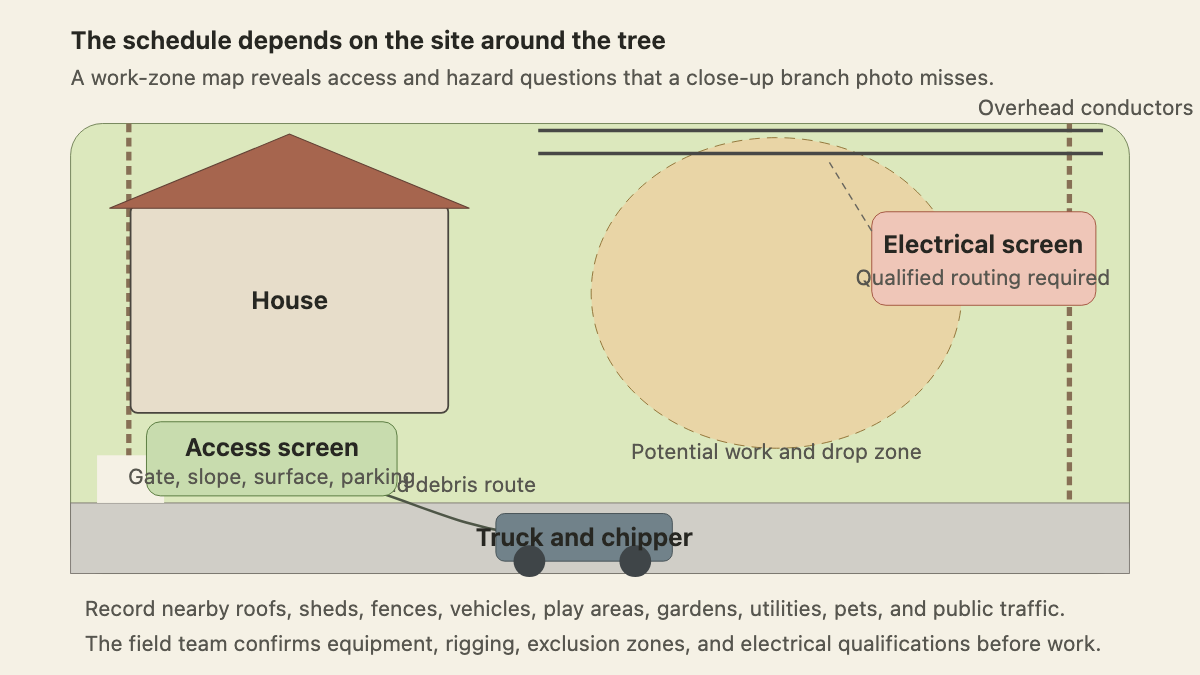
Ask about the space below the crown: roofs, sheds, fences, vehicles, play equipment, gardens, outdoor furniture, public sidewalks, parked cars, neighboring property, and animal areas. Note what can be moved before the visit and what must remain. The field team still sets the real exclusion and drop zones onsite.
Debris is part of the scope. Clarify whether the caller expects brush chipped and removed, wood hauled away, logs cut to a requested length, or material left onsite. Do not promise that every log can be milled, split, stacked, or carried through a narrow gate before the estimator sees its size and route.
Record locked gates, access codes through the company’s secure process, dogs, tenants, HOA controls, street-parking rules, and the person authorized to approve work. A tenant may provide access but lack authority to approve pruning. A neighbor may report an overhanging limb but not own the tree.
Treat timing as a field decision
Ask why the caller wants a particular date. A house closing, roof project, event, nesting concern, municipal notice, seasonal property closure, or planned construction may create a real constraint. Write it down without promising that the requested timing is appropriate or available.
There is no universal pruning month for every tree and objective. Purdue’s Tree Pruning Essentials says timing depends on tree health, environmental conditions, season, desired effect, and purpose. Local climate, species, pests, active defects, and the kind of pruning matter too. The office can offer an assessment slot and let the arborist recommend the work window.
Weather also changes field conditions. High wind, lightning, ice, saturated soil, heat, and poor visibility may delay climbing, lift work, or line-clearance operations under company safety rules. Give customers the rescheduling policy before a weather-sensitive date, especially when vehicles must be moved or access coordinated with tenants.
Build the estimate visit around the right decision
Some planned jobs can be quoted after a site visit. Others require utility coordination, municipal review, an arborist assessment, traffic control, special equipment, or a separate visit to define scope. The intake should reveal those needs early without turning reception into the estimator.
A useful call record includes:
- Customer name, service address, callback number, owner or authorized decision-maker, and access contact.
- Number and location of trees, reported species, whole-tree photos, and the specific pruning objective for each tree.
- Broken or hanging wood, recent changes, visible defects reported from the ground, nearby conductors, and anything below the crown.
- Truck parking, gate and surface access, slopes, structures, public traffic, pets, locked areas, and debris expectations.
- Requested timing, reason for the date, estimate policy explained, and any utility or qualified-arborist route started.
Read it back in plain language: “One mature oak in the rear yard. The customer wants an assessment of deadwood over the driveway and clearance from the detached garage roof. No active failure is reported. Overhead conductors run along the rear property line and appear near the outer crown, so the request is held for qualified review. Access is through a side gate beside the house; the caller does not know the width. The lawn is soft after irrigation. A shed and fence sit below the house-side limbs. Brush removal is requested, and the homeowner will be present to authorize scope. Wide tree, base, crown, conductor, gate, and parking photos are attached.”
That note gives the estimator a property to assess, not a guess to unwind.
An AI receptionist can collect these fields after hours and route electrical exposure or active failures under the company’s written rules. The script should preserve the same boundary as a trained coordinator: document the tree, objective, hazards, access, and authority, then leave pruning decisions to qualified field staff.
The most useful scheduling question is simple: “What do you want the arborist to assess, and what surrounds the tree?” The answer defines the visit far better than “How soon can you trim it?”
Sources
- OSHA: Line-Clearance Tree Trimming Operations
- Purdue University Extension: Tree Pruning Essentials
- International Society of Arboriculture: Pruning Your Trees