A homeowner calls at 7:12 a.m. and says, “A branch is sitting on the wire behind my garage. Can your crew take it down?” The office hears a tree job. The caller may be looking at an electrical emergency, routine vegetation growth, a service line to the house, or a communications cable. Nobody at the desk can settle that by appearance.
Start with distance and routing. Tell the caller to stay away from the tree, branch, wire, pole, fence, vehicle, and any nearby puddle or structure that could be involved. If the caller reports a downed line, arcing, sparking, burning, fire, active movement, or immediate danger to people, follow the company’s emergency procedure and direct the report to emergency services and the electric utility. For any branch touching, pressing on, or capable of falling onto an overhead electric line, the utility is the first electrical-status contact. The tree company can decide what role it may accept after the utility response and a qualified review.
Stop movement before asking for details
A worried caller often tries to help. They may offer to walk closer, move a fallen limb, test whether the fence is energized, or stand under the canopy for a better picture. Stop that first.
Use a direct sentence: “Please stay where you are and do not touch or approach the tree, wire, pole, fence, vehicle, or anything in contact with them.” If a person is injured or trapped, a line is on a vehicle, or fire and arcing are present, use the local emergency script. Reception should not coach anyone through exiting a vehicle, handling a conductor, cutting wood, using a ladder, or moving equipment. Those situations belong to emergency responders and the utility.
Ask whether other people can enter the area. A line across a driveway at dawn may soon meet school traffic. A backyard exposure may involve children, tenants, pets, a pool, or a metal fence. Record what the caller sees, then use the company’s approved language about keeping others away. Do not invent a clearance radius on the phone.
Weather belongs near the top of the note. Ask whether wind, rain, snow, or a recent storm changed the tree, and whether the branch or line is moving now. OSHA says line-clearance personnel may not work in adverse weather that makes the operation hazardous, subject to specific storm-restoration and deenergized-line provisions. The office does not interpret those provisions for a caller. It records conditions for the qualified reviewer.
Locate the scene precisely
Get the exact address before the call drops. Confirm the municipality, nearest cross street, rear or front of the property, and the electric utility if the caller knows it. A billing address may differ from the location of a roadside tree, vacant lot, rental, or neighboring property.
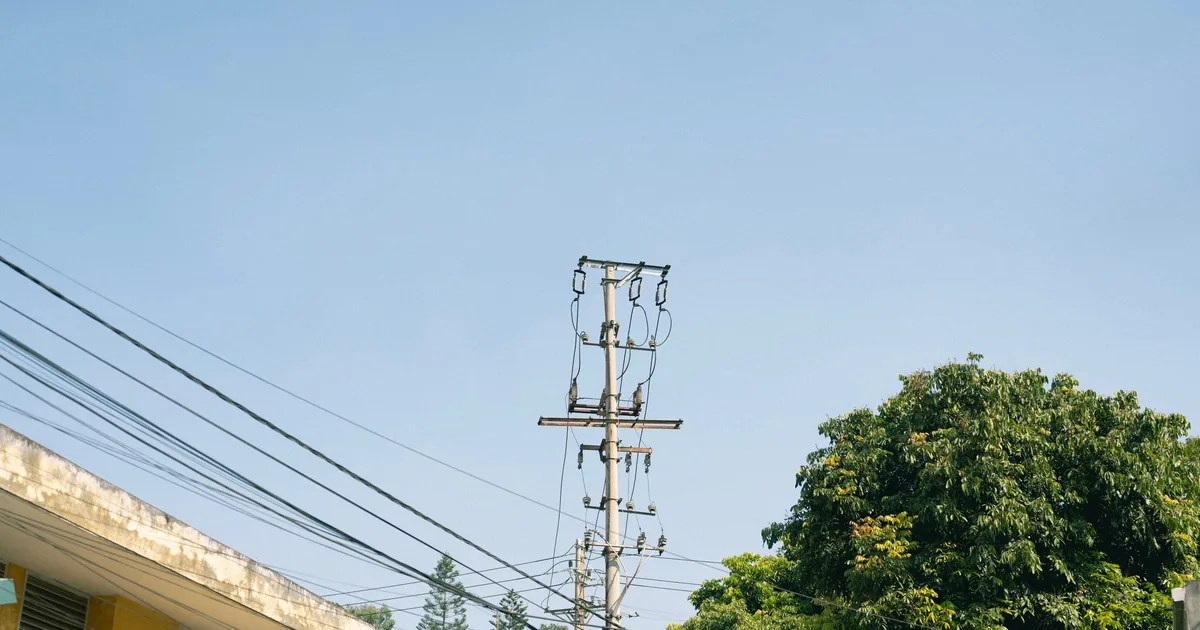
Then identify landmarks without asking the caller to approach. Is the tree beside a street, alley, driveway, backyard, field, or utility right-of-way? Which pole is closest? Does the line run between two poles, or from a pole toward a house or other building? PSEG Long Island asks hazard reporters for the exact address, whether the tree or broken limb contacts or could fall on a line, and whether the line is pole to pole or pole to building. Those are useful intake fields in any territory, though each utility sets its own response and work rules.
Avoid asking, “Is it a primary, secondary, cable, or phone line?” Most callers cannot identify conductors reliably. Record the physical relationship: “upper line between two roadside poles,” “single line from rear pole toward the east wall,” or “lower bundled line beneath the upper conductors.” The utility can identify its equipment.
Capture observable contact without diagnosing it
The phrase “near the wire” is too loose for assignment. Ask the caller to choose the description that fits what they can already see:
- A branch appears to touch or rest on a line.
- A branch appears to pull, press, or bend a line.
- A whole tree or major limb leans toward the line but has not made visible contact.
- A broken limb hangs above or beside the line.
- Leaves or small twigs have grown around a line with no reported movement, burning, or damage.
- A branch appears to pull the line or attachment away from a pole or building.
- A line is down, unusually low, moving, arcing, sparking, smoking, or burning vegetation.
Keep the caller’s uncertainty. “Caller cannot tell whether the limb touches the upper line” is valid. “Safe clearance” is not. A photograph cannot prove deenergization, voltage, ownership, or a safe work distance.
PSEG Long Island lists several observable patterns for hazard reporting, including a limb on an electric primary line, pressure against a secondary wire, a tree leaning on a wire, burning contact, and a branch pulling service wires from a pole or building. Use those as examples of what a caller might report, not as a remote classification system.
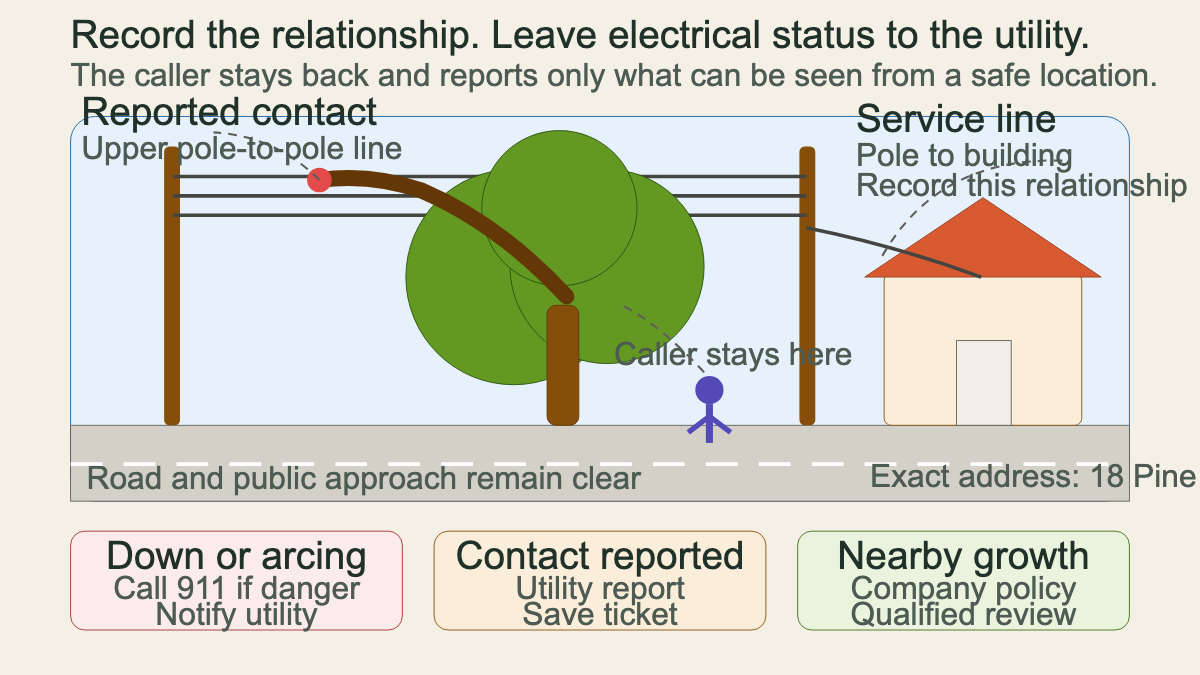
The streetscape keeps three decisions separate. Active electrical danger interrupts ordinary scheduling. Reported contact or pressure goes to the utility with a ticket or reference number when available. Nearby growth with no reported contact still needs a policy-based review before the office promises a crew, equipment, method, or date.
Know what the office cannot promise
A caller may ask, “Can your regular crew handle this?” The honest answer depends on the company’s qualifications, the site, the conductors, and utility coordination.
OSHA defines line-clearance tree trimming as pruning, repairing, maintaining, removing, or clearing trees near energized power lines, within 10 feet under the cited standard. OSHA also distinguishes electrically unqualified employees, qualified employees, and line-clearance tree trimmers who receive specialized training. Its page states that unqualified employees must maintain minimum approach distances of at least 10 feet, with greater distances applying at higher voltages.
That rule should tighten the intake boundary. Reception does not estimate feet from a phone photo, declare a worker qualified for a specific task, or promise that a utility will deenergize or cover a line. The company’s safety program and qualified supervisor decide whether the firm can accept the work, what coordination is required, and who may perform it.
Ownership questions also need care. The caller may believe the utility owns every wire, or that the homeowner owns everything beyond the pole. Practices vary by territory and equipment. Say, “We will record the line relationship and the utility’s response. The utility and our qualified reviewer will determine the next step.”
Record the utility handoff
When utility contact is indicated, collect the useful handoff details: utility name, time reported, channel used, ticket or reference number, instructions given, and current status. Preserve the utility’s exact words when possible. “Utility ticket 48217 opened; caller told to keep clear and await field review” is useful. “Utility made it safe” is unacceptable unless the utility has formally communicated that status through the company’s approved process.
Do not promise response times. New York’s Department of Public Service describes vegetation management as a utility reliability responsibility within utility-controlled rights-of-way and advises customers to contact the utility first about vegetation concerns. That framework does not create a universal schedule for residential calls, storm queues, service lines, private property, or another state.
If the utility says a private tree contractor may proceed, route that statement to the company’s qualified reviewer. A customer’s paraphrase does not replace the firm’s work planning. Record the utility representative, ticket, date, and any written confirmation available.
Request only photos the caller already can take safely
Photos can help locate the scene, but the request must never move the caller toward the exposure. Ask for a wide image only if it can be taken from the caller’s current safe position or another clearly safe public viewpoint. Zoom is enough. Existing doorbell, security-camera, or pre-incident photos may also show what changed.
Useful images show the whole tree and poles, the line route toward a building, the branch attachment, and nearby roads or structures. Skip every image that requires walking beneath the limb, approaching a downed or low line, opening a metal gate beside the scene, entering water, using a ladder, climbing onto a roof, or standing in traffic.
Name each file with the address, view direction, and time. “18 Pine rear yard from kitchen window 7:18 a.m.” can be matched to the call. A random camera filename cannot.
Build the qualified-review note
A weak dispatch note says, “Branch on wire, wants today.” A useful record lets the reviewer picture the site while preserving uncertainty:
“18 Pine Street, rear yard, reported at 7:12 a.m. after overnight wind. Caller is inside the kitchen and was told to remain away from the yard. Mature tree stands between rear fence and alley. Broken limb appears to rest on the upper of three lines running between roadside poles; caller cannot confirm contact. Separate line runs from the east pole toward the house. No reported arcing, sparking, smoke, fire, fallen conductor, injury, or active movement during the call. Children use the neighboring yard; caller is keeping the gate closed. Electric utility notified at 7:26 a.m., ticket 48217, field review pending. One zoomed photo from inside attached. No tree appointment promised. Route to qualified supervisor after utility status is recorded.”
Read the note back. Correct the address, tree, line direction, observed contact, changes, people nearby, utility name, and ticket while the caller is available.
For broad storm damage that includes blocked roads, building strikes, or several failed trees, use the storm-damage emergency intake guide. A branch over a building with a separate utility concern also needs the tree-limb-over-roof intake. Once electrical exposure has been controlled and the scope is ordinary pruning, the tree-trimming scheduling guide covers the appointment details.
The best final note may end without a booked job. It should still leave a clean chain: caller moved away, exact scene recorded, utility ticket captured, no electrical status invented, and qualified review waiting on facts rather than a dangerous guess.