A property manager calls about two steel cables in an old oak. She did not hire the original installer, has no report, and noticed one leader moving differently after last night's wind. “Can someone tighten the cable?” she asks.
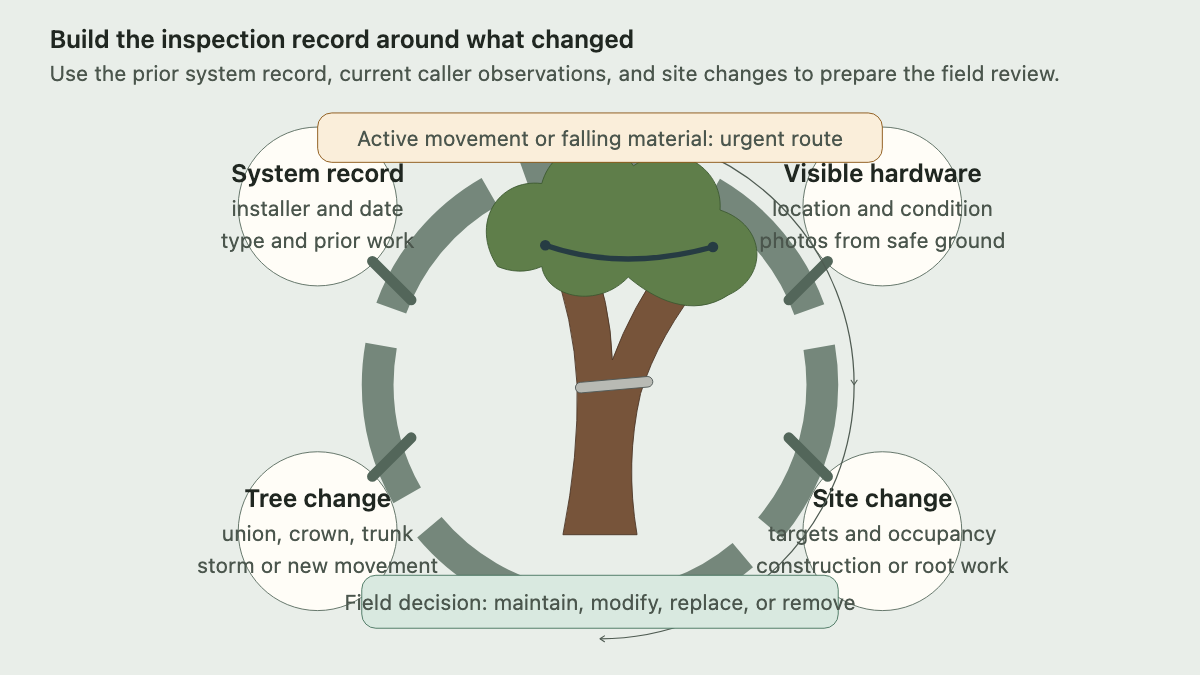
The office should book a qualified arborist inspection, not promise an adjustment. Capture the tree and address, what support hardware is present, who installed it and when if known, what changed, what sits beneath the tree, and which records or safe-ground photos are available. Active movement, falling material, or electrical contact goes through the company's urgent protocol first.
That opening keeps reception in the right role. A call record can prepare the field visit. The arborist must decide whether the system should be maintained, modified, replaced, or removed, and whether another tree-care option belongs in the plan.
Separate two kinds of support-system calls
The first distinction is whether support hardware already exists.
For an existing-system inspection, ask why the caller contacted the company today. They may have found a cable while buying the property, received a maintenance reminder, noticed corrosion, seen a branch change after a storm, or lost the original inspection record. The appointment must cover the tree as it stands now and the installed system.
A new-support consultation starts with a different question: “What condition or decision led you to ask about cabling or bracing?” The caller may describe a split where two trunks meet, a long heavy limb, an old storm injury, or advice from another arborist. Record the caller's words. Do not turn “there is a narrow seam between the stems” into “the union is failing.”
Some callers need a broader certified arborist consultation because the desired outcome remains open. Cabling, pruning, monitoring, or removal may all be questions for the site visit. Scheduling the professional judgment is more useful than forcing the request into a hardware estimate.
Explain what cables and braces do without promising safety
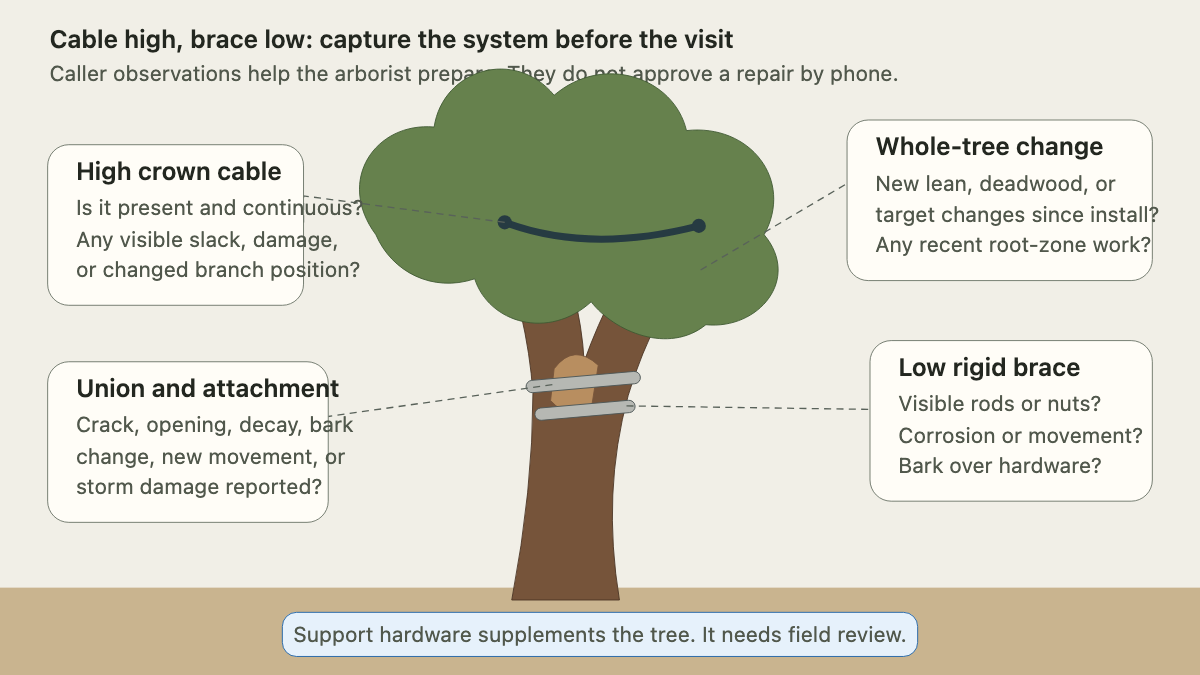
University of Massachusetts urban forestry guidance describes cabling and bracing as common forms of structural support. Flexible cables and rigid rods are used differently around defective unions. Virginia Cooperative Extension likewise describes braces near a trunk or limb union and cables higher in the crown.
That physical distinction helps reception ask clear questions. It does not authorize the office to identify a design or tell the caller that hardware is correctly placed. System objectives, arrangement, attachment points, material, size, tree condition, and current loads require professional review.
The Tree Care Industry Association's public summary of ANSI A300 Part 3 covers the installation and maintenance of cabling, bracing, guying, and other supplemental support systems. Its advisory language makes two points worth stating plainly to callers: the systems need periodic arborist inspection, and they do not provide the tree's primary support.
Avoid “the cable makes the limb safe” and “the brace will stop the tree from splitting.” UMass cautions that cabling is no guarantee against failure. A better office explanation is: “The arborist will inspect the tree and support system, then explain what condition it is in and what work, if any, is appropriate.”
Route active change before routine scheduling
A maintenance request can become an urgent call when the caller reports something moving, falling, splitting, or contacting a utility line. Ask whether any branch, stem, cable, rod, or soil around the trunk is moving now. Find out whether broken material is hanging over a house, entrance, sidewalk, parked vehicle, play area, or occupied work zone.
Follow the company's emergency and utility procedures. Keep the caller away from the affected area. Never ask someone to climb, pull on a cable, touch a brace, strike hardware, walk beneath a suspect limb, enter a barricaded zone, or approach electrical lines for a better photograph.
A new lean, fresh soil lifting, or movement around the trunk belongs in the leaning-tree assessment intake. Recent breakage after wind, ice, or lightning may need the storm-damaged tree call protocol. Those routes collect hazard details while this article stays focused on support-system history and inspection preparation.
Rebuild the original system record
Existing hardware makes its history part of the job. Ask who installed it, the approximate installation date, and whether another company has inspected or worked on the tree since. Request the proposal, diagram, invoice, inspection report, maintenance note, warranty terms, or photographs if the caller has them.
Record what the document actually says. “Invoice dated March 2019 lists dynamic cabling between two leaders” is useful. “Cable was installed correctly in 2019” is an unsupported conclusion.
Also ask about work performed after installation. Was the crown pruned? Did a storm remove a limb? Was another cable, rod, prop, or lightning-protection component added? Did construction, trenching, paving, grading, drainage work, or soil stockpiling occur near the tree? A support system cannot be understood from a close photo of one cable alone.
If the caller has no records, say so in the appointment note. Dispatch can then plan for identification and documentation in the field rather than expecting a routine adjustment with known specifications.
Capture safe observations of hardware and tree change
Start with the whole tree. Ask for the species if known, the number of trunks or major leaders, and the location of the supported area. Note whether the tree stands over a home, parking area, road, patio, playground, utility line, or neighboring property. Ask what changed around those targets since the last inspection. A formerly empty yard may now hold a deck and daily seating.
Then move to the hardware. The caller can report whether they see a flexible cable high between branches, rigid rods or nuts near a union, straps, props, or other components. They may notice visible slack, a disconnected part, corrosion, bark growing around an attachment, a shifted branch, or hardware that appeared after leaves dropped. Preserve phrases such as “caller reports” and “appears from ground.”
Move back to the tree. Ask about fresh cracks, openings at a union, cavities, deadwood, torn branches, crown thinning, a changed lean, mushrooms near the base, cut roots, or recent soil movement. The office is building a chronology, not a diagnosis. Dates help: “First noticed after Tuesday's wind” gives the arborist more than “looks bad.”
Request a small photo set from stable, permitted ground: one image of the whole tree and nearby targets, one of the supported leaders, one of the union or trunk area, and one closer view of the reported change if it can be taken safely. Older photographs can show how branch position, crown shape, or the site changed. Skip the photo if getting it would place the caller near a hazard.
Confirm access, authority, and the requested deliverable
A tree inspection can fail before the arborist sees the hardware. Ask about gates, dogs, parking, slope, locked yards, tenant notice, business hours, and who can meet the inspector. If climbing, a lift, or specialized access might be needed, flag the site for dispatch without promising the method.
Confirm who owns or manages the tree and who can approve inspection or work. A cable spanning leaders near a property line does not let reception decide tree ownership. Record a boundary dispute and explain that the company may need owner authorization, a survey, or outside advice before work is scheduled.
Ask what the caller expects after the visit. They may need a verbal explanation, a written inspection record, photographs, a proposal, or documentation for a property manager. Confirm what the company's appointment includes and whether an additional report has separate terms. Do not promise a “certificate of safety.”
Read back a field-ready appointment note
A complete note might read:
“Property manager requests inspection of existing support hardware in one mature white oak beside the south parking area. Species is caller-reported. Two overhead cables are visible between three leaders; installer and installation date are unknown. An invoice from the prior owner has been requested but is not yet available. Caller noticed the east leader moving more than the others after wind on September 3. No falling material, wire contact, fresh soil lifting, or active trunk movement is reported. Caller sees no disconnected cable from the ground. A dark area is visible around one attachment, but its condition is unknown. Parking spaces and a pedestrian entrance are beneath the outer crown; manager will close four spaces before arrival. Whole-tree, union, hardware, and parking-area photos are attached. Gate code is in dispatch notes. Manager requests a written condition summary and proposal if work is recommended; office must confirm that deliverable.”
Read the note back. Correct assumptions and label unknowns. An AI receptionist can capture these fields after hours, provided its script sends active hazards to the right route and leaves structural decisions to the arborist. The crew should arrive knowing what changed, what evidence exists, and what the caller needs from the visit.
Sources
- Tree Care Industry Association: ANSI A300 Part 3, Supplemental Support Systems
- University of Massachusetts Urban Forestry: Tree cabling and bracing
- Virginia Cooperative Extension: Tree Steward Manual, Chapter 9
- International Society of Arboriculture: Managing Hazards and Risk