A homeowner calls about a mature oak behind the garage. “You will need a crane,” he says. The driveway is wide, the tree looks reachable, and he wants the work done before relatives arrive next weekend.
The office still needs the whole site story. Ask about the road approach, gates, driveway and possible setup surfaces, the distance and obstacles between that area and the tree, overhead lines, structures beneath the crown, space to lower and process tree sections, traffic restrictions, and any neighbor or property-manager permissions. Request safe photos that connect those areas. Then send the record to a field estimator.
A caller can describe access. The estimator, crane operator, and field lead decide whether a crane belongs on the job, where equipment could be placed, and how the removal would be performed. Those choices depend on details that a driveway question alone cannot settle.
Start with the whole operation
Begin by confirming what the caller wants removed and why a crane came up. Did another tree company recommend one? Is the tree dead, storm-damaged, leaning, or simply too large for the caller's expected removal method? Does it stand behind a house, over a garage, beside a pool, or inside a courtyard? Record the caller's words without turning them into a condition assessment.
Then identify every target around the tree. Include the home, detached buildings, fences, neighboring property, parked vehicles, septic components, wells, gardens, play equipment, utility lines, roads, and pedestrian areas. Ask where branches extend and where the trunk stands relative to those targets.
The broader tree removal quote intake guide helps reception capture tree size, condition, debris, and stump scope. A crane-access call needs another layer: the possible route between the street, equipment, tree, and landing area.
OSHA's tree-care guidance names falls, falling objects, energized lines, heavy equipment, and traffic among the hazards employers must assess. That is why reception should avoid language such as “the crane will fit” or “the driveway is strong enough.” A useful note exposes conditions for the site visit. It does not approve them.
Trace the approach from the public road
Ask the caller to describe how a large truck would reach the property. Start at the public road. Is it a normal residential street, a narrow private lane, a cul-de-sac, a gated community, or a shared drive? Are there low branches, tight turns, weight-limited structures, parked cars, signs, mailboxes, or overhead services along the approach?
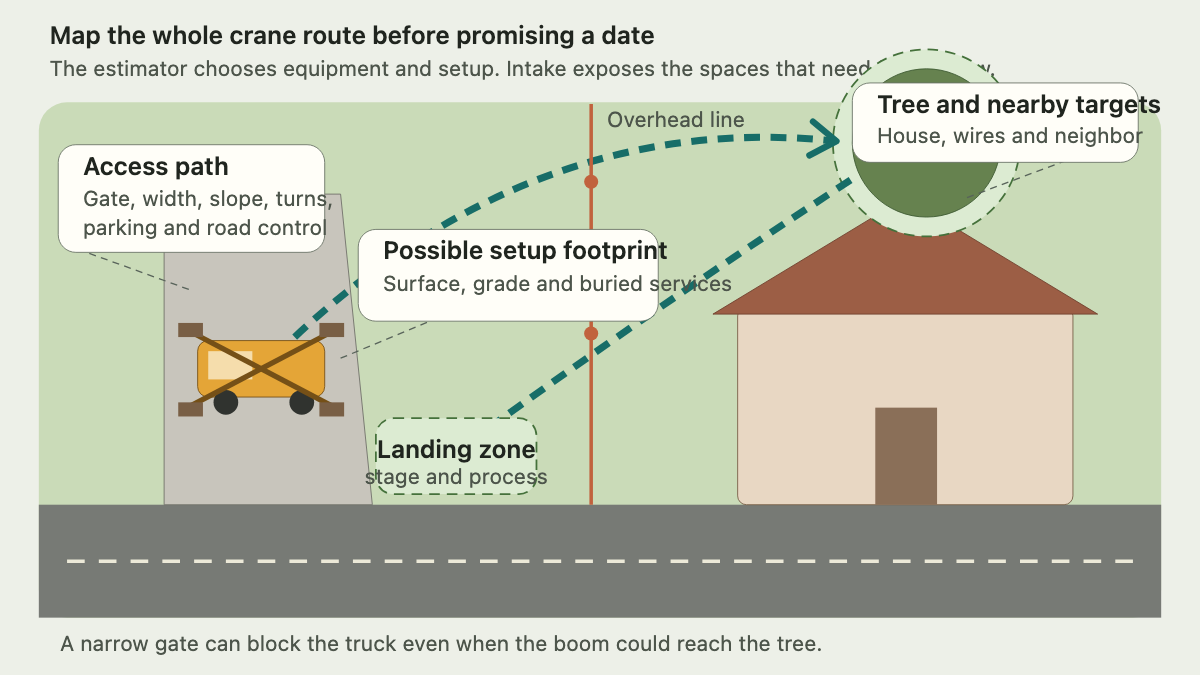
Move inward. Record gate width if the caller already knows it, but do not ask anyone to stand in traffic or near a hazard to measure. Ask whether the driveway curves, slopes, narrows between walls, crosses a culvert, or has soft shoulders. Note the surface: concrete, asphalt, pavers, gravel, turf, or an unknown base. Recent rain, trench work, patched utilities, a buried tank, or an underground vault belongs in the handoff.
The federal construction crane rule describes ground conditions through slope, compaction, and firmness and recognizes supporting materials such as mats and cribbing. Whether that rule applies to a particular tree job is a legal and operational question for the company. Its vocabulary still shows why “solid driveway” is too vague for intake.
Ask where the caller thinks equipment might stand, then label that answer as caller-reported. The estimator may choose another location or reject the proposed area after seeing the grade, edges, overhead space, buried services, and required footprint.
Show the estimator the reach path
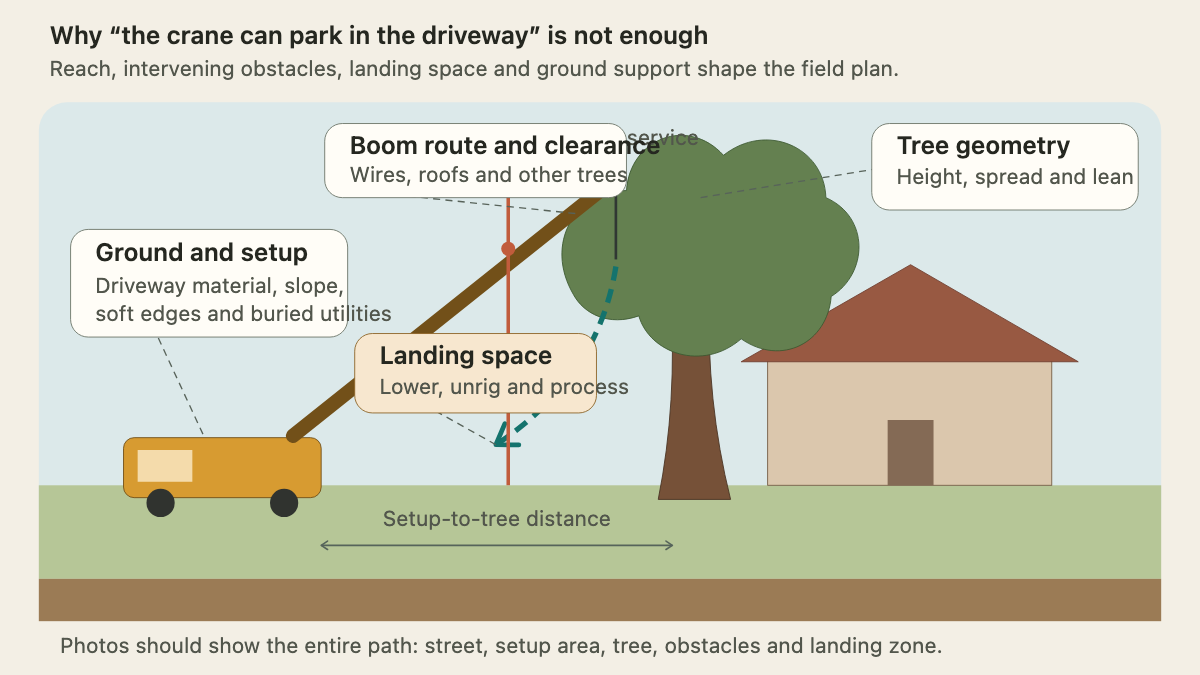
A crane parked on a driveway may still be separated from the tree by a roof, utility line, second tree, retaining wall, or steep grade. Ask what lies between the possible setup area and the trunk. Then ask what lies above that path.
Capture the approximate distance only if the caller can provide it safely. Existing surveys, site plans, property listings, and mapping tools may offer context, but none replaces the field check. Tree height and trunk diameter can also be caller estimates. Mark them that way.
Request a connected photo set:
- One wide image from the road toward the proposed entrance, one from the entrance toward the possible setup area, and one showing the full tree with the setup area in the same frame when possible.
- Separate views of overhead lines, roofs, neighboring trees, gates, slopes, surface changes, possible landing space, and the route debris would take to the chipper or truck.
- A street view in each direction if it can be photographed from private property or a safe pedestrian location.
- Existing photos or video from before leaf-out, before storm damage, or before recent construction when they clarify hidden branches and site changes.
Do not ask the caller to climb, enter a road, walk beneath a suspect tree, approach a line, cross a barricade, or stand inside an active work area for a better angle. A missing photo is an unknown for the estimator, not a reason to create another hazard.
Ask where each tree section could go
The route does not end at the canopy. Tree sections need a controlled destination and space for the ground crew to work. Ask whether the property has open lawn, a parking area, a closed section of road, or another place the estimator can inspect as a possible landing and processing zone.
Record what occupies that area now. Patio furniture, landscape lighting, irrigation heads, cars, playsets, fences, garden beds, septic lids, and low branches can matter. So can customer expectations about turf, pavers, or planting beds. Reception should document those concerns without promising that surfaces will remain untouched.
Ask how debris would leave. Can a chipper and material truck use the same approach? Would the crew have to move material through a gate, around a building, or across neighboring property? Is stump grinding part of the request, and can a separate machine reach the stump? A crane may solve one handling problem while access for the rest of the job remains open.
A Tree Care Industry Magazine case study makes the connection concrete. A large dead pine stood on a terraced front yard, beyond the company's normal bucket-truck reach, with limited stump-grinder access and one main community road. The field plan included a crane location, traffic control, and a defined plant-material zone. The case is not a template for every job. It shows why setup and debris handling belong in the same intake record.
Separate utilities, traffic, and permissions
Ask whether wires cross the street, driveway, setup area, tree, or possible movement path. Find out whether the caller knows what each line serves, but treat every identification as unconfirmed. The tree company and utility determine the next steps under their procedures. Reception should never tell the caller to touch, move, measure, or test a line.
If a limb is touching a line, a line is down, or the tree is actively moving near occupied space, switch to the company's urgent protocol. The storm-damaged tree intake guide covers immediate hazard sorting. A tree or limb over a building may also need the more focused roof-adjacent limb intake.
Traffic questions deserve their own note. Could equipment block a lane, sidewalk, shared drive, school route, loading area, or emergency access? Does a homeowners association, municipality, property manager, or private-road owner control the space? Record known restrictions and the right contact. Do not promise a road closure or permit timeline.
Confirm who owns the tree, who can authorize the estimate, and who controls every property the crew might need to enter. Neighbor access, shared drives, rented property, and commercial sites often add another decision-maker. Reception can collect names and contact details. It should not decide ownership or give legal advice.
Read back a field-ready access note
A clean handoff might read:
“Owner requests an estimate to remove one mature oak behind the detached garage. Another contractor told the owner a crane may be needed; no equipment choice has been confirmed. The tree stands about one garage length behind the building, with crown over the garage and rear fence. No active movement or wire contact is reported. Access is from a residential cul-de-sac into a straight concrete driveway. Owner reports a wood gate beside the garage and does not know its width. Driveway slopes toward the street. A patched utility trench crosses the lower drive, and the owner has been asked for any utility or site records. Overhead service runs from the rear corner of the house toward the alley and appears in the attached wide photos. Possible material area is the front lawn, which contains irrigation and one marked septic cleanout. Neighbor permission would be needed for entry beyond the rear fence. Road, driveway, gate, tree, line, lawn, and debris-route photos are attached. Field estimator must verify access, setup, utilities, landing space, traffic needs, and removal method.”
Read that note back to the caller. Correct assumptions and keep unknowns visible. An AI receptionist can collect the same fields after hours, provided urgent hazards follow the company's escalation rules and every equipment decision stays with qualified field staff.
The estimator should arrive with a connected view of the property, not a folder of close-ups that hides the route. Street. Setup area. Tree. Landing space. That sequence turns “yes, the driveway is wide” into a site visit the field team can prepare for.
Sources
- OSHA: Enforcement Inspection Guidance for Tree Care and Tree Removal Operations
- Tree Care Industry Magazine: Rocking Crane-Assisted Tree Removal
- Tree Care Industry Magazine: A Crane Removal in Southern California
- Electronic Code of Federal Regulations: 29 CFR 1926.1402 Ground conditions