A rider calls from the corner of a parking garage. The motorcycle is behind a locked gate, the only key is gone, and the caller wants to know whether a technician can make another one before the garage closes. A price is the tempting first answer. It is also the wrong place to start.
A useful motorcycle key replacement call intake begins with the exact bike, what remains of the key set, which locks are involved, whether the motorcycle recognizes an electronic key or fob, where the bike sits, and how the caller will satisfy the shop's authorization policy. Until those facts are clear, promise a review rather than a completed repair.
Start with the key situation
Ask the caller to describe what they still have. “I need a motorcycle key” can mean a spare copy from a working metal key, an all-keys-lost replacement, a blade broken inside the ignition, a key that turns but is not recognized, or a proximity fob that suddenly stopped working.
Those are different jobs. The first minute of the call should separate them.
Record whether any working key or fob remains. If there is a key, ask whether it operates the ignition and starts the motorcycle. Then ask whether it also opens the fuel cap, seat, saddlebags, top case, or steering lock. A rider may have an ignition key but still need help with a broken key in a luggage lock. Another may have a cut blade that turns while the security indicator says the electronic side is unresolved.
For a broken key, note where the piece is and whether part of it is visible. Do not coach the caller through extraction. Preserve the condition for the qualified person who will inspect it.
For a keyless bike, capture exactly what the rider sees. Does the display wake up? Does a security light remain on? Does the fob have buttons? Has its battery been changed? Does a backup PIN or emergency-start procedure exist in the owner materials? Do not ask the caller to read a PIN aloud on an open line. Follow the shop's secure handling policy for sensitive codes.
Manufacturer information shows why this distinction matters. An Indian Motorcycle service bulletin for covered keyless models separates motorcycle battery state, fob battery state, range, pairing, and PIN recovery. A metal key cut would not answer each of those complaints.
Identify the motorcycle precisely
“Black Ninja” is not enough for dispatch. Record the year, make, model, and any trim or model designation the caller can confirm from registration, insurance records, or the motorcycle itself. Ask whether the bike was sold for the US market or imported, since equipment and key systems can differ.
Capture the VIN through the shop's approved channel. NHTSA describes the VIN as a 17-character identifier that encodes information about a particular vehicle. Read it back in grouped characters or compare it with a clear document image according to company policy. Watch for common transcription errors such as a zero read as the letter O.
The VIN identifies the bike. It does not establish that the caller may order a key for it. Keep vehicle identification and authority as separate fields on the ticket.
Ask whether the caller has the original key-code tag, a code card, a PIN card, a remaining master key, or another factory-supplied security item. Record what exists and where it is. Do not copy a key code into free-form notes unless shop policy specifically allows that storage location.
Exact model identification protects the schedule too. A Ducati immobilizer bulletin documents several systems across the covered model years, with different paths when one key is lost, every key is lost, or a control component is replaced. The lesson for reception is simple: “Ducati key” is still too broad for a completion promise.
Map every lock in the key set
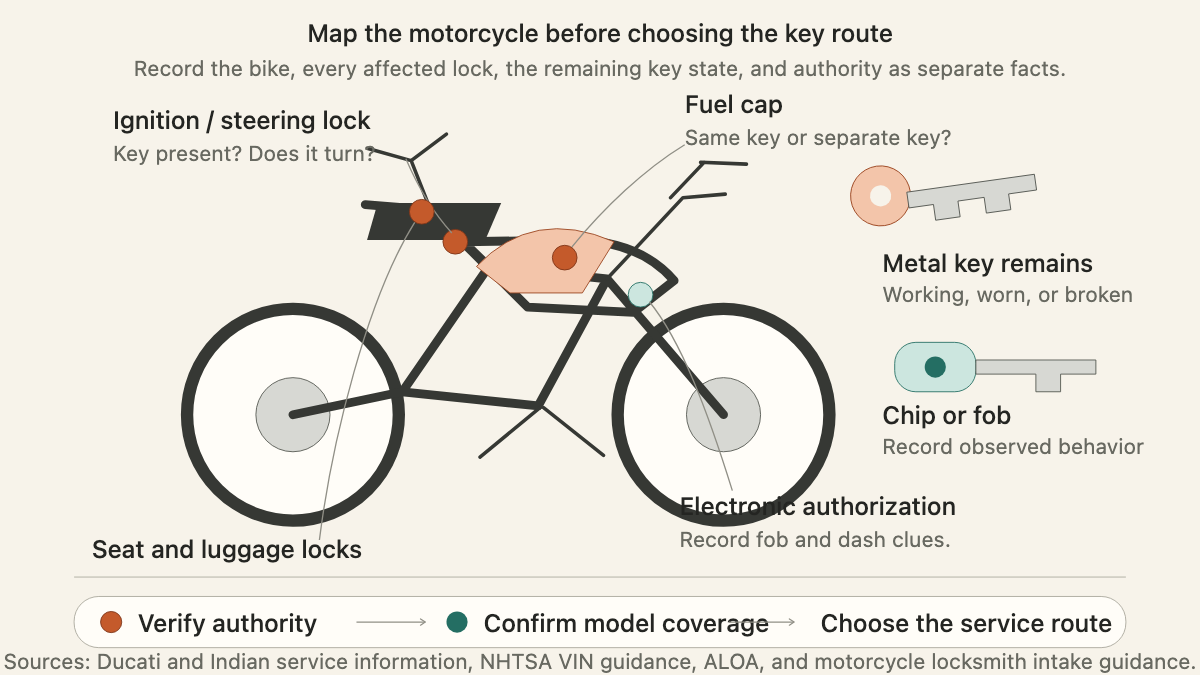
A motorcycle is a small vehicle with several lock points packed into a tight space. Ask which ones the missing or damaged key used to operate:
- ignition and steering lock
- fuel cap
- seat release or helmet lock
- factory saddlebags, top case, or other fitted storage
Then record the current state of each relevant lock. Is the steering locked? Is the fuel cap closed? Is the seat latched over documents or a battery compartment? Is a broken piece inside one cylinder? Does an aftermarket case use a separate key?
This map changes the likely scope. A replacement that starts the engine but does not open the tank or release the seat may leave the rider with an unfinished problem. It also tells the technician which photos may help before travel. Request a wide photo showing the whole bike and parking context, plus clear close views of the ignition area and affected locks. Tell the caller to avoid photographing or sending a visible key code through an unapproved channel.
The ALOA Security Professionals Association describes vehicle locksmithing as specialized work that depends on current training and equipment. The office should check the shop's own motorcycle coverage by exact model and system. Familiarity with car fobs does not automatically settle a motorcycle job.
Confirm location and physical access
A motorcycle in a private garage presents a different dispatch than one at a dealer auction, repair shop, tow yard, apartment basement, or roadside turnout. Record the street address and a precise position such as “Level 3, orange zone, space 318.” Ask whether the bike can be rolled, whether the steering is locked, and whether a truck can enter the property.
Access questions prevent a technician from reaching the address but not the motorcycle. Ask about gate codes, garage height limits, loading areas, parking validation, building hours, and the person who will meet the technician. If the bike is at a tow yard or repair shop, get the facility name, contact number, release process, and closing time.
Handle roadside safety before scheduling details. If the rider is standing near moving traffic, in severe weather, or in another exposed location, direct them to follow local emergency and roadside safety guidance. Reception can document a safe callback location. It should not coach someone to work around the ignition beside traffic.
Also ask whether the motorcycle shows signs of attempted theft, collision damage, a drilled lock, cut wiring, or a forced steering lock. Do not turn that observation into a diagnosis. Flag it for review because the service route, documentation needs, and repair trade may change.
Apply the shop's authority policy early
Key creation is security-sensitive work. Tell the caller what the shop requires before dispatch, using the policy's exact language. Common examples include government-issued identification and current registration, title, or another approved ownership document. Policies differ by business and jurisdiction, so avoid improvising exceptions on the phone.
Match-name problems need an explicit route. The rider may have just bought the motorcycle, inherited it, borrowed it, received it as a gift, or be calling for a business-owned vehicle. Ask whose name appears on the available documents and whether that person can be present. A property manager, auction representative, repair shop, or estate representative may need a different authorization packet.
Possession is not enough. The bike being in someone's garage does not prove that person can authorize a new key. Neither does knowing the VIN. If the documents are incomplete, mark the ticket for authorization review before a technician drives out.
This conversation should stay matter-of-fact. “Before we schedule key work, I need to check the bike details and the documents our policy requires” is clearer than accusing a caller or promising an exception.
Choose the route after capability review
Once the intake is complete, route the call according to the shop's actual coverage. The reasonable outcomes include mobile service, a shop appointment, dealer referral, transport or towing, a technician callback, or a request for more documentation and photos.
Avoid saying, “We can definitely make it onsite,” before the exact model and security system have been checked. Some jobs involve a mechanical copy or origination. Others add transponder or fob work. Certain systems, loss states, or missing security materials can require model-specific tools, dealer access, component work, or a different provider.
A solid ticket gives the reviewer enough detail to make that call:
- caller name, callback number, and their relationship to the registered owner
- year, make, model, VIN, and market or import status when known
- spare, all-keys-lost, broken-key, or electronic-recognition state
- every affected lock and the steering-lock position
- key-code tag, code card, PIN materials, remaining keys, and fobs present
- exact location, garage or gate access, bike mobility, and site hours
- documents available under the shop's authority policy
- recent theft attempt, collision, lock damage, wiring damage, or prior key work
- requested timing, useful photos received, and the promise made to the caller
Read back the uncertain details. “I have a 2016 model, but the trim is still unconfirmed” is useful. A guessed trim quietly copied into dispatch notes is not.
Keep the handoff as precise as the call
A technician should be able to open the ticket and see the motorcycle, key state, lock set, electronic clues, authority status, and access constraints without replaying the call. That is the standard whether a person answers or an AI receptionist captures the intake after hours.
The final line should state the next action in plain language: “Technician reviewing model coverage,” “Waiting for the registered owner,” or “Shop appointment confirmed after document check.” The rider then knows what happens next, and the locksmith arrives with a truthful picture of the bike waiting in space 318.