“The code beeps like it accepted, but the handle just spins.” That sentence tells a safe technician almost nothing about which part failed. It does tell the office what to preserve: the exact handle movement, the lock’s response, the door position, and what happened before the symptom appeared.
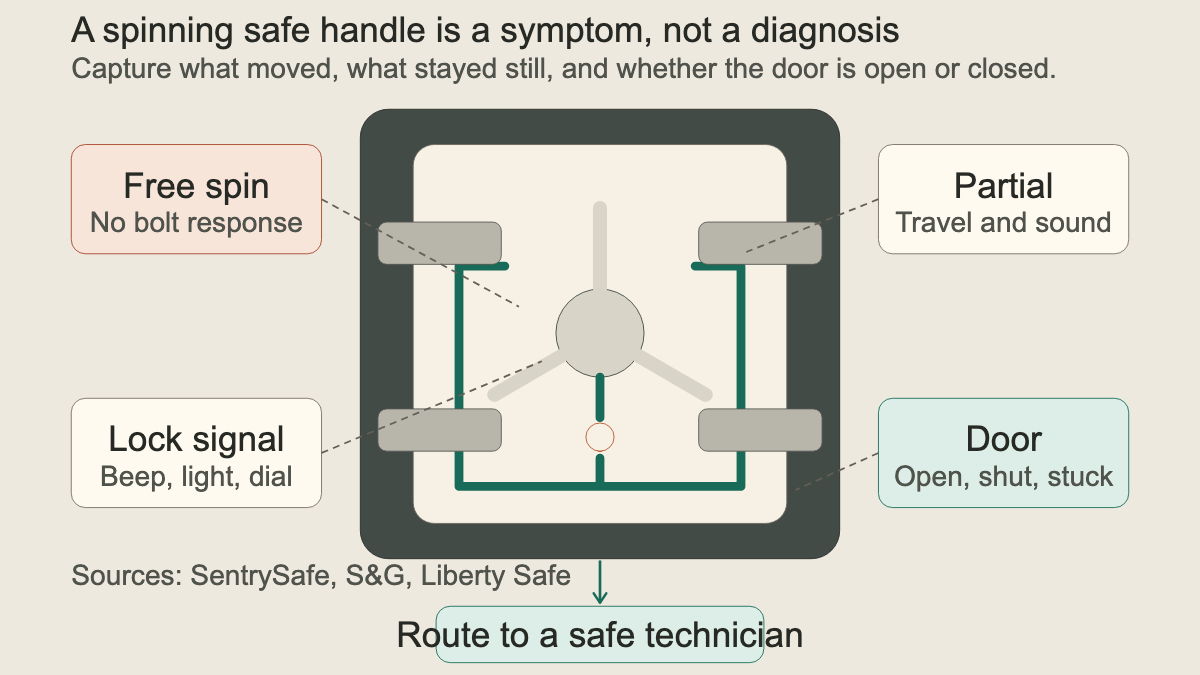
For a safe handle or boltwork service call, first ask whether the door is open, closed, or partly latched. Then record whether the handle turns freely, stops early, feels stiff, moves farther than usual, or travels normally while the door stays shut. Keep the keypad, dial, or key response in a separate field. Do not diagnose a spindle, clutch, linkage, relocker, or lock body over the phone.
Start with the door state
Ask one plain question before requesting a model number: “Is the safe door open right now?”
An open safe with rough or unreliable handle travel is a planned repair. The caller should leave the door open and stop cycling it until the shop gives model-specific guidance. A closed safe is an access problem as well as a repair problem. A door that is resting against the frame, partly latched, or obstructed needs its own description.
Record whether the locking bolts are visible. If the door is open, ask whether they are extended, retracted, or somewhere between those positions. Do not ask the caller to close the door for a test. That can turn a repair appointment into a lockout.
For a closed door, ask whether it sits flush with the frame. Is one corner proud? Does the door move when pulled gently, or does it feel fixed? Is anything visible in the gap, such as a strap, shelf edge, paper, cable, or fabric? The answer belongs in the ticket. Reception should not tell the caller to pry the gap, strike the door, or add force to the handle.
The general safe lockout intake guide covers authority, safe identity, and broad lock failure states. A handle-and-boltwork ticket goes narrower. It preserves the mechanical symptom that the technician will need to evaluate.
Describe handle travel instead of naming the failure
“Spinning” can mean several different things. Ask the caller to describe one past attempt, without repeating it:
- Did the handle rotate with almost no resistance, or did it feel normal at first?
- Did it stop at its usual endpoint, stop sooner, or continue beyond its usual range?
- Did it spring back, remain in the new position, slip with a click, grind, or move silently?
- Did any visible bolt move, even slightly?
- Did the symptom begin suddenly, or had the handle been getting stiffer over several openings?
Write down the caller’s words. “Three-spoke handle rotates a full circle with light resistance; no visible movement at the door edge” is useful. “Broken boltwork” is a diagnosis nobody has earned yet.
Some safe designs deliberately allow a handle or clutch to slip under excess force. A SentrySafe owner’s manual describes a protective feature in which the handle can move without moving the bolts after too much force is applied. Liberty Safe support also documents clutch behavior and separates several symptoms: a handle that will not turn, a handle that turns while the door remains closed, and intermittent opening. Those are product-specific examples, not a universal explanation for every spinning handle.
That distinction matters at intake. A freely rotating handle may involve a protective feature, a loose connection, wear, prior force, or another internal condition. The office should promise an assessment, not a particular replacement part.
Record the lock response separately
The lock and the safe’s moving boltwork are related, but they are not the same observation. Sargent and Greenleaf’s 6800 Series instructions refer separately to the safe door’s boltwork and the lock. The instructions also reserve lock servicing and lubrication for trained service personnel.
For an electronic lock, capture what happened during the last code entry. Did the keypad wake? Did every key respond? What lights, beeps, or messages appeared? Did the accepted-code signal sound different from an incorrect-code signal? How long passed before the handle was moved? Do not ask for the code itself.
For a mechanical dial, record whether the dial turns normally, stops where the caller expects, feels unusually tight, or has developed a scrape or wobble. For a key-operated safe, ask whether the key enters fully and whether it turns. The caller should not send a photograph that exposes a combination, code, or key bitting.
Then compare the lock response with the handle report. “Keypad gave its normal accepted signal; handle then rotated loosely; door stayed closed” is a clean observation set. So is “Dial never reached its normal stop; handle was not moved.” The second ticket may not belong in the same repair path as the first.
Capture what changed before the symptom
Ask when the safe last opened and closed normally. The story immediately before the failure often helps the technician prepare, even though it does not prove a cause.
Was the safe moved, dropped, tilted, anchored, or struck? Did someone pull hard on the handle? Was there a burglary attempt, fire, water exposure, or construction dust? Was the interior packed tightly before the door closed? Did a shelf, drawer, gun barrel, deposit bag, or document binder shift near the door? Has another company worked on the lock, hinges, handle, or door panel?
Ask about prior attempts without scolding the caller. Record whether anyone removed the keypad, loosened handle hardware, sprayed lubricant, drilled, pried, struck the door, or repeatedly forced the handle. If a part came off, ask the caller to keep it and photograph it in place rather than reinstall it.
A safe that has been attacked, exposed to fire, or damaged during a move may need different tools and site precautions. It may also require a different technician. Mark that history clearly instead of burying it in notes.
Identify the safe without exposing private information
Request the manufacturer, model, serial number, approximate dimensions, lock type, handle style, and safe category. A home fire safe, gun safe, commercial deposit unit, floor safe, vault door, and imported cabinet do not share one internal layout.
Ask for a small photo set through the shop’s approved channel:
- A full view of the safe and surrounding floor space
- A straight-on view of the door, handle, lock, hinges, and visible bolts
- A close view of any accessible manufacturer or model label
- A side view showing whether the closed door sits evenly in the frame
- A room view showing stairs, narrow halls, counters, shelving, or customer areas
Tell the caller to cover documents, cash, firearm serial numbers, combinations, access codes, and keys. Nobody should move or tip a heavy safe for a better label photo.
Precision Lock and Safe’s repair overview treats doors, hinges, handles, locks, and boltwork as separate service categories. That is a useful office rule. A photograph can show where the symptom appears, but it cannot confirm which hidden component needs repair.
Confirm authority and the site plan
Safe work still requires an authorization path. Record the caller’s name, callback number, service address, relationship to the container, and the documents your company requires. A homeowner, employee, property manager, executor, landlord, and business partner may have different authority records.
If the safe is at a business, capture the business name, on-site contact, floor, building hours, alarm check-in, security escort, loading access, and who can approve added work. At a residence, note stairs, finished floors, tight closets, pets, and whether the safe is bolted down or built into cabinetry.
Route the call to a technician who services the safe category and lock brand. Do not treat it as an ordinary house-door repair because the caller used the word “handle.” The locksmith resource hub separates container work from building and vehicle lock calls for this reason.
Set an appointment around diagnosis
Explain the first visit in bounded terms. The technician will confirm authority, inspect the safe, reproduce only the tests appropriate for that model and condition, and explain the next step. Opening, repairing the handle or boltwork, replacing a lock, and returning the safe to secure service can be separate parts of the job.
Do not promise damage-free opening, a specific repair, or a fixed part from photographs. If the door is already open, tell the caller to keep it open. If the door is closed, tell the caller to stop forcing the handle and preserve any loose pieces.
Read the ticket back: “Owner is on site with identification and purchase records. The safe is closed and bolted to the floor. The electronic lock gave its normal accepted signal on the last attempt. The three-spoke handle then rotated farther than usual with little resistance, and the door did not move. The problem began after the handle was pulled hard. No keypad, trim, or door panel has been removed. Photos show the manufacturer label and clear ground-floor access.”
An AI receptionist can collect the same observations after hours and route them under the shop’s safe-work rules. It should never request the combination, coach an opening method, or decide which internal part failed.
That ticket gives the safe technician a symptom worth investigating, a verified person to meet, and a door that has not been made worse by another round of guesses.