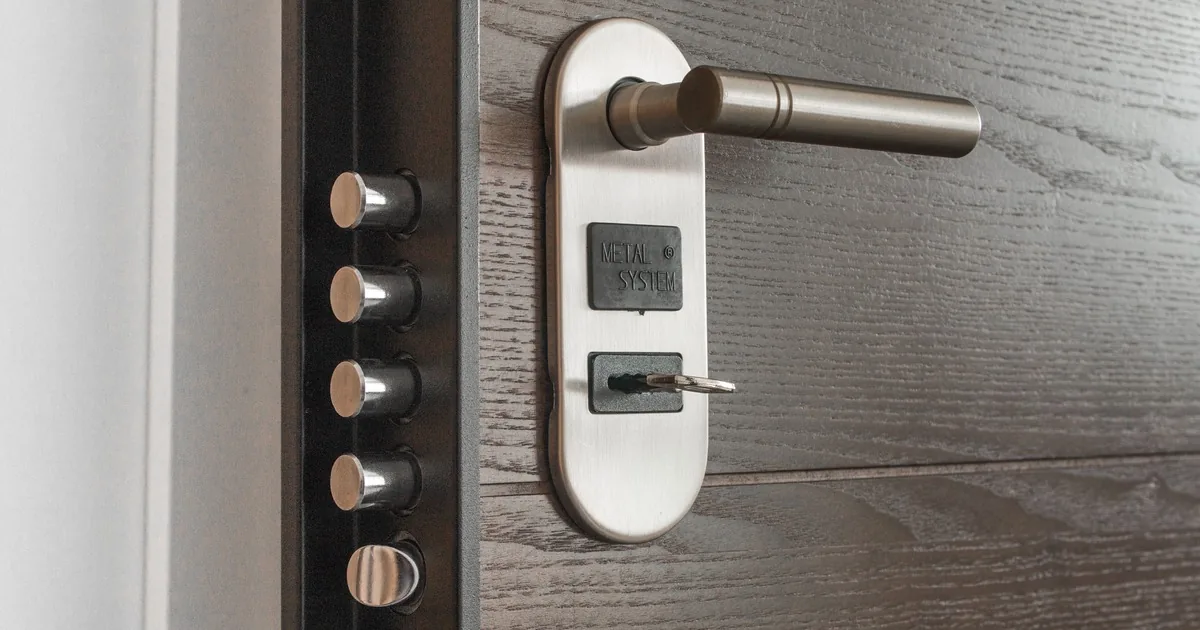
“The key turns, but the front door still will not open.” That sentence describes a symptom, not a repair. The cylinder may rotate while the latch or deadbolt stays extended. The bolt may retract partway and bind at the strike. The lock may work, yet pressure from a sagging or weather-tight door keeps the opening shut.
A useful service ticket separates five things: where the caller is, what the key does, what the inside hardware does, whether the latch or bolt moves, and whether pressure on the door changes the result. Reception should not name the failed part or promise non-destructive entry. The technician needs a precise motion record and a clear authorization plan.
Start with the person, not the hardware
Ask whether the caller is outside, inside, or able to use another entrance. Then confirm whether the affected door is the only safe exit, whether a child or dependent adult is separated from a caregiver, and whether there is smoke, fire, a medical problem, or another immediate danger. Follow the company’s emergency policy. Immediate danger belongs with local emergency services, not a routine service window.
Record whether the property can be secured. A resident who is inside with a stuck front door and a working rear entrance has a different access problem than a caller standing outside an apartment at midnight. A storefront that cannot open for customers has another schedule and authorization chain.
If access is the main issue, attach the emergency lockout intake workflow. Keep this symptom record too. “Locked out” explains the urgency. “Key rotates about a quarter turn, thumbturn stops at the same point, and pulling the door changes the resistance” helps the locksmith prepare.
Ask what turns and how far
Do not settle for “the lock turns.” Ask the caller to describe the exact motion they already observed, without repeating it over and over.
Start with the key. Does it rotate its normal distance, stop early, turn farther than usual, spin freely, spring back, or feel rough? Does the caller hear a click? Does the key return to the removal position? Record their words. Avoid translating “it spins” into a broken tailpiece or “it stops hard” into a jammed deadbolt. Those are possible explanations, but the phone call cannot confirm them.
Ask which hardware is involved. Is this a separate deadbolt above a knob, a keyed knob or lever, a handleset, a mortise lock, a multipoint door, or an unknown lock? Request one wide photo of the door and jamb plus close photos of both sides of the hardware when the caller can take them safely. Photos help identify the opening. They do not prove what failed inside it.
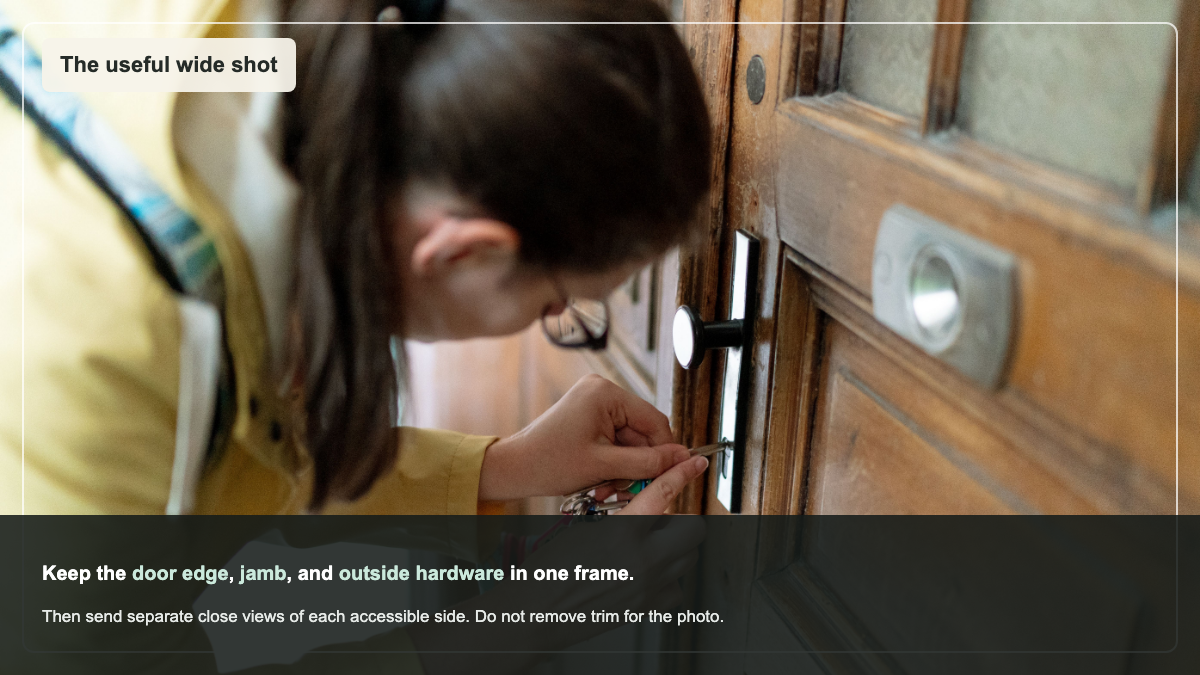
Next, ask whether the inside thumbturn, knob, or lever behaves differently. A caller who is inside may report that the thumbturn also stops short. Another may say the inside lever moves normally but the latch stays out. Preserve the difference. Never ask someone outside to enter through an unsafe route just to test the interior side.
Trace where the motion stops
A key is only the first link in the opening. Its rotation must transfer through the cylinder and connecting hardware, move the latch or bolt clear of the strike, and leave the door free to swing. The phone note should say where visible motion ends.
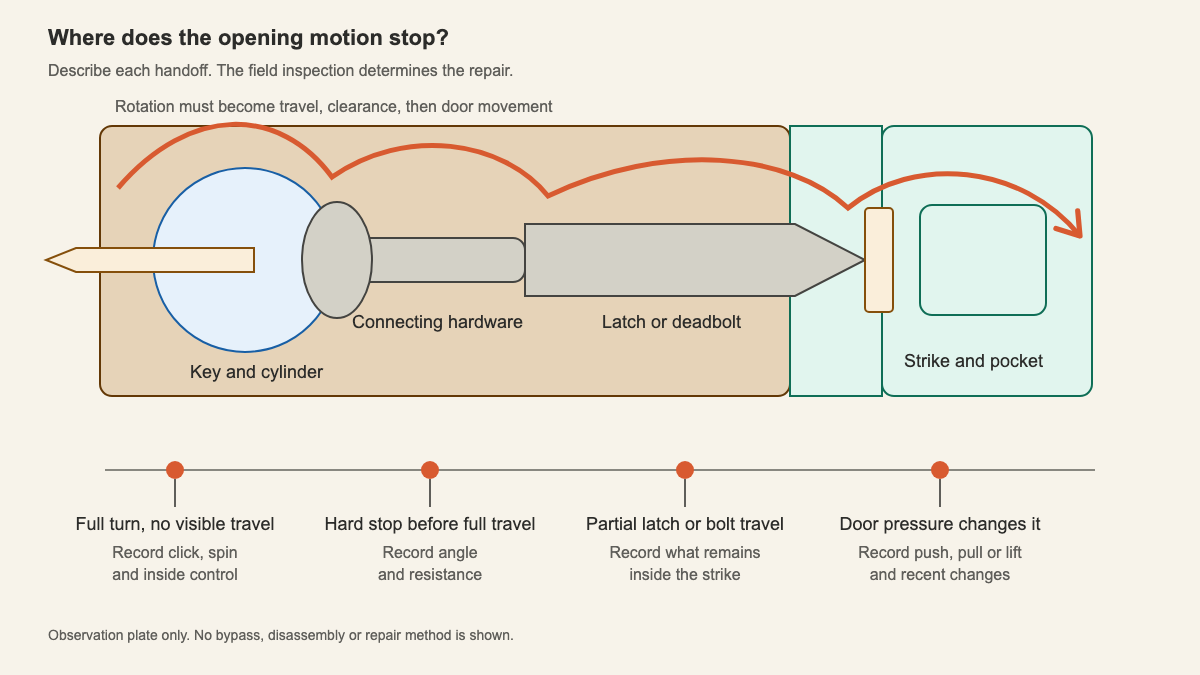
Ask whether any latch or bolt edge is visible from the caller’s safe position. On some openings, a gap or glass panel makes movement visible. On others, nothing can be seen. “Unknown” is a valid answer. Do not coach the caller to insert a card, wire, blade, screwdriver, or other object into the door gap.
Manufacturer support makes a useful distinction between the lock operating with the door open and binding when the door is closed. Kwikset’s latch support guidance notes, for covered products, that success with the door open but failure when closed points to latch and strike alignment. That is evidence for inspection, not permission for reception to prescribe an adjustment.
If the door is already open, ask the caller to leave it in a safe position and stop cycling a failing lock. Do not ask an outside caller to force the door open for a test.
Record pressure, sag, weather, and recent changes
Door load often appears in ordinary language: “I have to pull the door toward me,” “the key turns if I lift the handle,” or “this only happens on humid afternoons.” Capture the phrase exactly.
ALOA’s common lock issue guidance lists weather, poor alignment, lubrication needs, key wear, and lock wear as separate contributors to difficult operation. It also notes that hinges, frames, and weather stripping can affect how the latch meets the strike. Schlage’s door alignment guide describes seasonal movement, thick weather stripping, hinge sag, strike contact, and bolt-pocket clearance as conditions that can interfere with latch or deadbolt travel.
Turn those facts into intake questions:
- Did the problem begin suddenly, or has the caller been pushing, pulling, or lifting the door for days?
- Is the door exposed to rain, direct sun, freezing weather, or recent humidity?
- Was weather stripping, paint, flooring, a closer, hinges, the lock, or the door installed or adjusted recently?
- Did an impact, forced-entry attempt, move-in, or construction job happen before the symptom began?
- Does the same key still operate another authorized lock, and does a spare behave the same way here?
A spare key comparison may clarify whether one key is worn, but reception should not ask the caller to keep forcing copies through a resistant cylinder. Stop if the key bends, the hardware loosens, or resistance increases.
Document prior attempts without judgment
Ask, “What has anyone tried since the door stopped opening?” Write the sequence, not a cleaned-up summary. The caller may have added spray lubricant, pulled hard on the handle, kicked the lower panel, removed screws, tried another key, used pliers, or asked a maintenance worker to work on the lock.
Prior attempts change the condition on arrival. Loose trim, a bent key, an unknown lubricant, or impact damage may affect the service plan. If the caller reports drilling, broken hardware, signs of forced entry, or a door that no longer secures, route the call under the shop’s damage and security policy.
A lodged key fragment is a separate problem and needs its own extraction intake when part of the blade remains in the keyway. Do not merge “the key turns” with “the key broke” in one vague ticket.
Confirm the opening and authority to order work
Record the service address, affected opening, caller’s location, callback number, relationship to the property, and who will meet the locksmith. Follow the company’s authorization and identification policy. The office can explain what is required. The authorized staff member decides whether the documents and site contact satisfy it.
Managed properties need more names. Capture the tenant or unit, property manager, building engineer, after-hours contact, billing contact, alarm procedure, loading or parking instructions, and the person who may approve work beyond the initial visit. Note any master-key, restricted-key, fire-door, storefront, or access-control context.
Do not place door codes, alarm codes, or sensitive credential details in an unapproved text thread. Use the business’s secure record system.
Book inspection, not a guessed part
The honest appointment scope is usually “inspect and restore authorized operation,” followed by the company’s defined service boundaries. Adjustment, latch or bolt repair, cylinder service, trim repair, door work, and replacement hardware may be separate items. If the caller also wants old keys disabled, attach the rekey and lock-change quote guide. The dispatcher can explain the visit charge and estimate process without claiming which repair the door needs.
The FTC’s contractor guidance recommends checking credentials and getting an estimate that identifies the work, materials, timing, and price. Apply that clarity here. State what the initial amount covers, what remains subject to inspection, and who must approve added work.
Read the ticket back in concrete terms: “Tenant is inside and can use the rear entrance. The front deadbolt key turns about a quarter turn and stops. The inside thumbturn stops at the same point. Pulling the door inward changes the resistance, but the bolt position is not visible. The problem became worse after new weather stripping was installed. No drilling or hardware removal. Property manager will meet the technician and approve additional work.”
An AI receptionist can collect the same fields after hours and route the call under the locksmith’s access, urgency, and authorization rules. It should not teach entry methods, approve access, or diagnose a failed component.
The call is ready for dispatch when the technician knows who has access, what motion starts, where observation ends, how the door load changes the symptom, and who can approve the work.