A caller is standing in a self-storage corridor beside unit C-318. The key is gone, the office closed twenty minutes ago, and the caller wants a locksmith there now. That sounds like a routine lockout until dispatch asks one question: “Has the facility approved an outside locksmith to work on the unit?”
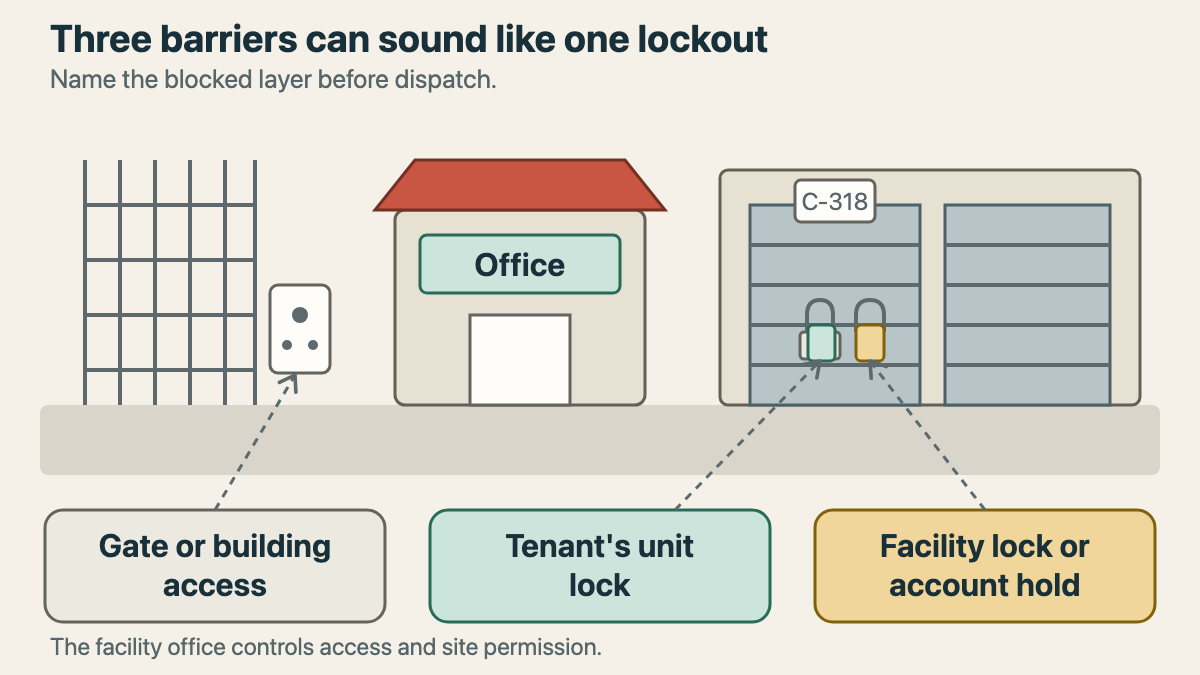
That question comes first. A storage unit sits inside property controlled by another business, and the caller may be blocked by the entrance gate, their own lock, or a facility lock tied to an account issue. A good storage unit lockout intake identifies the barrier, contacts the facility, verifies the caller’s authority under shop policy and local law, and then describes the lock and site conditions. If any link is missing, hold the dispatch.
Identify the barrier before quoting the job
Callers often use “locked out” for three different problems. The first is facility access. Their gate code fails, the app will not open a building door, or access hours have ended. A locksmith cannot fix an account credential or extend a facility’s hours. Route that caller to facility management.
The second problem is a tenant-controlled lock that will not open. The key may be missing, the combination forgotten, or the lock damaged. This can become a locksmith service call, but only after the facility permits the work and the shop confirms the requester’s authority.
The third is a facility overlock or another management restriction. The caller may see a second lock they did not install, or staff may have disabled gate access. Do not treat this as an ordinary lost-key call. Management must explain and resolve the restriction. A technician should never be sent to remove a lock that belongs to the facility.
Ask the caller to describe what stops them:
- Can they enter the property and reach the correct unit?
- Is there one lock or more than one on the unit?
- Which lock belongs to the renter, and which was placed by the facility?
- Does the renter’s key enter, turn, or fail to move the lock at all?
- Is the door itself jammed after the lock has been opened?
- Has the office said that outside locksmith work is allowed?
Keep those as observations. “The brass padlock accepts the key but will not turn” belongs in the ticket. “The cylinder is broken” is an unconfirmed diagnosis.
Get facility approval before dispatch
Large operators make facility contact the first step. Public Storage tells renters with lost keys to contact the company and schedule a lock cut. Extra Space Storage directs a renter with a lost key, forgotten combination, or damaged lock to the facility manager, who can verify identity and help with lock replacement or another solution.
Those pages do not create one policy for every operator or location. They do establish a sound intake rule: call the site before sending a locksmith.
Get the facility name, street address, unit number, building or floor, and the manager’s contact information. Ask the renter to contact the office while it is staffed. The manager may handle removal internally, use an approved vendor, require a written lock-cut authorization, insist that staff be present, or decline outside locksmith work entirely.
Record the answer with a name and time. “Caller says management is fine with it” is weak. “Dana at the facility office approved Northside Lock to inspect renter lock on unit C-318 during office hours and will meet the technician” gives dispatch something it can confirm.
Access hours and office hours are separate facts. A renter may enter the property late in the evening even though nobody is available to verify the unit or supervise work. Ask when the gate operates, when staff will be present, and whether the technician needs a vendor code, parking instructions, proof of insurance, or a check-in at the office.
Verify authority without declaring it verified
The call taker collects facts. The locksmith or an authorized reviewer decides whether those facts satisfy company policy and the law where the service occurs.
Rules differ by jurisdiction. Texas Occupations Code Section 1702.2865, for example, requires a customer seeking entry to property to show government-issued identification and provide signed authorization stating that the customer owns or is otherwise entitled to legal access, subject to a narrow imminent-threat exception. North Carolina’s locksmith law requires a licensed locksmith opening locked residential or commercial property to make a reasonable effort to verify that the customer owns it or has authorization from the owner.
Those examples support a conservative workflow, not a nationwide legal script. Build the exact policy with counsel or the appropriate regulator for each service area.
During intake, capture the caller’s full name, mobile number, relationship to the rental agreement, and who will meet the technician. Ask what identification and rental documentation will be available. If the named renter is deceased, incapacitated, absent, or a business, pause for human review. An executor, employee, family member, mover, or friend may have a legitimate reason to request access, but their authority needs more than a unit number and a plausible story.
Do not place ID numbers, gate codes, lock combinations, or account credentials in open notes. Use the company’s approved secure process. A photo of an ID or lease can support review, but reception should not tell the caller that authority has been verified unless the designated person has actually completed that check.
Describe the lock and the working area
Once permission and authority are on track, prepare the technician. Ask the caller for a wide photo of the complete unit door and a closer photo of the renter’s lock, taken without touching or removing anything. Get a photo of any second lock too. That helps the office distinguish the customer’s hardware from a facility device.
Record whether the lock is a conventional padlock, disc-shaped lock, built-in cylinder, combination lock, or electronic unit lock. If the caller does not know the name, accept a description and photos. Do not coach them through cutting, drilling, shimming, picking, or bypass. The article’s purpose is safe dispatch, not an opening lesson.
The door matters as much as the lock. Ask whether it is a roll-up door, swing door, or small locker door. Note a bent latch, shifted hasp, collision damage, corrosion, a door under pressure from stored contents, or a lock that opens while the door stays stuck. A door or latch repair may fall outside the locksmith’s scope or require facility maintenance.
Confirm the workspace. Indoor corridors may have limited outlets and tight clearance. Outdoor rows may have vehicle restrictions. The facility may prohibit sparks, noise, certain tools, or work outside staffed hours. Dispatch needs those rules before the truck arrives.
Route the call through two approvals
A storage unit lockout needs approval from the property side and the locksmith side. Facility management decides whether work may occur on its property and unit door. The locksmith company decides whether the request satisfies its authorization and safety policy.
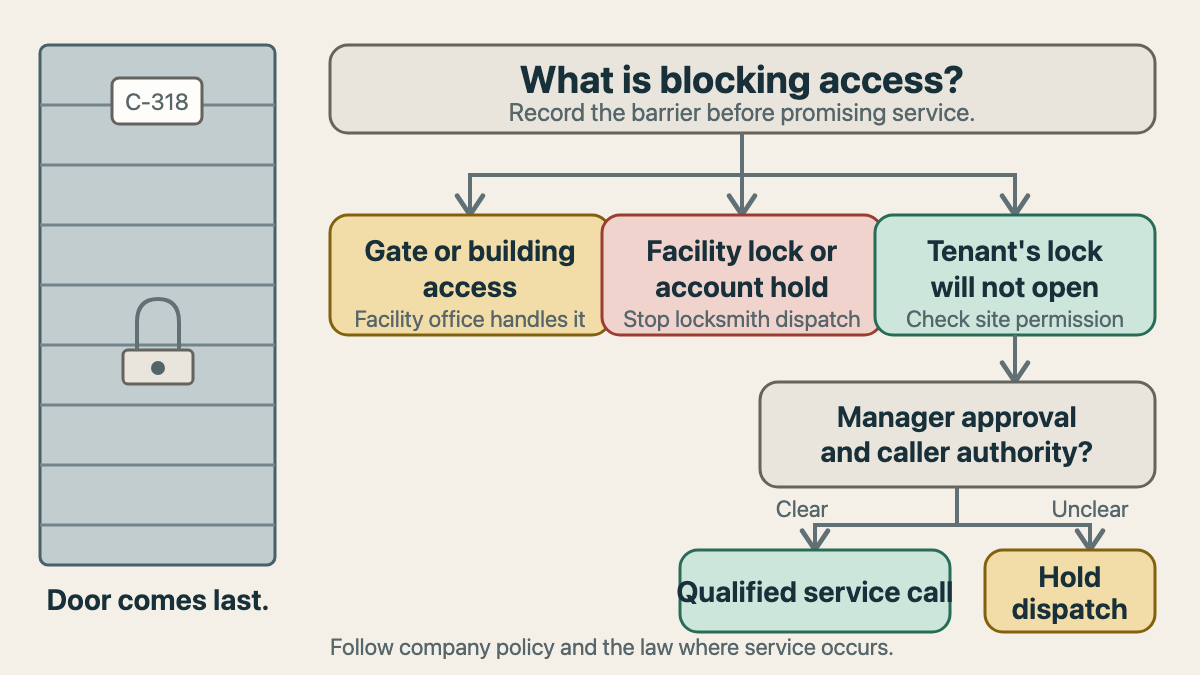
This is why an after-hours promise causes trouble. The dispatcher may quote an arrival time, only for the technician to learn that the office is closed, outside vendors are prohibited, the caller is not named on the agreement, or a facility overlock is the actual barrier. The trip was avoidable.
Use a conditional booking statement: “We can schedule the service after the facility confirms that an outside locksmith may work on your unit and our technician can verify your authorization. I’ll record the unit, lock, site contact, and access window now.”
Then explain pricing according to the shop’s real policy. State the service-call or diagnostic charge, after-hours terms, and whether replacement hardware is separate. Avoid promising that the lock can be preserved, that a particular method will work, or that the door will open during one visit. The technician still has to inspect the lock, latch, door, authorization, and site rules.
Build a ticket that survives the handoff
Before ending the call, read the record back in plain language:
“Jordan Lee is the named renter for unit C-318 at Harbor Self Storage. Jordan can enter the gate and reach the unit. One renter-owned disc-shaped lock will not accept the usual key. No second lock or facility notice was reported. Dana at the facility office must approve outside work and meet the technician between 10 a.m. and 4 p.m. Jordan will bring identification and the rental agreement. Photos of the door and lock are attached. Authorization still requires technician verification before work begins.”
That note separates facts, permissions, and unresolved checks. It also gives the field technician a clean reason to stop if the site does not match the call.
For general property rekey requests, use the rekey and lock-change intake guide. A safe or vault request has a different proof and equipment path, covered in the safe lockout service call guide. The locksmith resource hub collects the broader call-handling library.
An AI receptionist can collect the site, unit, caller relationship, facility contact, lock description, and access window after hours. It should place uncertain authority, a facility lock, a disputed account, or an unconfirmed manager approval into human review. When the office opens, the next action should already be obvious: confirm permission, complete verification, then dispatch.
Sources
- Public Storage: Help with Lost Keys
- Extra Space Storage: How to Open a Storage Locker
- Texas Occupations Code Section 1702.2865
- North Carolina Locksmith Licensing Act