“The code worked yesterday, but the safe will not open now.” Before anyone asks for another attempt, establish two things: who has authority over the safe, and what the lock did during the last attempt. A good ticket preserves that state. It does not contain a theory about how to defeat the lock.
A safe lockout service call should capture the service address, caller’s relationship to the container, manufacturer and model if known, lock type, lights or sounds, handle or dial behavior, prior attempts, and access conditions. Then route the job to a technician who services that safe category. Safe and vault work is its own specialty, so a locksmith who handles house lockouts may not take every safe job.
Confirm authority before discussing access
Start with the caller and the container. Ask for the caller’s name, callback number, service address, current location, and relationship to the safe. Is this a homeowner, business owner, property manager, employee, executor, bank representative, or another party acting for the owner?
Follow the company’s written authorization policy. Reception can explain which documents must be available, but should not decide that a story sounds convincing enough. Red Key’s safe lockout overview states that proof of ownership is required before work begins. Your shop may require identification plus a purchase record, property document, business authorization, estate document, or written approval from the person who controls the safe.
Some calls involve a deceased owner, a terminated employee, a landlord and tenant dispute, or a business partnership conflict. Record the facts and escalate them. Do not discuss opening options until the authorized person and required records are clear.
Ask what is believed to be inside only when company policy needs that information for safety or routing. A gun safe, pharmacy safe, commercial deposit safe, jewelry safe, and small document safe create different handling concerns. Do not ask the caller to send an inventory of valuables through an ordinary text thread.
Identify the safe and its lock
“Black safe with a keypad” is rarely enough. Ask for the manufacturer, model, and serial number if the caller can read them without moving the container, removing trim, or exposing private codes. SentrySafe’s lost key and combination support uses product-specific recovery paths, which is a useful reminder that safe support depends on the actual model.
Request photographs through the shop’s approved channel:
- One full view showing the entire safe and surrounding space
- One close view of the keypad, dial, keyway, handle, and visible indicators
- One view of any manufacturer or model label that is already accessible
- One view showing the hinges and door edge
- One room view showing stairs, narrow doors, shelving, counters, or other access limits
Tell the caller to cover combinations, access codes, keys, and documents visible in the frame. Never ask someone to tip, drag, or unbolt a heavy safe to find a label. A photo that confirms the lock interface is useful. A strained back is not.
Record the container category in plain language. Is it a portable fire chest, home safe, gun safe, floor safe, wall safe, commercial deposit unit, vault door, or unknown container? Is it bolted down? Is the door closed, partly open, or jammed? Has there been a fire, flood, burglary attempt, impact, move, or recent lock replacement?
Preserve the symptom before another attempt
The phrase “won’t open” hides several different states. Ask the caller to describe the last attempt from start to finish without trying it again.
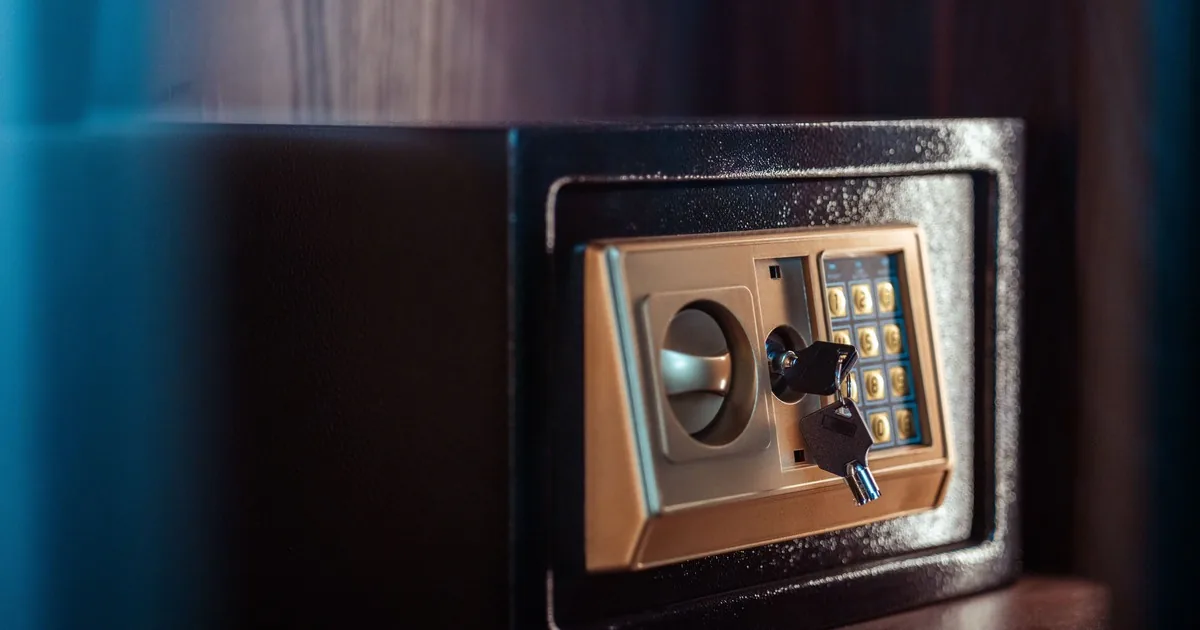
For an electronic lock, capture whether the keypad wakes, whether each key gives a response, what color appears, the beep pattern, any message, and whether the handle changes after an accepted code. For a mechanical dial, ask whether the dial turns normally, stops in a new place, feels loose, or binds. For a keyed safe, record whether the key enters fully, turns, sticks, or has broken. For any safe, ask whether the handle moves and whether the door or boltwork makes a sound.
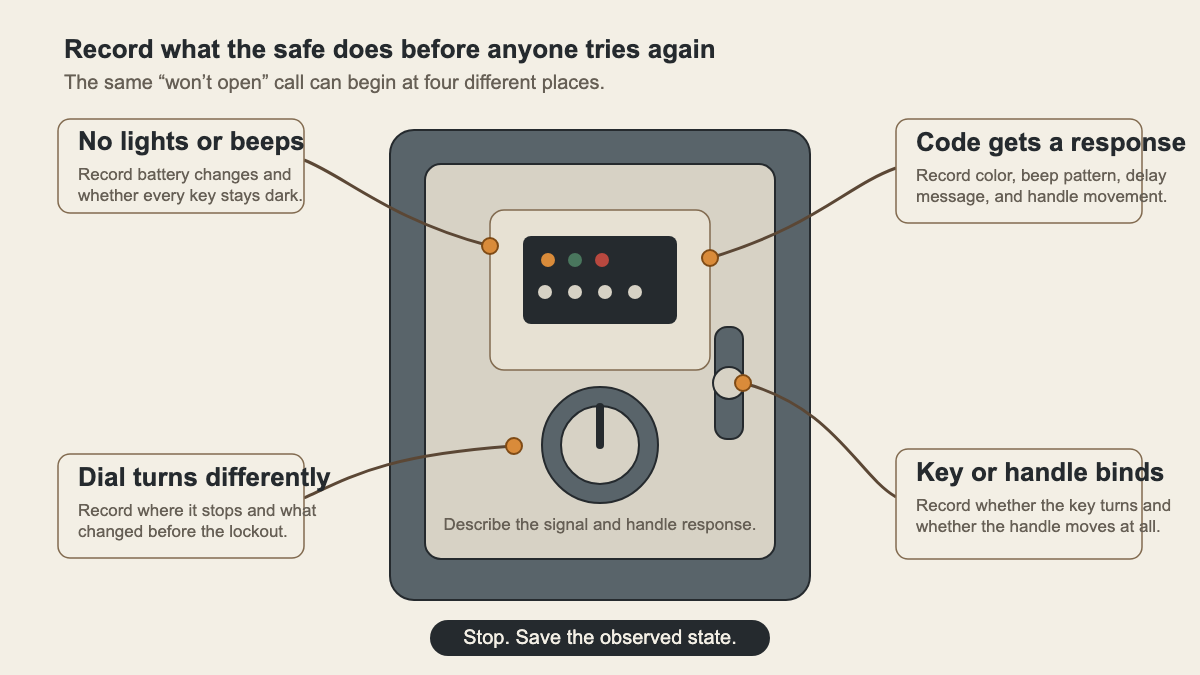
Write observations, not labels. “Red light flashes after the code, then the keypad stays dark for a while” is better than “bad keypad.” “Dial stops near the same point on each turn” is better than “broken combination.” The technician can interpret the pattern against the correct lock and manual.
Some electronic locks impose a delay after repeated invalid entries. The delay rules vary by model. A Master Lock electronic safe instruction sheet documents a two-minute delay after three consecutive invalid codes for the covered models. That figure belongs to those models, not every safe. US Safe & Vault also warns that repeated attempts can trigger delay on some electronic locks. If the lock starts delaying attempts, stop and report the exact signal.
Record what happened before the lockout
Ask when the safe last opened normally and what changed afterward. The caller might have changed batteries, moved the safe, shut the door while testing a new code, lost a key, inherited the container, returned after a long vacancy, or noticed trouble after a fire or attempted break-in.
Capture every attempt already made. Did anyone enter multiple codes, replace batteries, use an override key, pull hard on the handle, strike the door, spray a product into the lock, remove the keypad, disconnect wires, or hire another technician? Reception should not shame the caller. The goal is to preserve the current condition and prevent another round of improvised work.
Ask whether a valid code appears to receive a different signal than an invalid code. Ask whether fresh batteries were installed and, if so, the battery type, orientation, and whether all cells were replaced together. Do not offer a generic battery procedure across brands. The correct compartment, battery chemistry, and reset behavior come from the model’s manual.
If the container has been exposed to fire, water, forced entry, or structural damage, route the call under the shop’s damaged-safe policy. The appointment may require different tools, site precautions, or manufacturer guidance.
Match the job to the technician
The Safe & Vault Technicians Association maintains a safe technician search, reflecting the specialist nature of this work. An office should know which technicians handle electronic safe locks, mechanical combinations, high-security units, vault doors, commercial deposit equipment, fire-damaged containers, and post-opening repair.
Check the company’s service boundary before promising a dispatch. Does the shop work on that manufacturer and safe category? Does it have a technician available for the lock type? Can the technician enter the property at the requested time? Is a second person, building escort, loading access, or parking clearance needed?
For a commercial site, capture the business name, on-site contact, building hours, alarm or security check-in procedure, loading restrictions, floor, elevator access, and person allowed to approve additional work. For a residence, note stairs, finished floors, narrow hallways, pets, and whether the safe sits inside a closet or built-in cabinet.
Keep a safe call separate from a door lockout. A caller locked outside a building belongs in the emergency lockout workflow. A key that turns while a building door stays shut belongs in the key-turns service intake. This ticket is for a security container whose authorized user cannot gain normal access.
Set a bounded appointment
Do not promise that the safe will open without damage. Do not quote a fixed opening method from a photograph. The condition may involve the combination, keypad, lock body, handle, boltwork, door pressure, prior damage, or more than one problem. US Safe & Vault’s service guidance begins by distinguishing those conditions and asks for the manufacturer or model plus what happened before the lockout.
Explain what the initial visit covers, the service-call charge, when identification and authority will be checked, and how additional work will be approved. If your pricing depends on an on-site evaluation, say that plainly. Also explain that restoring access and returning the safe to secure service may be separate parts of the job.
Read the ticket back before ending the call: “Business owner is on site with identification and purchase records. Safe is a floor-bolted electronic deposit unit; manufacturer label and model are visible in the photos. Keypad lights on every press. After the last code entry, a red light flashed and the handle did not move. Staff stopped further attempts. No one has removed the keypad or forced the handle. Safe is behind a counter on the ground floor. Owner can approve added work after inspection.”
An AI receptionist can collect these fields after hours and route the call under the locksmith’s authorization and service rules. It should never disclose opening techniques, approve access, or promise a result.
That readback gives the safe technician a verified contact, a recognizable container, an untouched symptom record, and a clear path into the site.