“The handle moves, but the little bolt stays out.” That sentence tells a locksmith office more than “my lock is broken.” It points toward the spring latch at the edge of the door, yet it still leaves several possibilities open. The latch may fail while the door hangs open, or it may move freely until pressure from the strike loads it after the door closes.
A useful call intake starts with the door’s current state, identifies the moving part, and compares operation with the door open and closed. Reception should record what the caller sees and feels. The technician decides whether the problem sits in the trim, latch, installation, hinges, strike, frame, or another part of the opening.
Name the part and the current door state
Ask whether the caller means the beveled spring latch operated by a knob or lever, a separate deadbolt operated by a key or thumbturn, or hardware such as a panic bar or multipoint lock. A photo of the door edge and both sides of the trim can settle that question faster than a brand name.
The distinction matters. Schlage’s mechanical lock overview separates tubular, cylindrical, mortise, interconnected, deadlatch, and deadbolt products. Those families do not use one interchangeable internal arrangement. “Standard lock” is too vague for a parts promise.
Get the door state into the first line of the ticket:
- open and under the caller’s control
- closed but unlocked
- closed and locked
- stuck closed even though the handle moves
- unable to stay closed or secure
Then ask whether the person can use another safe entrance or exit. If somebody is trapped, smoke or a medical emergency is involved, or the failed door is the only practical way out, follow the shop’s emergency policy. Reception should not bury that condition under a routine repair appointment.
Keep neighboring intents separate. A deadbolt that will not enter its strike belongs in the deadbolt service-call intake. A key that turns while the locked door remains shut belongs in the key-turns intake. This guide owns a spring latch that does not withdraw normally when the knob or lever is operated.
Compare the latch with the door open and closed
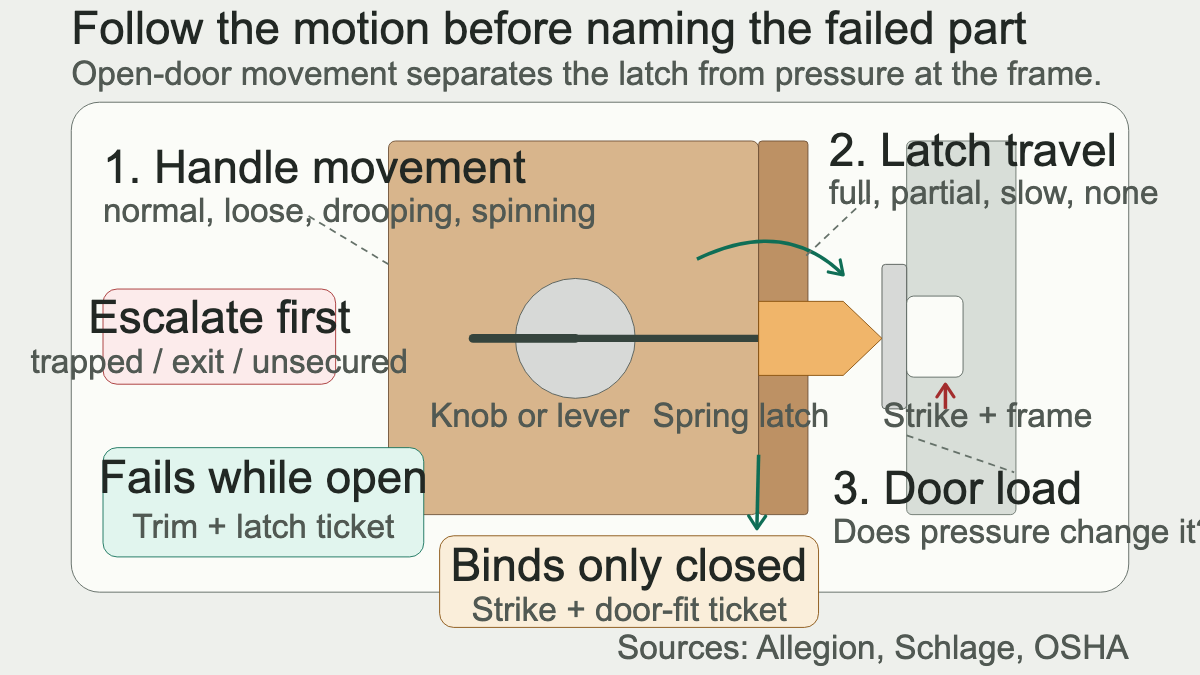
When the door is already open and safe to control, ask the caller to operate the handle once from each side while watching the latch. Keep fingers away from the door edge. The caller should report whether the latch retracts fully, moves only partway, responds slowly, or does not move.
Do not ask someone to close a questionable latch merely to run this comparison. A latch that stays extended could catch and leave the door unable to reopen normally. If the door is already closed, record that condition and leave opening methods to an authorized locksmith.
The open-door result changes the ticket. An industry guide from A Good Locksmith explains that a latch which moves in free air but binds after closing may be loaded against the strike or frame. If the handle turns and the latch still does not retract while the door is open, the lockset, latch, spindle connection, installation, or another internal interface remains in scope.
That is a routing distinction, not a remote diagnosis. Allegion’s latch troubleshooting guidance names strike misalignment, loose hardware, and worn latch or knob-and-lever components as separate categories. Similar complaints can therefore lead to different work after inspection.
Describe the movement without naming a cause
Ask the caller how the handle feels. Does it move through its usual arc, stop early, droop, spin loosely, grind, click, or need to be lifted? Does the symptom occur from the inside, outside, or both sides? When the handle is released, does it return normally?
Now describe the latch itself. “Moves about halfway, then stops” is useful. So is “does not move when either lever is pressed” or “retracts slowly and stays partly inside the door.” Avoid rewriting those observations as “broken spring,” “bad spindle,” or “misaligned strike.” A dispatcher cannot see the hardware engagement inside the door.
If the latch works while open but catches while closed, ask one careful question: without forcing anything, does gentle pushing, pulling, or lifting change the symptom? Record the exact response. A fresh rub mark at the strike, loose trim, a changed door gap, compressed weather strip, or recent impact may help the technician plan the inspection.
Timing adds context. Did the problem begin after a lock installation, rekey, paint work, weather-stripping change, hinge work, door impact, or attempted break-in? Is it constant, or does it appear after rain or during a temperature change? Record prior work too, including screws tightened, lubricant used, parts removed, or repeated force on the handle.
The office should avoid coaching disassembly, strike filing, latch shimming, or forced opening. Those steps can change the scene, damage the door, or disclose a bypass method to an unknown caller. Intake needs evidence, not a repair performance over the phone.
Route egress and security risks first
Ask whether the door currently opens from the inside and whether it is part of a workplace exit route. For U.S. workplaces, OSHA 1910.36(d)(1) says employees must be able to open an exit-route door from the inside without keys, tools, or special knowledge. Reception should flag the observed failure and use the company’s escalation policy. It should not declare code compliance from a phone description.
Also flag a fire label, stairwell location, panic hardware, automatic operator, access-control reader, electric strike, or alarm contact. Those features change who may work on the opening and what must be tested afterward. Do not advise the caller to tape the latch back, wedge a rated door open, block an exit, or install an improvised secondary lock.
Security deserves its own line. Can the exterior door stay closed? Does the latch extend enough to hold? Is the property occupied? Is another approved entrance available? Write what works and what does not. “Door closes but can be pushed open because the latch stays retracted” is better than “building unsecured,” which may overstate or obscure the physical condition.
For an apartment, office, school, clinic, or managed property, record who controls the opening and who may approve work. The person reporting the problem may lack authority to replace hardware or alter a frame. Capture the tenant or employee, site manager, property contact, billing party, and person meeting the technician.
Request photos that show the whole opening
A close photo of a shiny handle rarely explains the call. When it is safe and company policy allows images, request:
- the whole door in its frame from several feet away
- both sides of the knob or lever
- the door edge with the latch visible
- the strike plate and surrounding frame
- hinges, gaps, rub marks, loose trim, cracked wood, labels, and connected hardware
A short video can show the handle and latch moving together while the door is already open. Do not ask the caller to expose a key, access code, alarm credential, or private interior area. Never send somebody through an unsafe route to obtain a better angle.
Record the door and frame material if known. Note whether the opening is interior or exterior, residential or commercial, single or paired, and whether the door has a closer. A mortise lock on a labeled commercial door presents a different service scope than a tubular latch on a bedroom door, even when both callers use the phrase “stuck latch.”
Book inspection, not a promised part swap
Explain the service or diagnostic charge according to written company policy. State what that charge covers, when an estimate will be given, and who must approve added labor or parts. Avoid promising that a latch cartridge, handle, spring, or strike adjustment will solve the problem before the opening is inspected.
A dispatch-ready readback could sound like this: “Blue exterior side door at Sample Street Bakery. The door is open and under staff control. The inside lever moves normally, but the spring latch remains fully extended from either side. The lever returns when released. The problem started after new trim was installed yesterday. No parts have been removed. The opening is marked as an employee exit, and the manager has taken it out of normal use under the site’s safety procedure. Manager Dana Ruiz can authorize inspection and will meet the technician. Wide door, edge, strike, and trim photos are attached.”
An AI receptionist can collect these fields after hours and apply the locksmith’s urgency, authorization, and service-area rules. It should not choose the failed part or teach the caller how to defeat the latch.
The best ticket preserves the physical sequence: hand moves handle, handle drives the latch, latch clears or contacts the strike, and the door opens or stays caught. That gives the technician a real starting point before the truck leaves.