A caller says, “My father died, I am the executor, and I need every lock changed today.” The address is two counties away. A relative may still have keys. The caller has a copy of the will but does not know whether the probate court has issued anything yet.
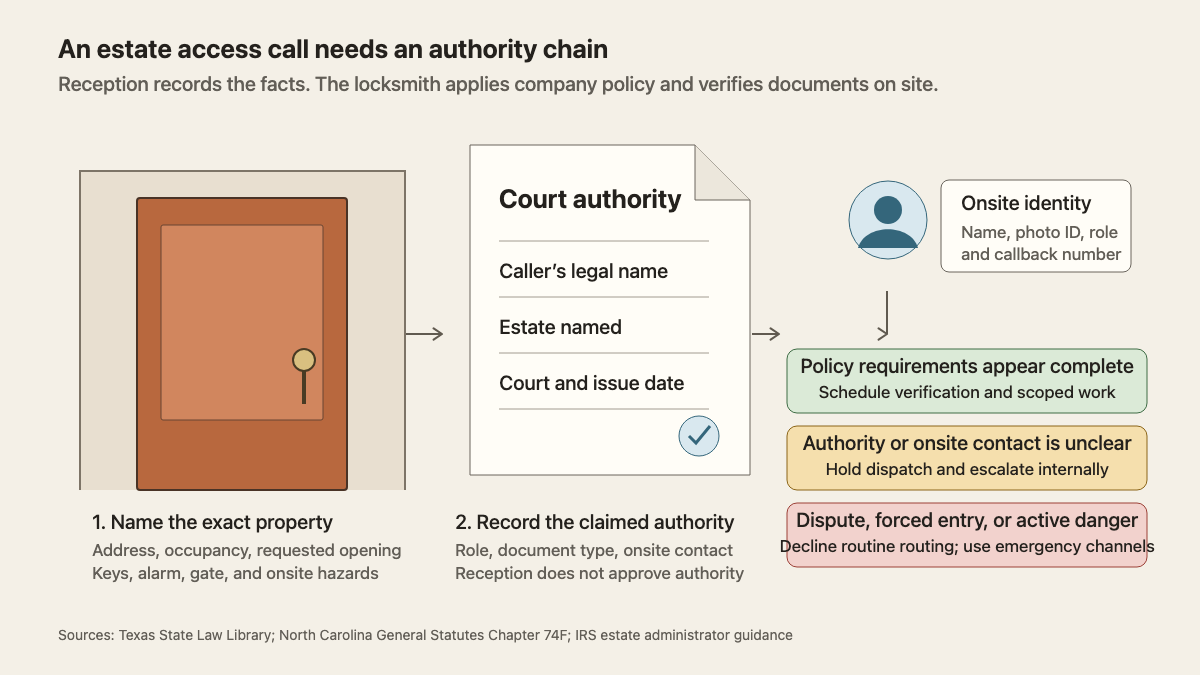
That call should not be booked like an ordinary lost-key lockout. Start with the property and requested work. Then record the caller’s claimed role, the authority document available, who will meet the technician, and any sign of a dispute. The locksmith’s written policy and onsite verification decide whether work proceeds. Reception should never turn a family story into legal approval.
Identify the property before discussing authority
Get the complete service address first. Confirm whether it is a house, condominium, apartment, commercial building, storage unit, or mixed-use property. Ask whether the property is occupied, vacant, listed for sale, managed by an association, or under the control of a property manager.
The exact opening matters too. “Change the locks” could mean one front-door cylinder or a detached garage, mailbox, safe, padlocked shed, gate, and four exterior doors. Those items may involve different ownership records, vendors, access methods, or permissions.
Record what access already exists. Does the caller have a working key? Is a key inside the house? Will another person open the door? Is there an alarm, smart lock, access-control panel, gated drive, or building superintendent? A technician needs this before arrival, especially at a vacant property where an alarm dispatch can turn a careful service call into a scene with police.
Use one plain scope sentence in the ticket: “Caller requests entry through the rear kitchen door and rekeying of three exterior cylinders at an unoccupied single-family house.” That is much more useful than “executor lock change.”
Record the caller’s role without approving it
“Executor” has a specific legal meaning, but callers often use it for any relative handling an estate. Ask what role the caller has been appointed to, using the words on their document. Depending on the jurisdiction and estate, the document may refer to an executor, administrator, personal representative, trustee, or another authorized person.
The distinction between nomination and appointment matters. The Texas State Law Library’s executor guide explains that a person named in a will generally must still apply for court approval. The IRS overview for estate administrators says the probate court appoints the estate’s legal representative and issues letters testamentary or a similar document that authorizes the representative to act.
Reception does not need to interpret those papers. It needs to collect accurate facts for the company’s verification process:
- Caller’s full legal name, callback number, and current location
- Name of the deceased person and the service-property address
- Role printed on the document
- Court and county that issued it, if applicable
- Document name, issue date, and whether the original or a certified copy is available onsite
- Name and role of the person who will meet the technician
- Name of the person authorized to approve charges and sign the work order
Do not promise that one named document will always be accepted. Probate procedure varies by state, and a locksmith may set a stricter internal policy for entry, rekeying, safes, or controlled keys. The right phone answer is specific: “I will record what you have and send it for review under our authorization policy.”
Separate entry, rekeying, and control of new credentials
A request to open one door is different from changing who controls the whole property. Ask which result the caller wants.
For entry, record the locked opening and whether any alternate authorized access exists. For rekeying, record the number and type of exterior openings, any known keying-alike arrangement, and who may still possess old keys. For replacement hardware, note visible brands, door materials, electronic components, and photos that the caller can provide. Leave the final hardware diagnosis to the technician.
Then ask who should receive the new keys, codes, or credentials. An executor may want one set for an estate-sale company, another for a real estate agent, and a sealed set for a co-representative. Reception should not create that custody plan. It should identify the decision-maker and put the approved handoff instructions in the work order.
Safes deserve a separate question. “There is also a safe” should not be buried in a residential rekey ticket. Safe opening can require different proof, equipment, scheduling, and approval. The same applies to mailboxes, leased storage units, vehicles, and access systems controlled by a condominium or commercial manager.
Treat occupants and family conflict as routing facts
Ask whether anyone currently lives at the property and whether every occupant knows that locksmith work has been requested. A caller may have estate authority while an occupant has rights or a court order that reception cannot evaluate. Do not tell the caller that an occupant can be removed, locked out, or denied a key.
Listen for direct signs of conflict: a sibling objecting to the lock change, an estranged spouse at the property, pending litigation, a protective order, threats, police involvement, or someone saying they will arrive first to stop the work. Put those statements in the record using the caller’s words. Escalate under company policy before dispatch.
If there is an active break-in, confrontation, fire, medical emergency, or immediate threat, direct the caller to the appropriate emergency service. A routine locksmith dispatch should wait until the scene is safe and lawful access can be verified. The locksmith call-after-a-break-in guide covers the separate intake needed after police release a property.
Vacant buildings bring physical hazards too. Ask about broken glass, storm damage, water, exposed wiring, animals, blocked drives, unstable steps, and whether utilities are on. Record who can disable the alarm and provide gate or lockbox access. These are field-planning facts, not side notes.
Set the onsite verification expectation
A good booking confirmation tells the caller what will happen at the property. The named contact should bring government-issued photo identification and the documents required by the locksmith’s policy. The technician will review them before opening the building or changing access. If verification fails, the technician may decline the work.
That expectation has legal support in some jurisdictions. North Carolina’s locksmith licensing statute requires a licensee opening a locked residential or commercial door to make a reasonable effort to verify that the customer is the legal owner or is authorized by the legal owner. It is one state’s rule, not a nationwide document checklist, but it shows why “the office said I was the executor” is insufficient.
The work order should also state who must remain onsite, which openings are in scope, and whether photos or a written estimate are needed before changes begin. For a distant executor, confirm whether the onsite person is authorized to approve added work. If they are only there to provide access, say so.
For ordinary lockouts, use the broader emergency lockout intake guide. Estate calls need the extra authority chain because the property owner has died and the person requesting work may not live at the address.
Give dispatch a record it can defend
Before ending the call, read back the address, property status, requested openings, caller role, onsite contact, available authority document, known occupants, dispute status, alarm details, and appointment window. Correct errors while the caller is still on the line.
An AI receptionist can capture those same bounded fields after hours and hold incomplete requests for review. It should follow the locksmith’s policy exactly. No automated script should approve probate authority or promise entry.
The best estate locksmith ticket is deliberately modest. It says who called, what they claim, what document they can present, which property and openings are involved, who will be onsite, and what could stop the job. The legal and security judgment stays with the people responsible for making it.