A regional property manager calls about a turnover rekey at 18 West Pine. The locksmith reaches the address and finds three buildings, two units marked 3B, and nobody onsite. The manager who placed the call cannot approve a damaged deadbolt. The new tenant gets keys at four.
The work order failed before the truck arrived.
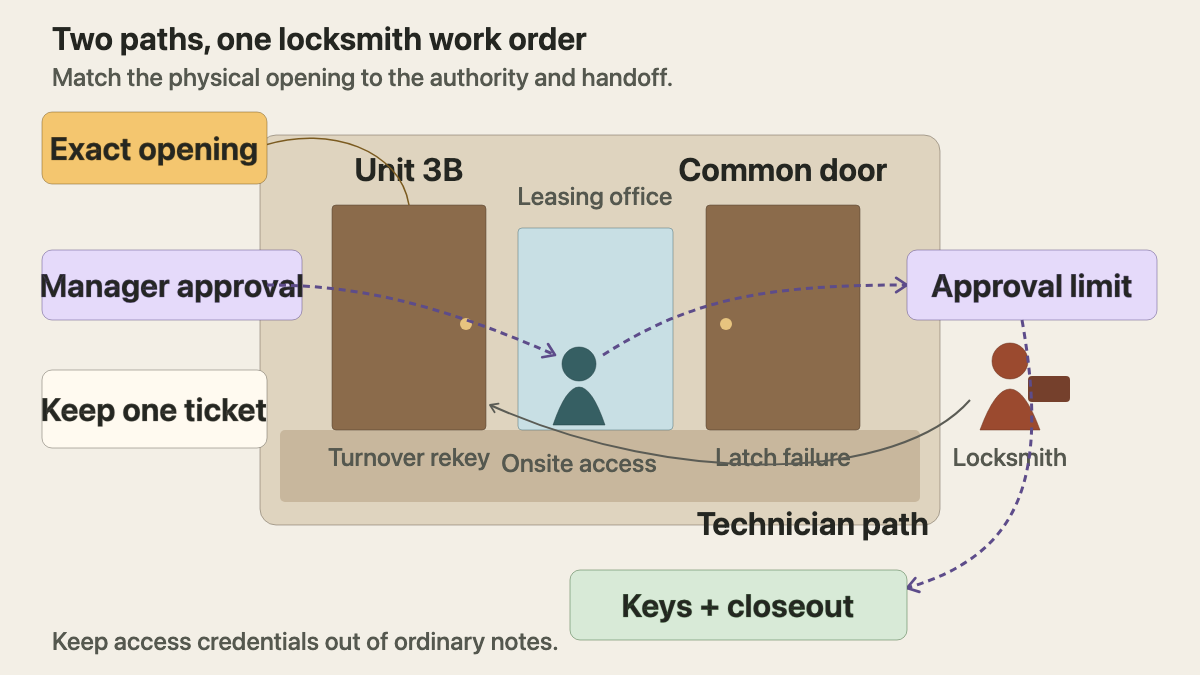
A useful property manager locksmith ticket identifies the exact opening, current condition, service authority, access route, approval boundary, key handoff, and required closeout. Capture those facts in that order. The reporter, approver, onsite contact, occupant, and billing contact may be five different people. The record must name each role because “property manager” does not identify who can make each decision.
Start with the property, then name the opening
A street address gets the technician to a parcel. It may not get them to the lock. Record the property name, street address, building, floor, unit or suite, and a plain-language opening label such as “Unit 3B front entry,” “east pool gate,” or “leasing office rear aluminum door.” Ask which side of the building faces the opening and whether the number is visible.
Then describe the request in observable terms. “Lock broken” might mean a key will not turn, the latch will not catch, a lever hangs loose, a door rubs the frame, a key snapped in the cylinder, or the opening was forced. Ask whether the door is open, closed, secure, occupied, or blocking required access. Record visible damage and request one wide photo plus a close photo when the caller can take them safely.
Do not convert those observations into a repair promise. A technician may find alignment trouble, damaged hardware, a key-control issue, or a door problem outside the original request. The ticket should preserve what the caller sees and what the company agreed to inspect.
For a turnover, ask whether the manager wants existing hardware rekeyed, replacement considered, or a condition assessment first. The rekey and lock-change intake guide covers cylinder counts, keyed-alike goals, compatible hardware, and replacement boundaries. Keep that scope attached to the exact unit opening.
Separate the reporter, occupant, and approver
Ask the caller to state their role and company. Record the property owner or management company, the person requesting service, the person authorized to approve it, the onsite contact, and the billing contact. Use the locksmith’s established verification process. A familiar building name, company email signature, or work-order number may support the record, but reception should not invent an authorization shortcut.
Occupancy needs its own field. Is the unit occupied, vacant, in turnover, used by staff, or part of a scheduled possession process? If occupied, who has been notified and who will meet the technician? If vacant, who confirmed that status and how will entry be provided? The office should never tell a technician to assume an apparently empty unit is available for entry.
Eviction-related work belongs on a separate path. Laws and procedures vary by jurisdiction, and office staff should not decide that a notice, email, or caller’s statement establishes lawful possession. Quick Key’s published property-management process says it waits until the sheriff restores possession to an authorized representative and does not conduct private lockouts. Build your own approved documentation and escalation rules with local counsel and responsible management.
When authority is uncertain, pause the dispatch or limit it to the company’s allowed inspection scope. Write who must resolve the gap. “Waiting on regional manager approval” is useful. “Manager says okay” is not.
Build an access plan that works at the appointment time
Capture the appointment window, onsite name, direct callback number, and meeting point. Ask about gates, parking, loading restrictions, elevators, locked common areas, front-desk hours, resident notice, pets, alarms, and any rule that limits noisy work. If a property uses a lockbox or electronic credential, follow its secure sharing process. Do not place a combination, key code, master-key detail, or reusable access credential in ordinary free-text notes.
The access plan should survive a handoff. “Call maintenance” is too loose. A stronger note says: “Meet maintenance lead Rosa Chen at the north leasing entrance at 1:45 p.m.; she holds the approved access credential and will remain onsite.” If Rosa leaves at two, write that too.
Occupied units need a communication owner. Decide whether the property manager, locksmith office, or onsite team contacts the resident and confirms the window. Do not let each party assume another one handled it. For vacant turnovers, name the person who receives the new keys and the approved handoff location.
Common-area requests need precise timing. A pool gate, mailroom, laundry door, utility room, or retail entrance may serve many users and may have closing, latching, egress, or accessibility considerations. The office can collect the inspection report, opening label, failure description, photos, and deadline. Final code determinations and repair scope stay with the qualified parties responsible for them.
Keep the approval boundary beside the scope
Property managers often use a work-order number, purchase order, or not-to-exceed amount. Record the exact reference and the person who supplied it. Then write what happens when the technician finds work outside the approved scope: stop and call, send photos for written approval, perform only temporary securing allowed by policy, or schedule a quoted return visit.
Avoid a blank “repair as needed” instruction. The Federal Trade Commission’s contractor guidance recommends written estimates that describe the work, materials, completion date, and price. It also advises checking required licenses and insurance and avoiding agreements with blank spaces. A commercial property account may use different documents, but the same operating lesson holds: scope and price terms should be readable before they expand.
Price questions need a bounded answer. Explain the service-call or assessment charge, known approved work, after-hours terms, and the callback rule for additional labor or parts. Do not promise a final total when hardware, door condition, key system, or authorization is unknown.
Urgency also belongs beside approval. An unsecured exterior opening after a break-in may need a different route than a routine turnover next week. For access requests, the emergency lockout intake guide keeps identity, authority, current location, and safe dispatch boundaries in view. A move-in deadline may be important, but it does not erase the authority or access check.
Treat every key as a controlled handoff
Ask whether the opening belongs to a standalone lock, a keyed-alike group, a master-key system, a restricted keyway, an interchangeable-core program, or an electronic access system. The caller may not know. Record that uncertainty and request the property’s authorized key-system contact.
Do not copy bitting lists, master-key charts, restricted-key authorization details, or credential secrets into a general work order. Store sensitive records only in the company’s approved protected system. The service ticket can say that a restricted system exists, identify the authorized contact, and describe the requested result without exposing the data used to produce it.
Allegion’s key-control guidance ties mechanical security to tracking issued keys, missing keys, unauthorized duplication, and returned keys. It also describes master-key access by opening or area. That means a turnover ticket needs more than “make four keys.” Ask how many tenant, management, and maintenance keys are authorized; who receives them; whether old keys must be returned or handled under policy; and who updates the property’s key record.
A request that changes access levels across several doors belongs in a planned commercial master-key consultation. Keep a single-unit turnover from quietly becoming a portfolio redesign at the door.
Define what closes the work order
Before dispatch, ask what the property needs back. Common closeout items include the serviced opening, work completed, parts used, keys produced, key recipient, unresolved conditions, before-and-after photos where appropriate, technician notes, approval record, work-order or PO reference, and an itemized invoice. Choose the fields that match the account and local requirements.
Read the appointment summary back to the caller. A good summary sounds like this: “Turnover rekey at Building C, Unit 3B front entry. Unit reported vacant by Maya Ortiz, regional manager. Rosa Chen meets the technician at the north leasing entrance at 1:45 and receives two tenant keys plus one management key. Work order 4812 authorizes the listed rekey. Call Maya before replacement hardware or work beyond the approved amount. Return completion photos, key recipient, service notes, and the invoice with the unit and work-order number.”
That summary is specific enough to correct. Maybe the unit is 3D. Maybe Rosa cannot receive keys. Fixing either detail while the caller is still on the line is cheaper than discovering it beside the wrong door.
An AI receptionist can collect approved account fields after hours and route authority gaps, occupied-unit questions, unsecured openings, and scope changes to a person. The script should use property-specific contacts and rules. When the locksmith arrives, the ticket should point to one opening, one authorized decision path, and one named key recipient.
Sources
- Quick Key: Property Management Locksmith Services
- Allegion: Understanding Key Control
- Federal Trade Commission: How To Avoid a Home Improvement Scam