A caller says the back door was forced overnight. Police have taken the report, the strike side is split, and the door closes only when somebody leans against it. A ring of keys is missing from the kitchen counter. The caller asks, “Can you change the lock and make the house secure today?”
The office needs to slow that question down. A useful locksmith after break-in service call intake begins with safety and police-scene status, then records the damaged opening, every exposed key or credential, current access, authority to approve work, and the deadline for securing the property. Promise the next step that your shop can support. Leave the final repair decision for inspection.
Clear the safety and evidence gate first
Ask whether everyone is in a safe place and whether the caller believes anyone may still be inside. If there is an immediate threat, the caller needs local emergency services, not a locksmith dispatch script. Reception should never ask someone to enter a property to inspect a lock.
Next, ask whether the burglary has been reported and what police told the caller about the damaged area. Do not decide that the scene is ready for repair. Record the agency, case or incident reference if one was provided, whether an officer or forensic examiner is expected, and the exact instruction the caller received about touching or securing the opening.
Avon and Somerset Police advises burglary victims to avoid touching or moving likely evidence and to wait for a forensic decision before arranging repair or replacement of damaged locks, doors, or windows. Its guidance also recognizes that a forced opening may need to be secured. When that must happen, people carrying out the work should minimize contact and wear hand coverings.
Local procedures differ. The safe office rule is simple: follow the responding agency’s direction and put that direction on the ticket. “Police report filed” does not automatically mean “door released for repair.”
Identify the opening and its current condition
Start with the service address and the exact opening. “Back door” could mean a wood door into a mudroom, a sliding patio panel, a steel service door behind a shop, or one leaf of a paired commercial entrance. Ask what room or area lies behind it and whether there is another controlled way into the property.
Then capture the opening type in plain language. Is it a hinged door, sliding door, storefront door, gate, window, or garage service door? What material does the caller see in the door and frame? If the caller knows the lock type, record it, but do not turn a guess such as “regular deadbolt” into a confirmed hardware description.
Ask what the opening does right now. Does it close fully? Does the latch enter the strike? Can the deadbolt extend without lifting, pushing, or pulling the door? Is there a visible gap? Does the door drag, bow, or sit out of square? Is glass loose or missing? These observations establish urgency without asking the caller to repeat a test that could disturb evidence or worsen the damage.
A wide photo of the whole opening can be more useful than six close-ups of the cylinder. Follow the shop’s approved photo process and police instructions. Request a front view, the frame on the lock side, the hinge side, and any detached parts that can be photographed without moving them. Keep personal documents, alarm codes, key-control records, and visible access codes out of general photo channels.
Map damage across the whole assembly
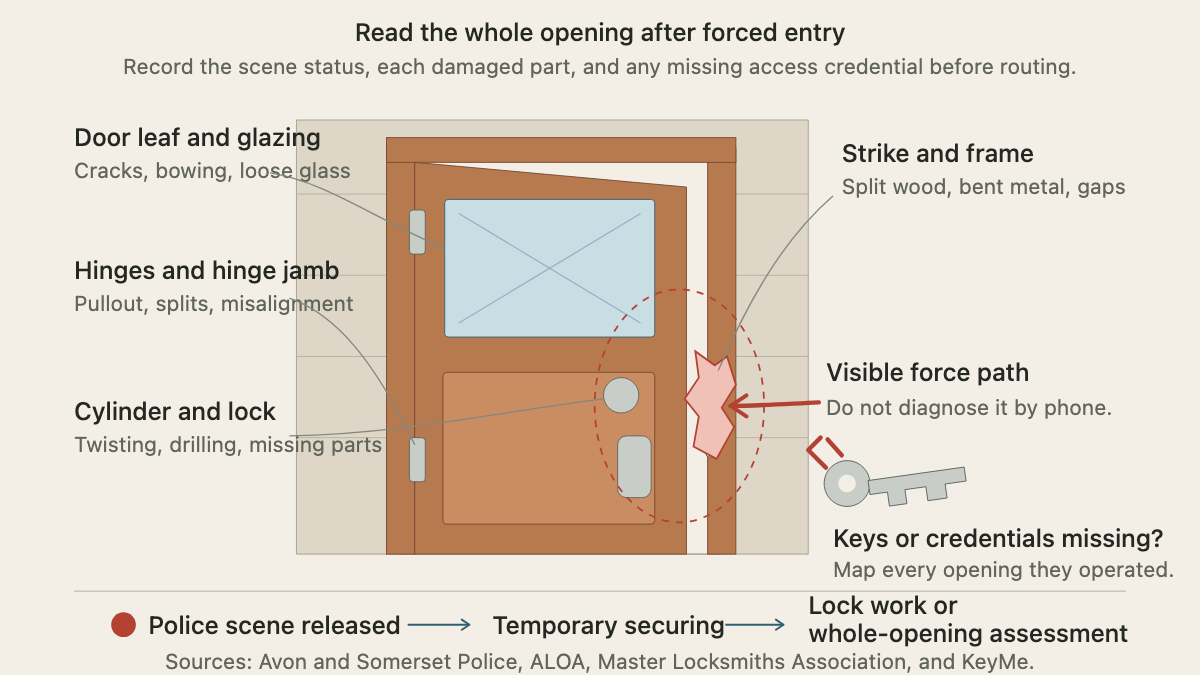
A forced entry can damage several parts that happen to meet at the lock. Treat each as its own intake field.
- Cylinder and lock: Note visible twisting, drilling, missing trim, a displaced cylinder, a bent bolt, or loose hardware.
- Strike and jamb: Record split wood, bent metal, torn fasteners, a widened gap, or a strike that has pulled away.
- Door leaf and glazing: Capture cracks, delamination, crushed edges, broken panels, loose glass, or damage around the lock preparation.
- Hinges and hinge jamb: Ask about pulled screws, bent hinges, splits, or a door that dropped after the incident.
- Surrounding opening: Note sidelights, transoms, adjacent windows, paired doors, thresholds, and alarm contacts that may be affected.
The Master Locksmiths Association warns that a commercial break-in may compromise the leaf, frame, hinges, and locking points. Its point applies to intake beyond commercial sites: replacing a cylinder cannot repair a split frame or a door that no longer holds its shape.
ALOA also describes professional locksmith work as extending beyond keys and locks to doors, frames, electronic access, and life-safety considerations. That does not mean every locksmith performs carpentry, glazing, storefront work, or temporary boarding. It means reception should identify the whole problem before choosing the trade and service route.
Treat missing keys as a separate incident branch
Ask whether any house keys, business keys, master keys, mailbox keys, vehicle keys, fobs, cards, remotes, or written codes are missing. A forced rear door and a stolen front-door key create two different exposures. Repairing the rear opening does not retire the missing key.
For each missing credential, ask what it operated and whether it carried a label, address, company name, unit number, or vehicle information. Record whether spare keys still exist. For a business, ask whether the key belonged to a master-key system and who manages the key records. Keep key codes, bitting records, and alarm credentials out of free-form notes unless the shop’s secure process explicitly allows them.
If the caller wants locks changed throughout the property, connect the ticket to the shop’s rekey and lock-change intake. Count the openings, identify special hardware, and separate the emergency opening from the wider access-control scope. A whole-property rekey may be sensible under shop policy, but reception should not declare it sufficient before the locksmith reviews the damage and key system.
Codes and electronic credentials need the same discipline. Ask which locks, gates, alarm panels, garage doors, or access systems used the missing device. Do not collect active codes on an ordinary call. Route the issue through the approved reset or credential-revocation process.
Confirm who can authorize the work
A shaken caller may be a homeowner, tenant, property manager, employee, neighbor, family member, insurer representative, or restoration contractor. Their presence at the property does not establish authority to approve changes.
Capture the caller’s name, callback number, relationship to the property, and current location. Ask who owns or manages the opening and who can approve emergency securing, lock replacement, rekeying, door repair, or a return visit. Identify the onsite contact separately. For a rental or managed site, record the property manager or landlord process. For a business, ask which person can approve work and who controls after-hours access.
The ticket should also state whether the property is occupied tonight, vacant, open to staff or customers, or subject to building access rules. A damaged rear service door at a restaurant has different operating constraints than a bedroom window at a house. Commercial exits may raise life-safety questions that the qualified professional must evaluate onsite.
Avoid insurance promises. Ask whether the caller has contacted the insurer and whether the insurer gave instructions about documentation, estimates, or preferred vendors. Record the claim contact or reference if the customer wants it attached. Say what your company can document. Do not say that a carrier will pay for a particular lock, door, temporary barrier, or upgrade.
Choose a route the shop can actually deliver
Once the scene status, opening, damage, credentials, authority, access, and timing are clear, choose the next action under company policy. That may be emergency temporary securing, locksmith inspection, lock or cylinder work, rekeying, a measured return visit, or coordination with a door, frame, glass, garage-door, or storefront specialist.
Temporary security and permanent repair are often separate appointments. The first visit may restore controlled closure for the night while the permanent door leaf, frame section, multipoint mechanism, glass, or commercial hardware is sourced. Explain the boundary before dispatch. “The first visit is to inspect the opening and secure it if our technician can do so safely with the materials carried” is more accurate than promising a completed repair from one phone description.
Some calls belong partly in another workflow. A caller who cannot enter through an undamaged door may also need the emergency lockout intake. A split frame, damaged slab, water exposure, or weather problem may need the wider exterior door repair intake. Keep the forced-entry record attached so the second route does not erase the police and evidence constraints.
Before closing the call, read back the facts that affect dispatch: police direction, exact opening, what closes and latches, visible damage, missing credentials, current occupancy, alternate access, authorized decision-maker, photos received, and the promise made. Mark unknowns as unknowns.
The handoff should sound like a real place: “Rear wood entry door at the kitchen. Police released the opening for repair. Strike jamb is visibly split, deadbolt trim is loose, and the door will not latch. Front-door key may be missing. Homeowner is onsite and can approve temporary securing. Wide and close photos are attached.” That gives the locksmith a usable first picture without pretending the inspection has already happened.