“The key turns, but the store still will not lock.” That could describe a cylinder problem, a bolt that never reaches the frame, a door sitting out of position, an inside paddle that does not release, or an electric strike holding when it should not. A parts promise made during that first sentence is likely to be wrong.
A useful storefront lock repair intake starts with the exact opening and its current secure status. Then record the door configuration, what the key or inside control does, which piece moves, where movement stops, what meets the frame, and which other systems touch the door. The technician should diagnose the opening and confirm parts on site.
Find out whether the business can secure the door
Ask whether the storefront is open, occupied, or trying to close for the day. Can the door close fully? Does the lock secure from either side? Is anyone locked inside or outside? Has glass, the frame, or the lock area been struck, pried, or bent?
A shop that cannot secure its primary entrance needs different routing than a shop with a sticky key and a working secondary lock. Record the exact condition without suggesting a workaround that could trap occupants or interfere with required exit hardware. If there is fresh forced-entry damage, tell the caller to follow the company’s emergency and law-enforcement policy before touching the opening.
Ask about a safe alternate entrance for the technician. A failed front door may be the only customer entrance, but the building could have a rear service door controlled by a landlord or alarm company. Record who can admit the technician and who has authority to approve work.
Do not tell the caller to remove a cylinder, force a paddle, tape a latch back, or dismantle the narrow aluminum stile. Those steps can damage hardware and erase useful evidence about how the parts behave together.
Identify one opening before naming the lock
“Front door” is too vague when the storefront has two glass leaves, a vestibule, and a side delivery entrance. Give each opening a plain label: street-side left leaf, street-side right leaf, interior vestibule door, or rear aluminum service door.
Record whether it is a single door or a pair. Ask which leaf normally opens and whether the other leaf has flush bolts at the top or bottom. From the secure exterior side, does the active door swing in or out? The Schlage handing guide uses the outside or corridor side as the reference for handing. Reception does not need to assign a handing code. A clear swing observation and photo are safer.
Ask what the door and frame appear to be made of. Many retail openings use narrow aluminum stiles around large glass panels, but a storefront can also have hollow-metal, wood, frameless glass, or mixed hardware. Record what is visible. Avoid assuming that every glass entrance uses the same lock body.
Request three broad photos when policy allows: the full door from outside, the full door from inside, and the door edge facing the frame while the door is open. Add close views of the cylinder or trim, latch or bolt, and strike. Photos should avoid keys, alarm codes, access credentials, faces, payment screens, and sensitive interior areas.
Ask what each control actually does
Work through the controls one at a time. When the authorized caller uses the key from outside, does it enter fully, turn normally, turn only partway, spin, bind, or come out with difficulty? Does anything visible move at the door edge? Does the same problem occur with a second working key?
From inside, identify the control without forcing it. It may be a thumbturn, lever, paddle, push bar, knob, or electronic release. Ask whether it moves and returns normally. A storefront deadlatch can be operated by a key, handle, or paddle, depending on the configuration. Adams Rite’s 4510 deadlatch documentation also separates the lock body from the cylinder, handle, paddle, and strike. That is why “the lock is broken” does not name a part.
Then ask about timing. Did the failure appear suddenly after a delivery, attempted break-in, key change, power outage, or door impact? Has it worsened over weeks? Does it happen only when the door is pulled tight, only after the closer shuts it, or only in hot, cold, or windy conditions? These are field clues, not a diagnosis.
If the key works while the door is open but not when the door is closed, record that exact contrast. If the inside paddle retracts the latch but the outside key does not, record both observations. A ticket with paired observations is far more useful than “lock bad.”
Map the symptom across four hardware interfaces
A narrow-stile storefront opening often hides the lock body inside a slim aluminum rail. The caller may see only the cylinder or trim on the face, the latch or bolt at the edge, and the strike in the frame. Treat those as separate interfaces.
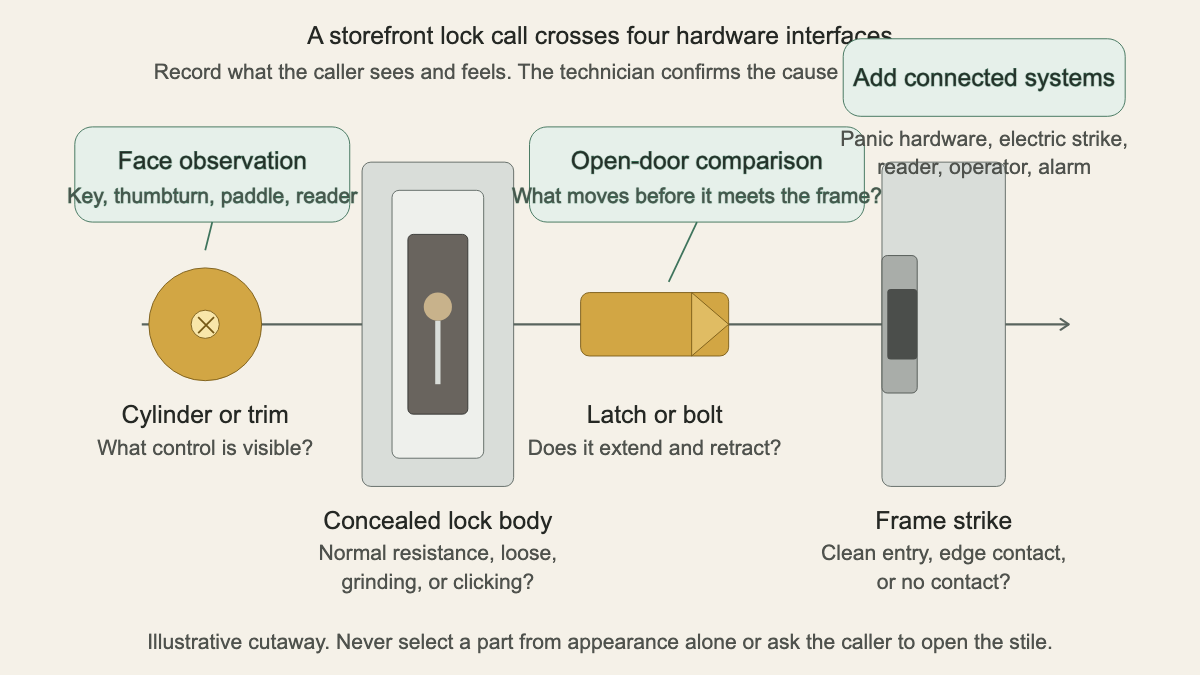
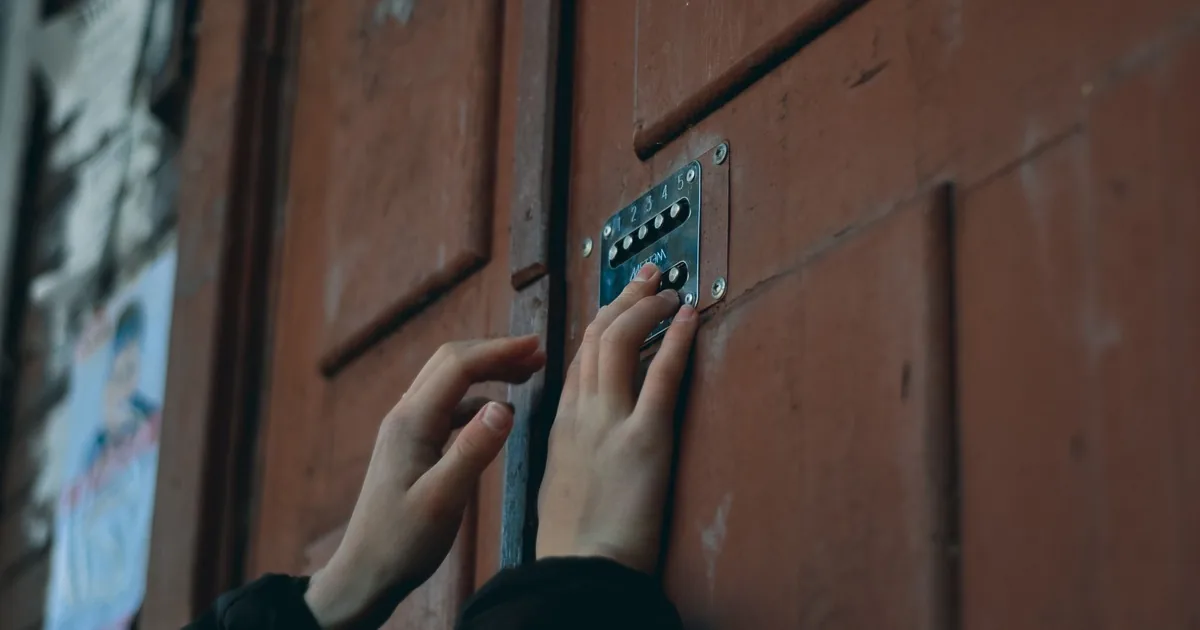
At the face, record the visible control. Is there a round mortise cylinder, a thumbturn, paddle, lever, keypad, card reader, or blank plate? Capture the brand or model marking only if it is easy to read without removal.
At the concealed body, reception usually cannot see much. Ask whether the control meets normal resistance and whether any grinding, loose movement, or repeated clicking is reported. Never ask the caller to open the stile so the office can identify the case.
At the door edge, ask whether a spring latch, straight bolt, hook-shaped bolt, or another piece is visible. Does it extend and retract with the door open? Do not tell the caller to hold back or manipulate the part. Adams Rite describes deadlocks for narrow-stile aluminum and glass doors, while its deadlatch uses a spring-loaded latchbolt. Those are different functions even when the face of the door looks similar.
At the frame, record whether the moving part lines up with the strike opening. Does it hit above, below, or against the lip? Are screws missing, the strike visibly loose, or the frame damaged? The office should report the contact point. The technician decides whether the cause is the lock, strike, door position, hinge or pivot, closer, frame, or a combination.
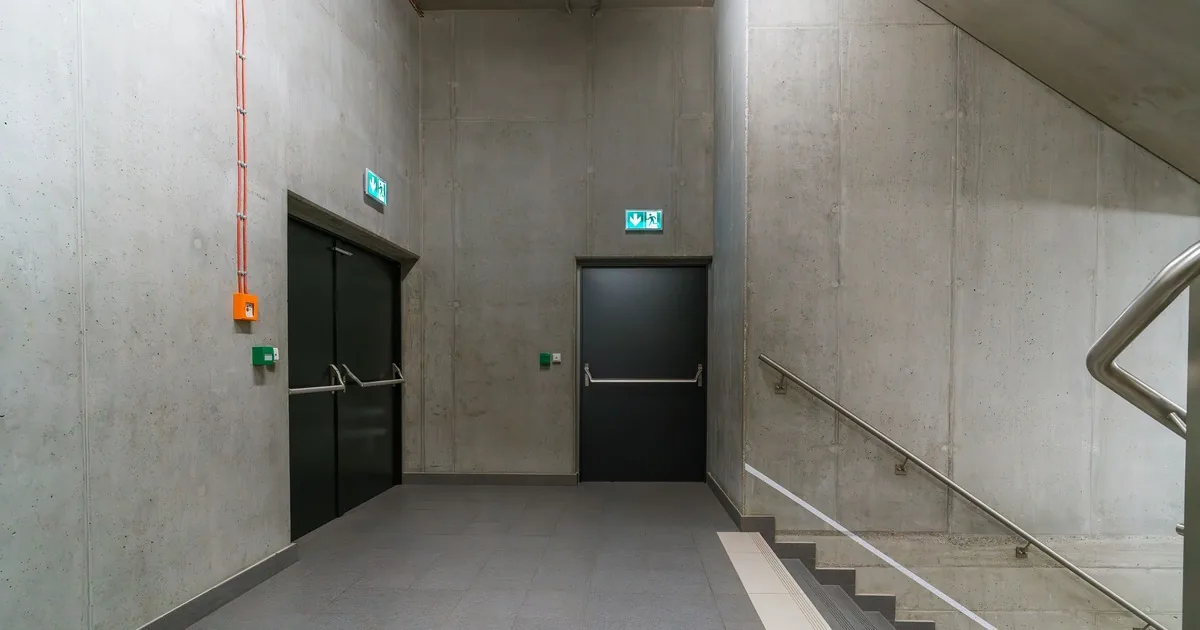
Flag panic hardware, access control, and accessible routes
Ask whether the interior has a push bar or panic device. If it does, record whether the reported problem affects entry from outside, exit from inside, or both. Do not suggest chaining, blocking, or adding a secondary lock to an exit door.
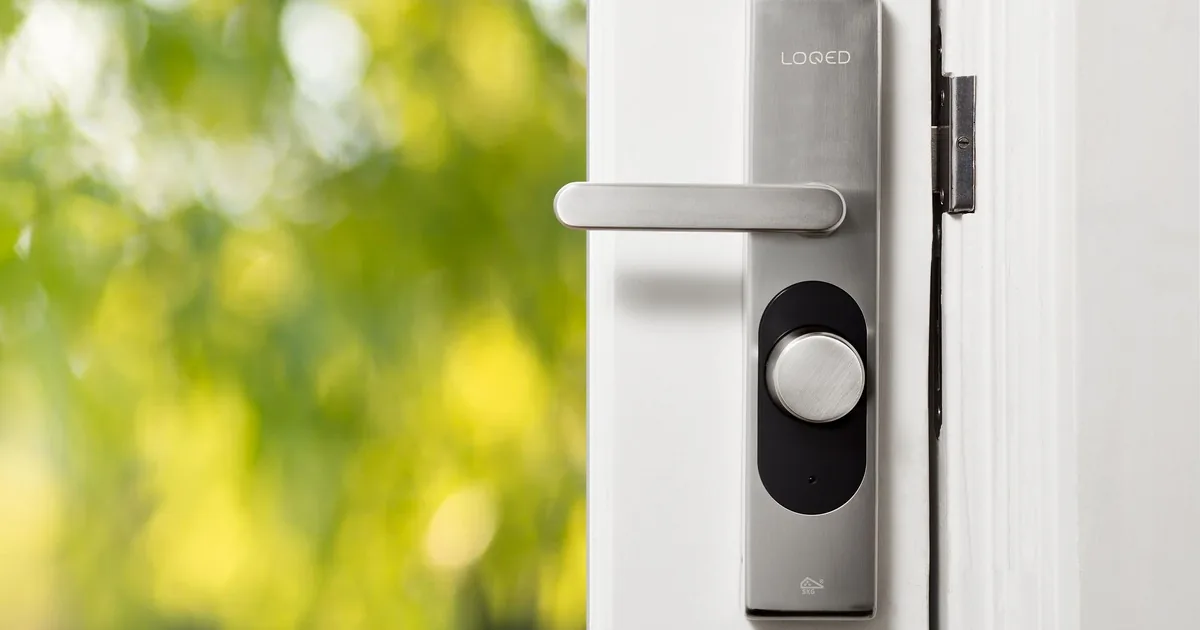
Ask about powered hardware too: electric strike, magnetic lock, card reader, keypad, intercom, automatic operator, door-position sensor, or alarm contact. Note any recent power outage, wiring work, alarm service, tenant change, or access-control update. Capture the person who manages that system. A locksmith may need to coordinate with the landlord, security vendor, electrician, or access-control administrator.
A public entrance can also sit on an accessible route. The U.S. Access Board’s door guide covers operable hardware, clear width, maneuvering clearance, closing speed, opening force, and controlled entrances. Reception should flag an accessible entrance, automatic operator, or reported difficulty using the hardware. The field professional and applicable authority determine what standards apply.
Keep this scope separate from whole-door closing problems. If the door slams, drags, rebounds, or stops before reaching the latch area, the opening may need closer and alignment evaluation along with lock service. Record both symptoms, but do not collapse them into a promised lock replacement.
Build a dispatch ticket that survives the handoff
A good ticket lets a technician picture the opening before loading parts. Include:
- business name, address, opening label, occupancy, and current secure status
- single or paired door, active leaf, material, exterior-side swing, and reported damage
- key behavior, inside-control behavior, visible latch or bolt movement, and strike contact
- panic hardware, access control, alarm, operator, and accessible-entrance flags
- approved photos, visible brand or model text, site contact, authorization, billing contact, and safe entry point
Explain the service or diagnostic charge under the company’s policy. If the hardware cannot be identified confidently, say that the technician will inspect the opening and confirm repair options. Matching appearance alone does not establish backset, faceplate, strike, handing, cylinder cam, trim, electrical function, finish, or compatibility.
Read the ticket back in physical order: “Closed retail storefront cannot secure the street-side right leaf. It is a paired aluminum-and-glass opening, and the right leaf swings out from the secure exterior side. The outside key enters and turns partway. The inside paddle retracts the visible spring latch with the door open. When closed, the latch contacts below the strike opening and does not catch. There is an electric strike and card reader. No forced-entry damage is reported. The manager can admit the technician through the rear door and has repair authority.”
That ticket does not pretend to know the failed part. It gives the field technician the opening, interfaces, connected systems, risk, and access plan needed to start the visit well.
An AI receptionist can collect the same bounded observations after hours and route the call under the locksmith’s own emergency and authorization rules. The useful result is simple: one named door, one precise symptom record, and no premature parts promise.