A homeowner calls on Tuesday because forty guests will be in the backyard on Saturday. “Can you spray before the party?” sounds like a simple booking request. It is missing nearly everything the technician needs: where people are getting bitten, when activity peaks, what holds water, whether the yard has a pond or vegetable bed, and what access will be available.
A good mosquito control plan inquiry starts with the customer’s use area and the pattern they have observed. Then the office maps water, shade, sensitive areas, people and pets, access, and the event timeline. Reception can explain the inspection and scheduling process. Product choice, application method, preparation, service interval, and reentry instructions stay with the licensed operation, the site assessment, and the product label.
Start with the place the customer wants to use
Ask where the problem is felt. “The backyard” may mean a shaded patio beside the house, a swing set at the rear fence, a side garden, or the path between the garage and a pool. Put that location in the work order. A technician who knows the complaint centers on the patio at dusk can inspect a more useful area than one sent to “spray the whole yard.”
Record when the caller notices activity: early morning, midday shade, dusk, after dark, after rain, or throughout the day. Capture the first date noticed and whether the pattern changed after a storm, landscaping work, irrigation repair, pool opening, or neighboring construction. Do not turn the caller’s timing into a species identification. It is field evidence.
If an event drives the call, write down the date, start time, guest area, and any setup that will block access. A tent company arriving Friday afternoon matters if the technician needs the lawn or side gate on Friday. Keep the outcome modest. The appointment can follow the company’s inspection and service process; the office should not promise a bite-free party.
Ask whether the concern is limited to one property. Mosquitoes may be associated with conditions beyond the customer’s fence, and some communities already run public mosquito-control programs. The National Pesticide Information Center recommends checking whether a formal local program is operating and contacting the local vector-control agency when appropriate. Record known neighborhood spraying or notices so the manager has context.
Map water, shade, and the property edge
Water questions should name objects. “Any standing water?” often gets a quick no, even when the yard has a clogged gutter, a folded tarp, two plant saucers, a wheelbarrow, and a children’s toy that holds rain.
Ask what remains wet after a normal rain and for how long. Walk through gutters and downspouts, low lawn areas, drainage inlets, buckets, toys, furniture covers, tires, birdbaths, rain barrels, pool covers, fountains, and plant trays. Add permanent water too: a swimming pool, ornamental pond, drainage swale, creek edge, or stormwater feature. The caller does not need to inspect a roof or enter water during the call. Existing knowledge and safe ground-level photos are enough for intake.
The CDC’s description of integrated mosquito management puts surveillance and egg-laying-site reduction alongside larval control, adult control, and follow-up monitoring. The EPA’s integrated approach also emphasizes habitat, structural barriers, larval stages, and adult mosquitoes. That is why a spray-only phone script is weak. The property record should show where the mosquito life cycle might intersect with the yard before anyone discusses a method.
Shade and vegetation deserve their own line. Ask about dense shrubs, ivy, bamboo, hedges, tree canopy, damp leaf litter, and the narrow space between a fence and planting bed. Record recent pruning or overgrowth. These details guide inspection access and help the technician understand where the customer spends time in relation to the landscape.
Put six property facts on every inquiry
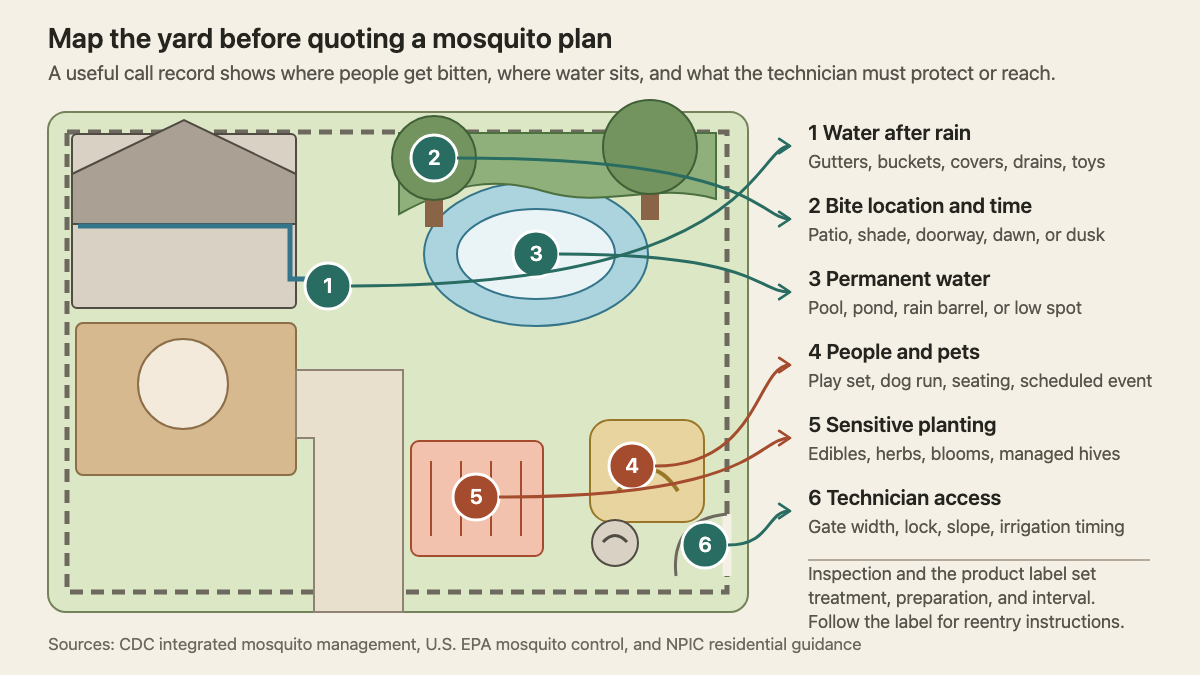
A short intake can still be specific. These six fields give the estimator or technician a usable first view:
- Activity: exact bite area, usual time, first date noticed, and recent weather or property changes.
- Water: temporary containers, drainage trouble, gutters, pool or pond, and anything that stays wet.
- Use: patio, play set, dog run, garden path, event area, or another place people need to occupy.
- Sensitive areas: edible plants, flowering beds, managed hives, fish ponds, pet areas, toys, and outdoor seating.
- Access: lot size if known, fence and gate location, gate width, locks, slope, dense planting, and parking limits.
- Authority: homeowner, tenant, landlord, property manager, condominium association, or commercial decision-maker.
Lot size can help with routing, but it should not replace the map. Two quarter-acre properties can present different work. One may be open lawn with easy gate access. The other may have a pond, thick perimeter shrubs, a locked side yard, a vegetable bed, and a dog that must be secured.
Photos help when they answer a question. Request one wide view of the main use area and safe ground-level views of obvious water or access constraints. Do not ask a caller to climb, move a heavy cover, reach into a drain, or disturb a hive. Label each photo by location in the customer record.
Record people, pets, and sensitive areas before scheduling
Ask who uses the yard and when. Children, pets, older residents, gardeners, tenants, customers, and event crews can affect access and preparation. Note pet species and where food bowls, shelters, runs, or water containers sit. “We have a dog” is less useful than “the dog uses the fenced east run, and the bowl is beside the rear door.”
Ask about vegetable beds, herbs, fruit trees, flowering borders, managed bee colonies, fish ponds, and neighboring features close to the property line. Reception should capture the location without deciding what can be treated. The technician and manager need that information before selecting any service method.
NPIC advises people using mosquito pesticides to follow the label and identifies toys, pet dishes, play structures, pet areas, vegetable gardens, and edible herbs as items that may need removal or protection. It also ties time away from a treated area to label directions or drying, depending on the product. A generic promise such as “everyone can go outside in an hour” does not belong in an intake script. Use the approved instructions for the product and service actually selected.
Irrigation timing is easy to miss. Record watering days, automatic start times, recent drainage trouble, and whether a pool service, lawn crew, or landscaper visits on the same day. The field team can then coordinate within its operating procedure and label requirements.
Explain what a plan can and cannot promise
Customers often ask how long a treatment lasts or how frequently the company will visit. Reception should explain the company’s process before quoting a universal interval. Property conditions, weather, local mosquito pressure, the chosen method, label directions, and the plan sold all matter. Give the caller the real inspection or estimate step and say when a manager will confirm scope.
NPIC states that residential mosquito pesticide applications offer no guarantees, may not last long, and may leave later-arriving mosquitoes unaffected. That supports plain language: “The plan is designed to reduce mosquito activity under the service terms we review with you. We cannot promise that no mosquito will enter the yard.”
Define follow-up ownership. Tell the customer what observations the company wants after service, how to report them, and who reviews a callback. Useful notes include the date, time, exact location, weather, and whether activity changed in the original problem area. “Still bad” gives the manager little to compare.
This mosquito-specific intake can sit beside the company’s general recurring pest service scheduling workflow. Keep the records separate enough to preserve mosquito habitat, outdoor use, and sensitive-area details. The pest-control resource hub has related call-handling guides.
Book the next step the company can support
Finish by reading back the property picture: “You are seeing the most activity on the shaded rear patio around dusk. Water collects near the east downspout after rain. The yard has a fish pond, vegetable bed, swing set, and locked six-foot side gate. Your party begins Saturday at 4 p.m.” The caller can correct a direction or forgotten feature before dispatch.
Then book the correct next step. That may be a phone estimate under a defined company policy, an onsite inspection, an initial service visit, a manager callback, or a referral outside the service area or license scope. Confirm the address, property contact, authorization, gate instructions, pets, parking, appointment window, event date, and what the visit includes.
The live article on mosquito add-on calls for lawn-care companies covers a related sales situation. A pest-control plan inquiry needs a broader operating record because the office may be coordinating inspection, recurring service, sensitive-area review, and callbacks under a pesticide program.
An AI receptionist can collect these approved fields after hours and route an event deadline or sensitive-property question to a manager. The script should use the company’s actual service area, license scope, plan terms, preparation process, and escalation rules. By morning, the office should know more than “spray requested.” It should know that the problem is the shaded patio, the downspout stays wet, the fish pond sits twenty feet away, and the gate is locked.
Sources
- Centers for Disease Control and Prevention: What Mosquito Control Programs Do
- U.S. Environmental Protection Agency: Success in Mosquito Control, an Integrated Approach
- National Pesticide Information Center: Do I Need to Spray for Mosquitoes at Home?