A homeowner calls after the third outage of the season and asks, “What size generator will run my well pump?” The office can help, but a horsepower guess is a poor starting point. The useful answer depends on the installed motor and controls, the electrical supply, the loads the owner expects to power, and how generator power will be transferred safely.
A strong consultation call does five things. It defines the water service the owner wants during an outage, identifies the pump and controls from records or visible labels, documents existing generator and transfer equipment, captures site and fuel constraints, and assigns the next step to the right qualified contractor. Reception should collect facts. Generator sizing and electrical connection belong with qualified field staff.
Start with the water job the owner wants during an outage
“Keep the water on” can mean several different projects. One owner wants enough backup power to operate the well pump at intervals. Another wants the pump, refrigerator, furnace controls, and selected lights. A third expects whole-home coverage with automatic operation. Those scopes create different load and transfer questions.
Ask what must work and what can wait. Does the property need water for ordinary household use, livestock, irrigation, a home business, or fire-protection equipment? Is the request for a planned outage, routine resilience, or an active loss of power? Does anyone at the property depend on powered medical equipment? The last question may change the urgency, though it does not turn the well contractor into an emergency-power designer.
Separate planning from troubleshooting. If utility power has returned but the home still has no water, route the call through the well pump power-outage recovery process. If the owner is planning future backup, keep the ticket focused on equipment identity, intended loads, and trade coordination.
Also ask how the owner expects the system to operate. A portable generator brought out during an outage is a different proposal from a permanently installed standby unit with automatic transfer. Record the preference without promising that it will suit the property.
Identify the motor and controls before discussing generator size
Horsepower alone does not describe the electrical demand. Voltage, phase, motor design, control method, and starting behavior matter too. Other loads connected at the same time change the total again.
Fall River Electric Cooperative’s standby generator guide distinguishes running load from the extra demand associated with starting motors. It directs users to equipment nameplates and manuals for exact values. Franklin Water maintains its AIM resources for application, installation, and maintenance questions involving submersible motors. Those references support a simple office rule: collect exact equipment information and let qualified staff interpret it.
Request the most useful records:
- pump and motor model, horsepower, voltage, and phase
- control-box, pressure-switch, or variable-frequency-drive information
- a pump invoice, installation record, well report, or prior service ticket
- generator model and rated output if the owner already has one
- photographs of safely visible labels with covers left closed
- the main panel, transfer equipment, disconnects, and control locations
- a list of every other load the owner wants backed up
The wording “safely visible” matters. Nobody should remove a panel cover, open a control box, handle conductors, or enter a wet equipment area to improve a phone ticket. A blurry label can wait for a site visit.
Some callers will know that the pump is “one horsepower” but not whether it is a two-wire motor, a three-wire motor with a control box, or a variable-speed system. Record what they know and where it came from. A remembered invoice is a lead. A clear nameplate photograph is better.
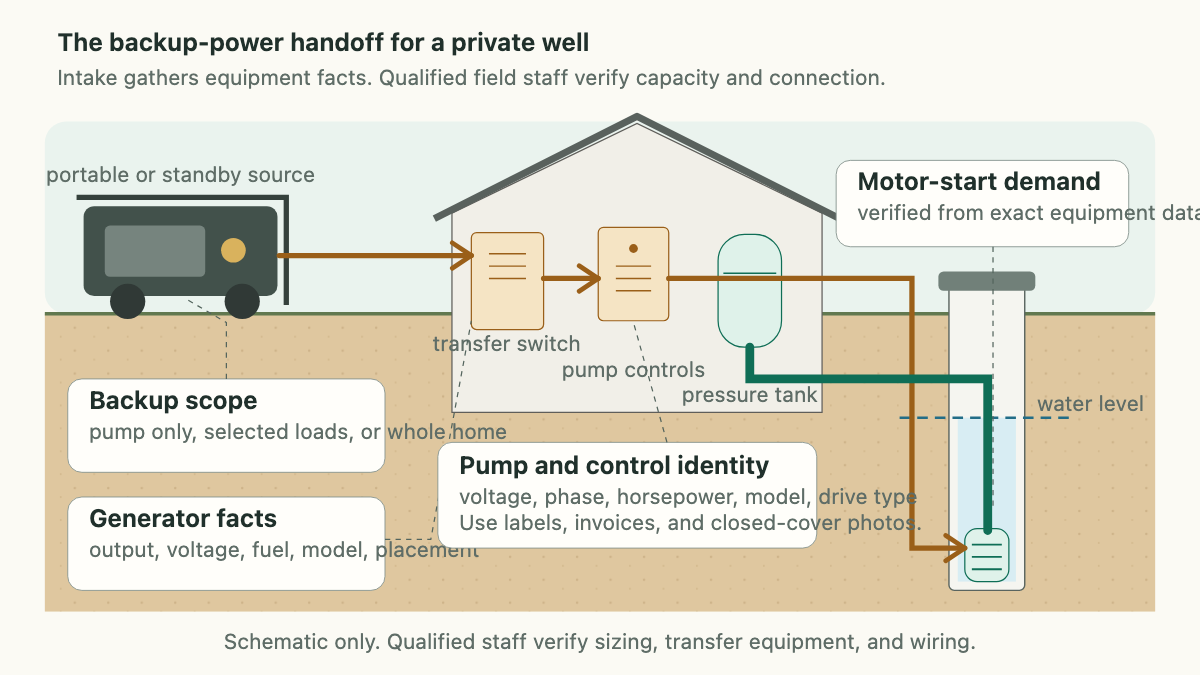
Map the electrical handoff without designing it by phone
When generator power will serve fixed building wiring, transfer equipment is part of the job. Penn State Extension’s generator safety guidance calls for a professionally installed transfer safety switch and warns against direct connection to building wiring or an outlet. The U.S. Consumer Product Safety Commission also warns against powering house wiring by plugging a generator into a wall outlet because backfeeding can electrocute utility workers or neighbors.
Ask whether the property already has a transfer switch, interlock, generator inlet, automatic transfer equipment, or a dedicated pump connection. Capture the brand and model if visible. Then ask who installed it and whether documentation is available. Reception should never confirm compatibility from a photograph or tell a caller how to connect the generator.
The ticket must name the trade handoff. Who will verify the generator capacity? Who will inspect the transfer arrangement and conductors? Who will confirm the pump motor and controls? Some companies hold the licenses and experience to coordinate the whole project. Others handle the water system and work alongside an electrician or generator dealer. Describe the company’s actual scope plainly.
For a broader whole-home project, the owner may need an electrical generator consultation before the well contractor can confirm pump-specific details. That sequence is often cleaner than asking either trade to estimate the other’s work from partial information.
Screen placement, fuel, and operating conditions
Generator location is a safety issue and a design input. Ask where the owner proposes to place the unit, where windows and doors are located, whether the area can flood, and how power would reach the approved connection point. Note stairs, gates, steep grades, snow storage, soft ground, pets, locked enclosures, and access for service.
Ready.gov’s power-outage guidance says generators and fuel should be used outdoors at least 20 feet from windows, doors, and attached garages. It also advises keeping generators dry, letting them cool before refueling, and maintaining working carbon monoxide detectors. Those are operating boundaries, not a site plan. Manufacturer instructions and local requirements still govern the actual installation.
Capture the proposed fuel as well. Gasoline, propane, natural gas, and diesel involve different storage, delivery, runtime, maintenance, and siting questions. If a standby unit is proposed, ask whether the property already has gas service or a fuel tank. Do not promise that an existing line or tank can support the generator.
An active hazard stops the ordinary consultation. Smoke, sparking, a hot electrical odor, damaged conductors, floodwater near electrical equipment, or a generator operating inside or near an opening needs the company’s emergency safety procedure. The call taker should not troubleshoot the condition remotely.
Build a ticket that qualified staff can use
A good ticket lets the reviewer see the system before visiting. It should state the service address, occupancy, current water status, outage pattern, desired backup scope, pump and control identification, existing generator, transfer equipment, proposed fuel, site constraints, and available records. Attach original photographs rather than screenshots that hide label detail.
Then choose a concrete next step. Four outcomes cover most calls:
- Records review: Equipment labels, installation records, and the desired backup scope are clear enough for qualified staff to review.
- Well-system visit: The motor or controls cannot be identified, the well equipment has an unresolved fault, or the owner needs pump-specific inspection.
- Electrical or generator visit: Transfer equipment, service capacity, generator placement, fuel, or other household loads need field verification.
- Coordinated assessment: The project crosses both scopes and should be scheduled with a defined handoff between contractors.
Close by telling the caller what to send, who will review it, and when the office will respond. Do not quote a generator size unless the person giving that figure is qualified and has the inputs the company requires.
The most useful sentence in the final ticket is rarely “Customer has a one-horsepower pump.” It is closer to this: “Owner wants pump and refrigerator backup; pump invoice and closed control-box label attached; no transfer equipment identified; propane tank on site; electrician and well-system review required.” That gives the next person a real place to start.