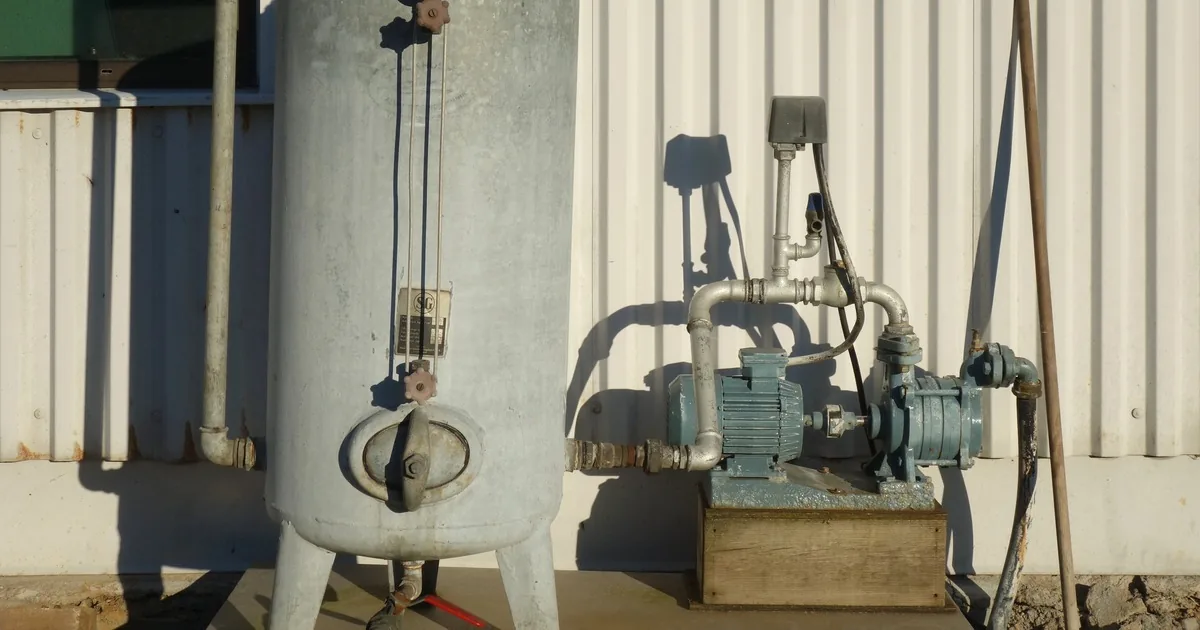
“The lights came back, but the water didn't.” That sentence belongs in a different dispatch lane than “the whole road is still dark.” The first caller may have a pump, control, breaker, pressure tank, or well problem that remained after utility service returned. The second caller has an active power outage, and the pump cannot refill the pressure tank yet.
A useful intake starts with the event sequence. Confirm whether power is available now, whether the pump circuit has power, what happened to water pressure during the outage, and what changed after restoration. Screen for floodwater, wet wiring, fallen lines, visible damage, heat, smoke, or a burning odor before discussing equipment. Then capture gauge readings, pump sounds, breaker behavior, water appearance, system records, and access for the technician.
Do not diagnose the failure by phone. A power outage gives the call a starting point, but it does not prove what failed.
Establish where the outage stands now
Ask for the property address first. An outage may affect one house, several nearby properties, or a wider utility area. The caller may say “power is back” because the kitchen lights work while a separate pump circuit remains off. Record what the caller can observe without asking anyone to open a panel or remove a control cover.
Use a short sequence:
- Is utility power back at this address now?
- Did the well supply water before the outage?
- Did water continue briefly, weaken, or stop at once?
- Has any water returned since the power came back?
- Are other high-load appliances operating normally?
- Has the pump breaker tripped, and did it trip again after one ordinary reset attempt made under the customer's own safe household procedure?
- Is a generator supplying any part of the property?
A repeat trip is service information, not an invitation to keep resetting the breaker. Record it and follow the company's escalation policy. The office should never coach a caller through electrical testing, panel work, pressure-switch contact cleaning, or improvised generator connections.
The broader no-water well pump emergency guide covers pump failures with many possible starting points. This article stays with one timeline: utility power went away, then water stopped or failed to recover.
Screen the equipment area before discussing recovery
Storm outages can arrive with flooding, wind damage, lightning, falling branches, or water in a basement or well house. Those conditions change the call immediately. Ask whether the caller can see standing water near electrical equipment, damaged conduit, a displaced well cap, exposed wiring, fallen lines, smoke, unusual heat, sparks, or a burning odor. Nobody should enter a flooded space or touch wet equipment for the sake of intake.
The CDC's emergency well guidance warns that disasters can damage well piping and electrical systems. It tells well owners to turn off electricity around a damaged well area and have qualified electrical or well professionals check wiring before power is restored. The office can use that boundary without turning the call into a repair tutorial.
Water quality needs a separate screen. Ask whether floodwater reached the well, whether the cap or casing was damaged, and whether restored water looks cloudy or contains sediment. Ask about fuel or chemical odor too. An ordinary power interruption does not by itself prove contamination. Flood entry, casing damage, repair work, or a sudden change in water creates a different concern, and local health guidance may apply.
If a portable generator is involved, ask who connected it and whether it is operating outside. The CDC generator safety fact sheet identifies carbon monoxide from portable generators as a lethal hazard. The call taker should follow company policy for immediate generator safety concerns and leave connection methods, electrical capacity, and transfer equipment to qualified people.
Explain why the faucets may run for a while
A private well system moves electricity and water along separate paths. The pump needs power to lift water and refill the pressure tank. The tank stores pressurized water for use between pump cycles. When utility power fails, the pump stops, but the house may still draw whatever usable water remains under pressure. Once that reserve falls, opening a faucet cannot make the unpowered pump refill it.

Avoid giving a runtime estimate. Available water depends on the tank, its pressure and condition, the system settings, and how much water the property used after the outage began. “We had water for one toilet flush and then nothing” is a useful observation. It does not identify the failed component.
This distinction also prevents a common intake mistake. Water that stopped during an active outage can be expected behavior for an electric pump. Water that remains absent after power returns deserves a closer service screen.
Capture what happened after restoration
Ask for the time power returned and what the caller noticed next. Did the pump start? Did the pressure gauge move? Did water return at one fixture, all fixtures, or none? Was the flow steady, weak, pulsing, cloudy, or sandy? Did the pump run continuously, cycle rapidly, hum, click once, or remain silent?
Keep each observation tied to its source. “Caller hears a hum near the pressure tank” is honest. “Pump motor is seized” is a diagnosis the office cannot support.
The National Ground Water Association's annual inspection guidance lists system output, water level, pump motor performance, line voltage, grounding, the pressure tank, and pressure-switch contact among professional inspection points. That list explains why a single symptom cannot settle the cause. Several electrical and hydraulic components meet at the same complaint: no water.
Ask about breaker behavior with restraint. If the caller reports that the pump breaker will not stay set or trips again, stop there. Do not advise repeated resets. Heat, odor, noise, wet equipment, or visible damage moves the call to the company's urgent safety lane.
When water returns but pressure surges or the pump starts and stops rapidly, link the record to the company's pressure-system workflow. The guide to pressure tank replacement calls shows which tank, switch, gauge, and cycling details belong in that intake. The outage may have made an existing symptom more noticeable without proving that the tank failed.
Route four outcomes, not one generic no-water call
A clean recovery map gives the office four destinations.
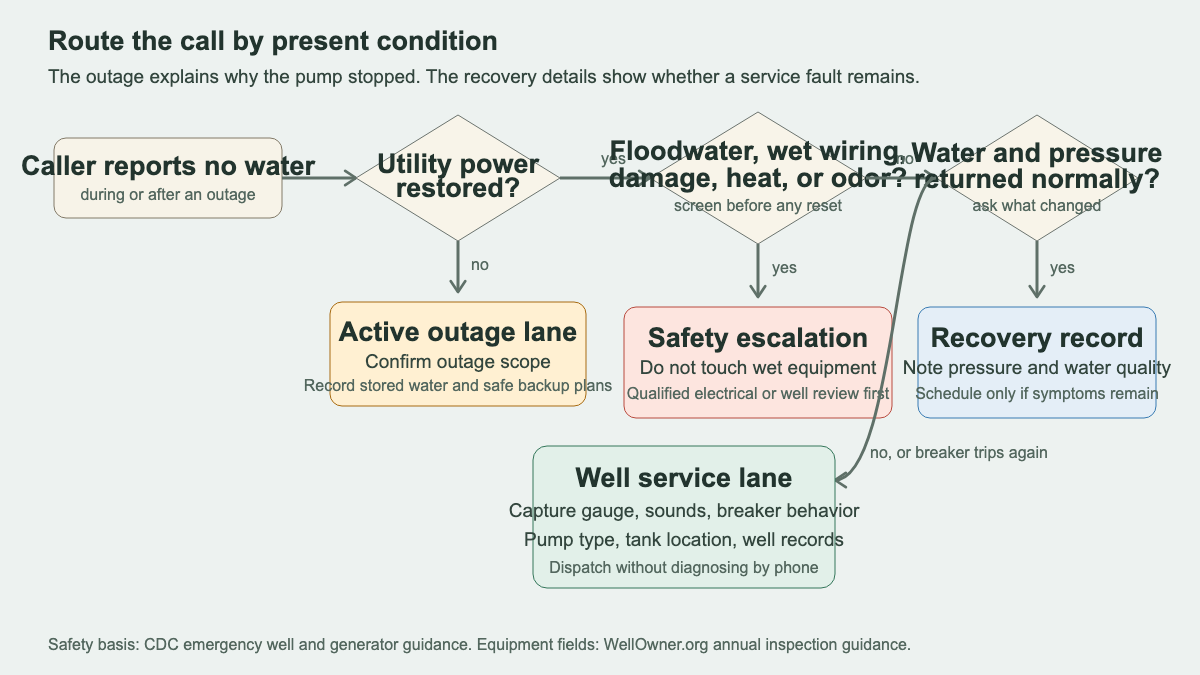
The outage is still active. Record outage scope, the property's remaining water, any essential water needs, and whether approved backup equipment exists. Set a callback rule for restoration. Do not promise that the pump will recover before power is available.
The area is unsafe. Floodwater, wet electrical equipment, damaged wiring, fallen lines, smoke, heat, sparks, or fuel odor requires the company's safety escalation. The immediate instruction must come from established policy and the appropriate emergency, utility, electrical, health, or well authority.
Power returned and water recovered normally. Note when pressure and flow returned. Ask about unusual color, sediment, odor, noise, or cycling. A routine visit may still be appropriate if symptoms remain, but a normal recovery should not be sold as a confirmed equipment failure.
Power returned and water did not recover, or the breaker tripped again. Create a well-service dispatch record. Capture the gauge reading, pump sounds, breaker behavior, pump and tank location, any controls the caller can identify without opening them, recent repairs, and whether neighbors on separate wells have water.
The split matters. A crew should not drive toward an unpowered property expecting to test a running system, and a caller with wet wiring should not be handled as an ordinary scheduling request.
Build the field-ready dispatch record
Well records can save time. Ask for the well completion report or log, pump installation invoice, pump age if known, prior service notes, water-treatment equipment, and any generator or transfer-equipment documentation. Penn State Extension's well maintenance guide recommends retaining construction, pump, inspection, testing, and repair records because changes in performance need a point of reference.
Then collect the practical access details: full address, gate code, road condition, wellhead location, pressure tank location, basement or crawlspace access, animals on the property, and the person who can authorize work. If storm debris blocks the wellhead or driveway, put that in the first line of the work order.
Read the handoff back in chronological order:
“Utility power failed at about 7:10 p.m. Water weakened after two toilet flushes and stopped. Power returned at 9:05 p.m. The house lights and range are working. The caller reports no water at any fixture, a zero reading on the visible pressure gauge, and no pump sound. The pump breaker tripped again after one reset, so no further resets were attempted. There is no flooding, visible wire damage, smoke, heat, or odor. The pressure tank is in the basement, the wellhead is behind the detached garage, and the 2019 pump invoice is available.”
That record gives the technician a timeline, safety screen, electrical symptom, hydraulic symptom, equipment locations, and a document to review. It does not pretend to name the failed part.
An AI receptionist can collect the same sequence after hours if its rules are conservative: stop on hazards, never coach electrical work, record the caller's words, and transfer uncertain cases under the contractor's policy. The most useful first note remains simple: whether power is back, and whether water came back with it.