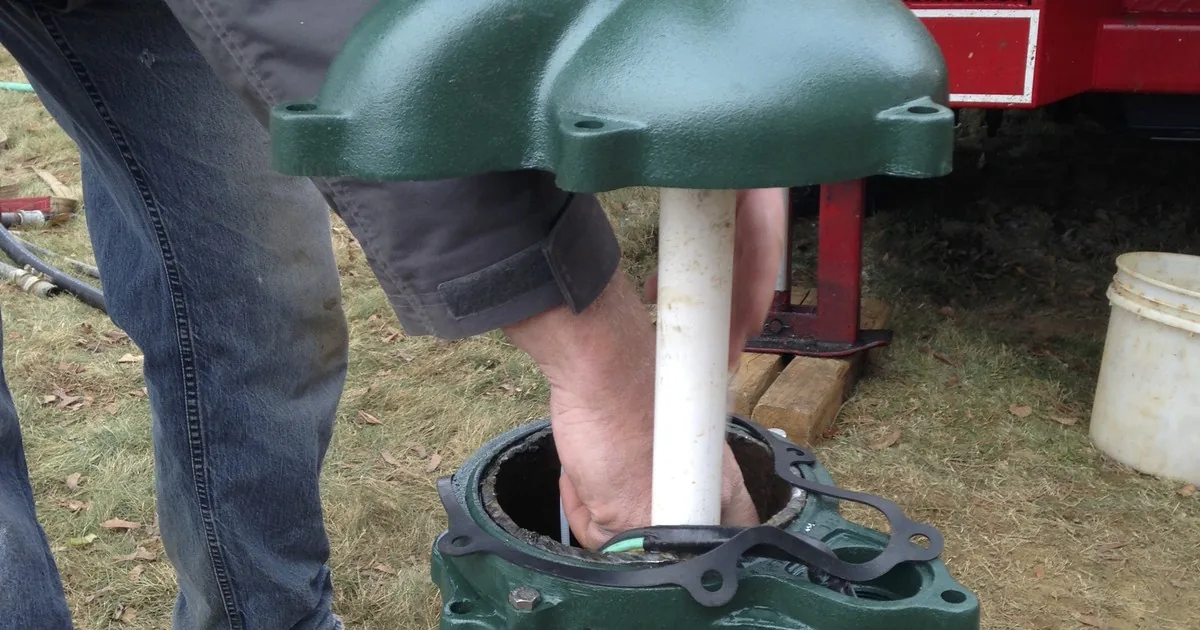
A homeowner calls after finding the well cap tilted beside the driveway. A mower may have clipped it. Rain fell overnight, and the caller wants to know whether the water is safe. The office cannot answer that last question from a photograph or a phone description. It can collect the facts a well contractor needs, flag possible contamination for the proper testing handoff, and keep people away from damaged equipment.
For a well cap or casing repair call, capture four things first: the visible damage, any recent event, the household's water situation, and access to the wellhead. Treat a missing cap, cracked casing, flood contact, exposed wiring, or an unstable opening as an urgent assessment. Do not promise that replacing the cap resolves water quality. System repair and certified water testing may become separate parts of the response.
Establish what is damaged before discussing the appointment
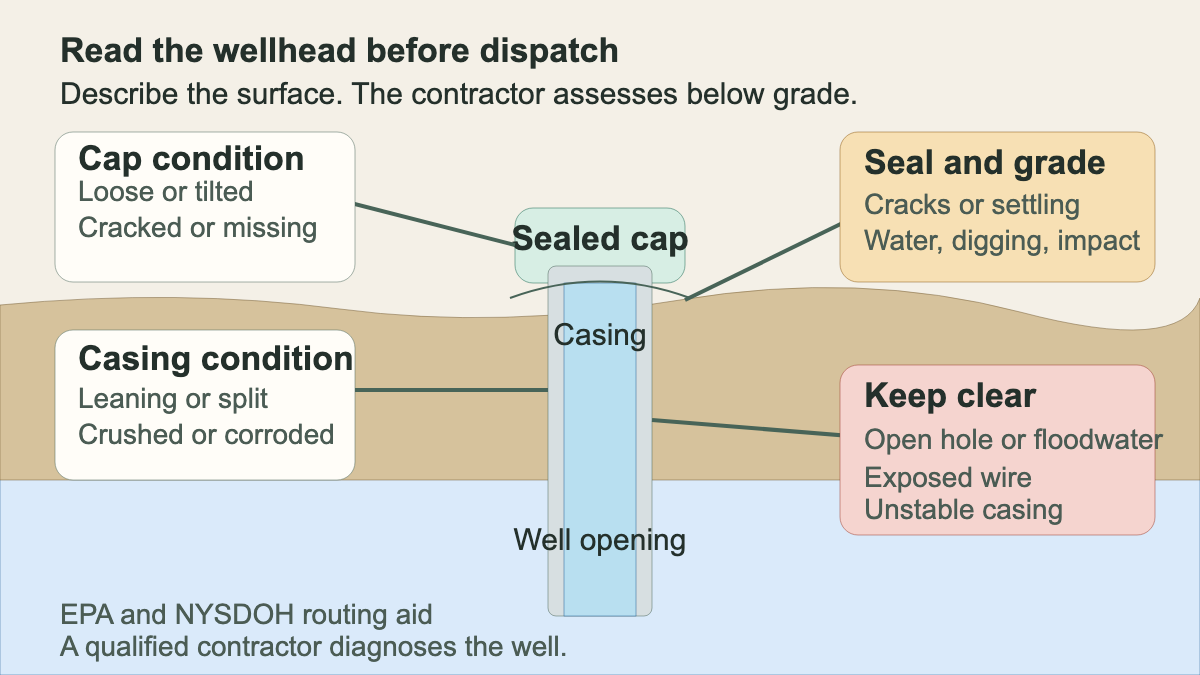
Callers use “cap,” “cover,” “pipe,” and “wellhead” interchangeably. Ask them to describe the object without correcting them. A useful opening is, “What do you see at the top of the well right now?” Then establish whether a metal or plastic casing rises above the ground, whether a cap remains attached, and whether anything looks shifted, split, corroded, crushed, loose, or missing.
The EPA's private-well guidance describes the well cap as the part placed on top of the casing to keep debris, insects, and small animals out. The casing is the tubular structure that maintains the well opening and helps keep unwanted water and material from entering. Those roles explain why “the lid is loose” deserves more detail.
Ask for wide and close photographs if the business accepts them. The wide image should show grade, nearby paving, drainage, vegetation, and anything that may have struck the wellhead. The close image should show the cap, the exposed casing, cable or conduit, and the damaged area. Photos help dispatch. They do not establish water safety or prove the condition of the casing below grade.
Build a short event timeline
A damaged wellhead rarely arrives as a tidy work order. The caller may remember a delivery truck near the casing last week, then mention that landscaping soil was added yesterday. Put events in order.
Record when the wellhead was last known to be intact and when the damage was first seen. Ask about mowing, plowing, construction, excavation, falling limbs, vehicle contact, recent service, flooding, ponded water, and a sharp freeze. If the caller did not witness an impact, say so in the note. “Found cap loose at 7:10 a.m.; cause unknown” is more useful than “mower damaged cap” when nobody saw the mower touch it.
Weather belongs in the timeline when it changed site conditions. It should not be written as a diagnosis. The EPA advises owners to inspect exposed well parts for cracked or corroded casing, a broken or missing cap, and settling or cracking at surface seals. Its guidance also calls for testing after major changes near the well, including flooding, land disturbance, and new construction.
New York State's post-flood well assessment notes that debris can distort or crack casing and that mud or sediment around a well can indicate flood effects. The agency directs owners to qualified professionals when the casing or pump needs repair. Local instructions vary, so the office should record the event and route the caller to the applicable health or environmental authority for water-use and testing advice.
Screen for immediate hazards without coaching a repair
The receptionist's job is to keep the scene stable until a qualified person assesses it. Ask whether the casing opening is exposed, whether wires or conduit are visible or damaged, whether the area is flooded, and whether the wellhead is leaning or loose in the ground. Ask if children, pets, tenants, or contractors can reach the area.
When there is an open hole, damaged electrical equipment, floodwater around the well, or a structure that may fall or shift, tell the caller to keep people and animals away. Follow the contractor's approved emergency language for electrical shutdowns or water use. Do not ask a homeowner to lift a cap, touch wiring, pour disinfectant into the well, straighten casing, or excavate around it.
Avoid improvised repair instructions even when the caller says the part looks simple. A cap can carry wiring or monitoring equipment, and casing damage may extend beyond the visible edge. The USGS photograph used for this article shows instruments being installed beneath a sealed domestic well cap. That is a good reminder that the office may not know what sits under a particular cover.
Separate the repair path from the water-quality path
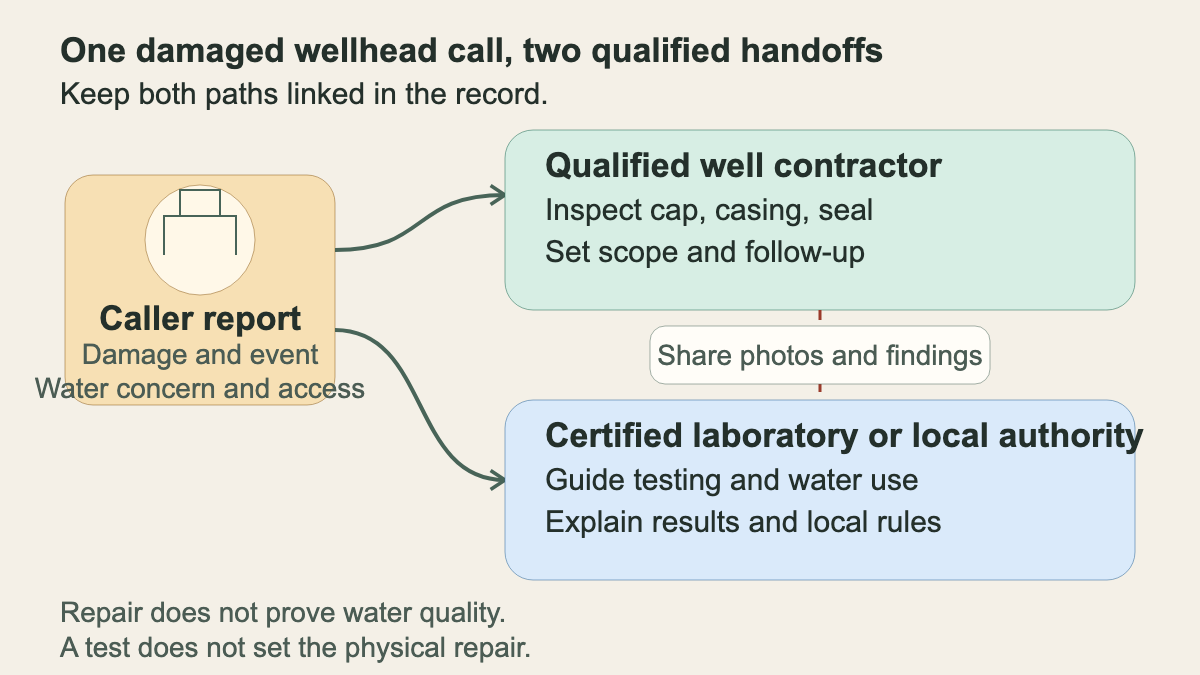
A contractor can inspect the cap, casing, surface seal, electrical entry, and surrounding grade. A certified laboratory measures water quality. Keep those paths linked in the call record, but never collapse one into the other.
The EPA recommends periodic inspection for damaged casing, a broken cap, and cracked surface seals. It also directs private-well owners to certified laboratories and local health departments for testing. Penn State Extension advises annual well inspection for visible damage or contamination and recommends professional evaluation when performance changes. Its maintenance guidance also identifies casing corrosion as a condition that can damage a well over time.
That evidence supports a simple office rule. If the protective structure may have been compromised, book the qualified inspection according to company policy and give the caller the approved contact for testing guidance. Do not say that clear water means the well is safe. Do not say that a new cap makes testing unnecessary. And do not promise that disinfection is required until a qualified professional or local authority has assessed the situation.
Capture the details that change dispatch
Once immediate risk has been screened, gather the work-order facts. Use a compact sequence so the caller does not have to repeat the story:
- Service address, caller name, callback number, and property occupancy
- Whether the property currently has water and whether any change in color, odor, taste, sediment, or pressure has been noticed
- The caller's exact description of the cap, casing, seal, conduit, and surrounding ground
- The suspected event, date, time, and whether anyone witnessed it
- Flooding, standing water, excavation, construction, or recent well work
- Well location, gate conditions, driveway limits, animals, locked enclosures, and parking distance
- Available well log, prior inspection notes, testing records, and photographs
Access deserves its own questions. A casing behind a locked pasture gate requires a different arrival plan than one beside a paved driveway. Ask whether a service truck can approach, whether overhead branches or soft ground restrict access, and whether another contractor has equipment parked near the well. Record who can open the property and whether the technician needs notice before arrival.
If the well serves a rental, business, food operation, or multiple households, flag that fact for the dispatcher. Do not improvise regulatory advice. The contractor and local authority can determine which rules and notices apply at that address.
Write a work order that preserves uncertainty
A strong note distinguishes what the caller observed from what the office inferred. “Steel casing is bent” may sound definite, but “caller reports the exposed metal pipe leans toward the driveway” preserves the source of the statement. “Contaminated after rain” should become “cap found loose after overnight rain; caller asks about testing.”
Use headings inside the work order if the dispatch system allows them: observed condition, event timeline, water-use concern, access, and promised next step. Attach the original photos. Avoid cropping away the surrounding grade unless a second close image is also included.
Here is a complete sample note:
Owner reports the cap on the six-inch metal pipe beside the north driveway is tilted and one fastener appears missing. Last known intact Saturday afternoon. Damage found Monday at 7:10 a.m. after overnight rain; no witnessed impact. No standing water now. Household reports normal pressure and no noticed change in water appearance or odor. Two adults live at the property. Owner was advised to keep people away from the wellhead and contact the county health office for water-use and testing guidance under the company's approved protocol. Gravel drive supports service access. Dog will be indoors. Photos and 2008 well log attached.
That note gives the technician a scene, a timeline, and a clear record of what the office did not claim.
Set the appointment without promising the repair
Explain what the scheduled visit covers in plain terms. The technician will inspect the accessible wellhead and determine what work, testing coordination, equipment, or follow-up is needed. If the company has separate rates for an assessment and repair, state the approved fee and what it includes. Do not quote casing depth, excavation, replacement scope, code compliance, or restoration before inspection unless the contractor has a documented quoting rule for that exact situation.
Give the caller a realistic preparation list: keep the route clear, secure animals, have records available, leave damaged parts in place, and avoid work around the casing. Confirm the arrival window and the person who can authorize work. If water-use guidance is still unresolved, repeat the approved local-agency handoff and document it.
Related calls may need a different intake. A household with weak flow but no visible wellhead damage belongs in the low water pressure service-call workflow. Rapid pump starts and stops belong in the short-cycling intake guide. Keeping those intents separate prevents a physical-damage call from being buried under a symptom label.
An AI receptionist can follow the same approved questions after hours and pass the answers to dispatch. The script still needs contractor-defined emergency language, local testing contacts, and a firm boundary against diagnosis.
A damaged cap call should end with a precise record: what is visible, what happened, who may be exposed, how the technician reaches the well, and which testing contact the caller received. That is enough to move the work safely into qualified hands.