“We need the well shocked before Friday” sounds like a simple booking. Then the caller mentions a positive bacteria result, two houses on the same well, a softener, horses on automatic waterers, and a septic system beside the only outdoor faucet. The calendar is now the easy part.
A good well chlorination intake starts with the reason for service and maps the entire connected water system. Record the laboratory result or event that triggered the request, the well and plumbing details, every building and water-using device, treatment equipment, alternate water needs, access, and safe flushing space. The contractor decides the disinfection method and chemical dose. Reception builds a schedule the property can actually follow.
Start with the event that prompted the call
Ask, “What happened before you decided the well should be chlorinated?” Keep the answer in the caller’s words. Useful triggers include a laboratory report showing bacteria, recent pump or plumbing work, a new well, floodwater around the wellhead, a damaged cap, a long vacancy, or recurring odor.
The reason changes the route. New Mexico State University Extension explains that shock chlorination can address bacterial contamination introduced when a well is installed or when work is done on the pump or plumbing. The same guide warns that contamination from the groundwater source will return when more of that water enters the system. One treatment is therefore different from an investigation into repeated positive samples.
Ask for the actual laboratory report when testing prompted the request. Record the sample date, analytes reported, result, laboratory name, collection point, collector, and any instructions supplied with the report. “The water failed” leaves the field team searching for details that may already exist on one page.
A flood call needs a separate safety screen. The CDC’s emergency well guidance tells owners to involve local health officials and qualified well or pump contractors because flood damage can affect wiring, piping, and the well structure. Ask whether floodwater reached the well, pump controls, pressure tank, or electrical equipment. Record downed lines, standing water near power, exposed wiring, damaged casing, debris, fuel odor, or chemical odor.
Fuel and toxic chemical concerns do not belong in an ordinary chlorination slot. CDC states that boiling or disinfection will not make chemically contaminated water safe. Route the caller to the local health authority and the company’s emergency policy. Do not tell them that bleach will handle it.
Inventory every part connected to the well
A chlorination service may begin at the wellhead, but the treatment path can continue through hundreds of feet of pipe. Minnesota Department of Health includes the well, water lines, tanks, water heater, interior and exterior fixtures, appliances, yard hydrants, and outbuildings in its system procedure. New Mexico State also calls out automatic animal waterers and irrigation.
Build the system record before discussing an appointment window:
- Well type, casing diameter, total depth, static water level if known, well log, cap style, pump type, and recent repairs
- Pressure tank, water heater, storage or cistern capacity, and known distribution branches
- Softener, carbon filter, reverse-osmosis unit, ultraviolet system, cartridge filters, chemical feed equipment, and any bypass arrangement
- Number of homes, apartments, barns, shops, clinics, rental units, or other buildings supplied by the well
- Indoor fixtures, exterior faucets, yard hydrants, irrigation, ice makers, dishwashers, laundry equipment, boilers, humidifiers, and automatic waterers
- Septic system location, landscaping, ponds, streams, drainage paths, and possible flushing areas
- Locked gates, buried or enclosed wellheads, dogs, livestock, tenants, and the person who can provide access
Treatment equipment deserves its own line in the ticket. Minnesota warns that bleach can damage or improperly disinfect certain filters and appliances. Its guidance tells users to follow each manufacturer’s instructions. Oregon State and CDC also discuss bypassing softeners in applicable procedures. Reception should capture make, model, current valve position if the caller knows it, and a photo of the equipment label taken from a safe location. The contractor decides what is isolated, disinfected separately, serviced, or replaced.
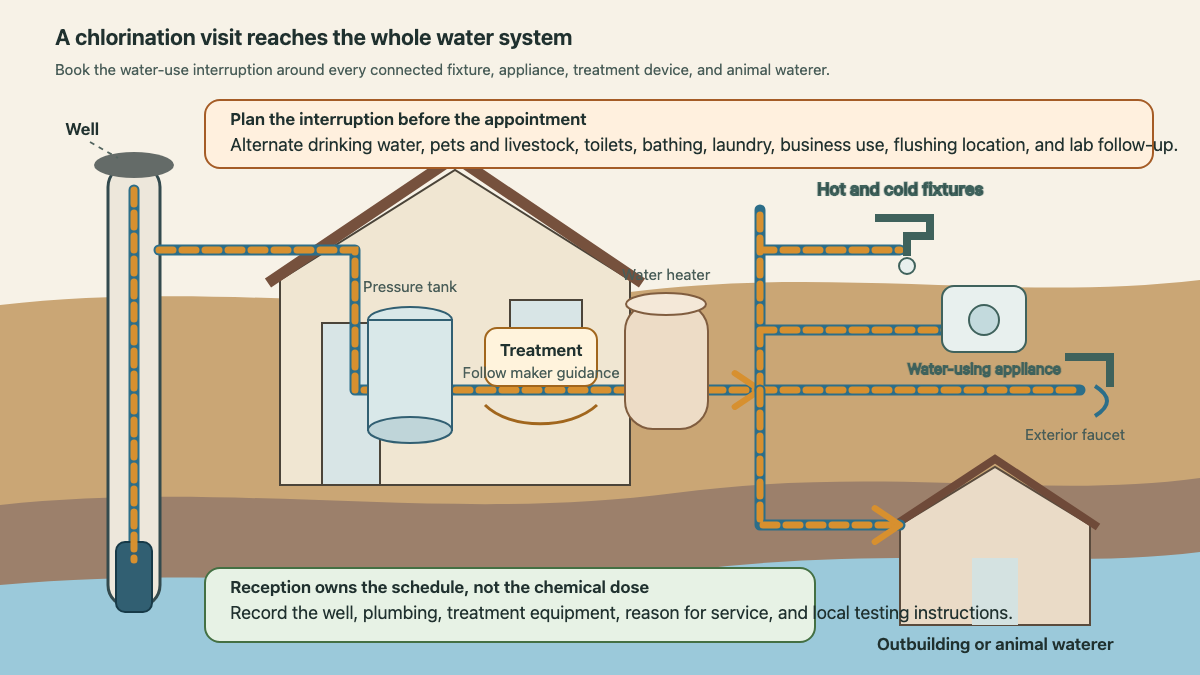
The map also catches a common scheduling mistake. A homeowner may plan around kitchen and bathroom use but forget that a barn waterer, tenant laundry room, or office ice machine uses the same supply. That forgotten branch can interrupt the procedure or leave part of the system outside the contractor’s planned scope.
Quote the approved service window, not a universal number
Callers want to know how long they will be without normal water. There is no responsible national answer that fits every system and local procedure.
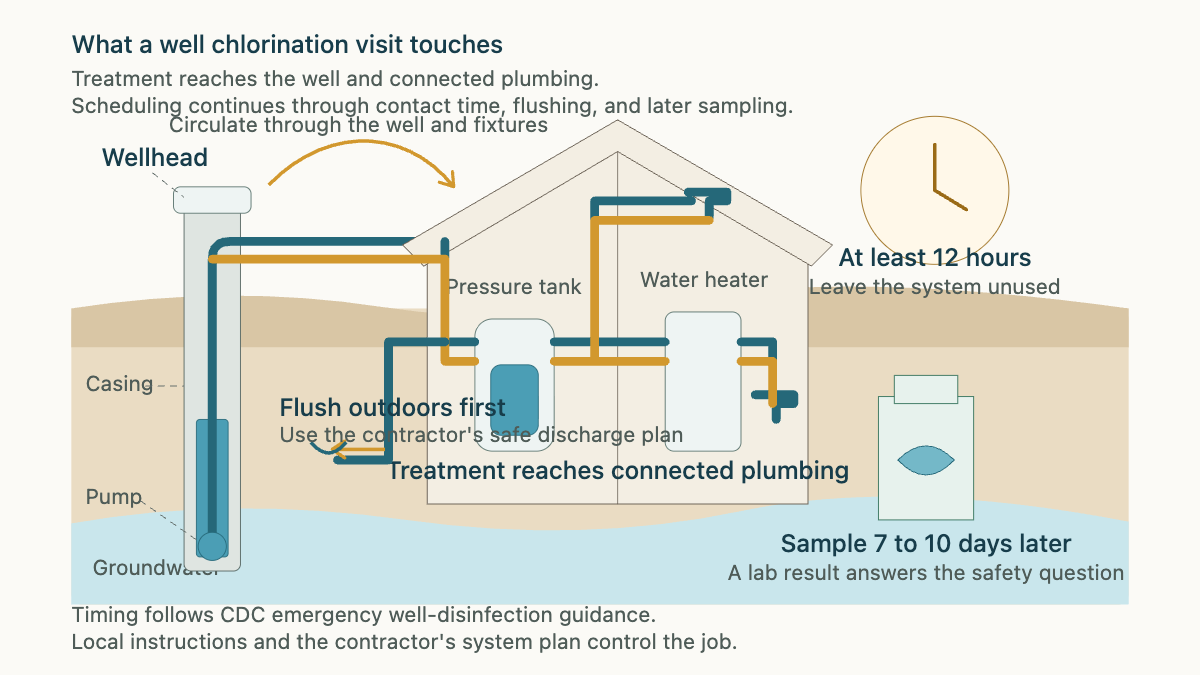
Published guidance shows why. Minnesota specifies a minimum two-hour contact period and prefers six hours or overnight. Oregon State University Extension says to hold chlorinated water in the pipes for six to twelve hours. New Mexico State tells owners to plan for at least eight hours without faucet and toilet use, preferably twelve to twenty-four hours. Those figures come from different procedures, bleach concentrations, systems, and regional guidance.
Your office should quote the contractor’s approved window for the specific job. Separate four parts in the schedule: field setup and inspection, distribution of chlorinated water, the contact period with restricted use, and flushing. Then explain that laboratory follow-up may extend restrictions on drinking or cooking after the plumbing is usable for other purposes. Use the local health authority and laboratory instructions for that final boundary.
Ask how the property will function during the interruption. How many adults and children are present? Does anyone have a medical or sanitation need? Are tenants, employees, customers, boarding animals, or livestock affected? Which safe alternate source will cover drinking, food preparation, hand washing, toilet needs, and animal care under the contractor’s plan?
“Bottled water is in the garage” may solve drinking for two adults. It does not answer how a veterinary boarding building will clean kennels, how forty cattle will drink, or whether a restaurant can operate. Those facts belong in the booking conversation, before chlorine reaches the first pipe.
Treat flushing as part of the job
The appointment does not end when the contact period does. Chlorinated water must be removed from the system under the approved procedure, and the property needs somewhere suitable for it to go.
Minnesota says discharge should stay away from the well, septic system, landscaping, and water bodies. New Mexico State warns about plants and says to minimize chlorinated water entering a septic tank. Oregon State gives the same basic cautions. Minnesota also notes that flushing can take thirty minutes to twenty-four hours or more. That range is wide because well yield, plumbing volume, storage, chlorine level, and connected outlets differ.
Ask where an exterior hose can reach and whether the route crosses a driveway, neighboring property, slope, garden, drainage ditch, stream, pond, or septic area. Find out whether the well has a history of low yield or water loss during heavy use. If flow falls sharply during service, Minnesota directs the user to stop and contact a licensed well contractor. Reception should never promise a short flush on a system whose recovery rate is unknown.
Confirm who will be present for the return visit or flushing phase if the company separates those steps. A locked gate at the end of an overnight contact period can turn a careful plan into another day without normal water.
Set the laboratory handoff without promising a pass
A caller may ask, “Will the water be safe as soon as the chlorine smell is gone?” The office should resist that shortcut. Odor is not a laboratory result, and published sampling intervals vary.
Minnesota recommends sampling after the bleach solution has been removed and retesting two to four weeks later. Oregon State says to test about three days after treatment. New Mexico State describes sampling about two weeks after flushing and another test two to three months later. CDC’s post-flood guidance says to wait at least seven to ten days before sampling, with more follow-up tests after that.
Use the instruction that applies to the property, reason for treatment, contractor’s procedure, and laboratory. Record the accredited or certified laboratory, who collects the sample, required bottle and handling instructions, collection point, planned date, expected report route, and the person who reviews the result. The private-well water testing call guide has a fuller sampling handoff when a sale or lender deadline is involved.
Never promise that chlorination will produce a negative result. If bacteria remain or return, the contractor and health authority may need to look for a damaged cap, construction defect, surface-water entry, failing seal, plumbing contamination, source-water problem, or another condition. A recurring well-water odor or new cloudy or discolored water also needs its own symptom record.
Close the call with a read-back that names the owner and timing of the next step: “Maya will review the positive total-coliform report, well log, softener model, barn waterer, septic location, and site photos at 8 a.m. She will call before 9 with the approved service window and laboratory plan. You have alternate water for the house, but the horse trough plan still needs confirmation.”
That final sentence may be the most useful part of the ticket. It finds the missing operational detail while there is still time to solve it, before the contractor opens the gate and discovers that six horses share the same well.