“My pressure tank is bad. How much to replace it?” The caller has already named the part, but the office still needs a symptom, a system record, and an access plan. A pulsing shower, rapid clicking, weak flow, a wet floor, and a house with no water can lead to very different appointments even when every caller asks for the same tank.
For a well pressure tank replacement call, record whether the property has water now, what happens during one named water demand, where any sound or leak appears, and what the caller can see without touching equipment. Ask for a wide photo of the equipment area and clear photos of the tank, pump, control, and treatment labels. Then capture stairs, doorways, overhead clearance, standing water, locked access, and recent service. Book a diagnostic visit unless a qualified technician has already confirmed the tank and replacement specification.
Do not ask the caller to open a pressure-switch cover, touch wiring, drain the tank, check the air charge, move a leaking tank, or change a pressure setting. Those are field checks.
Treat “bad tank” as the caller’s description
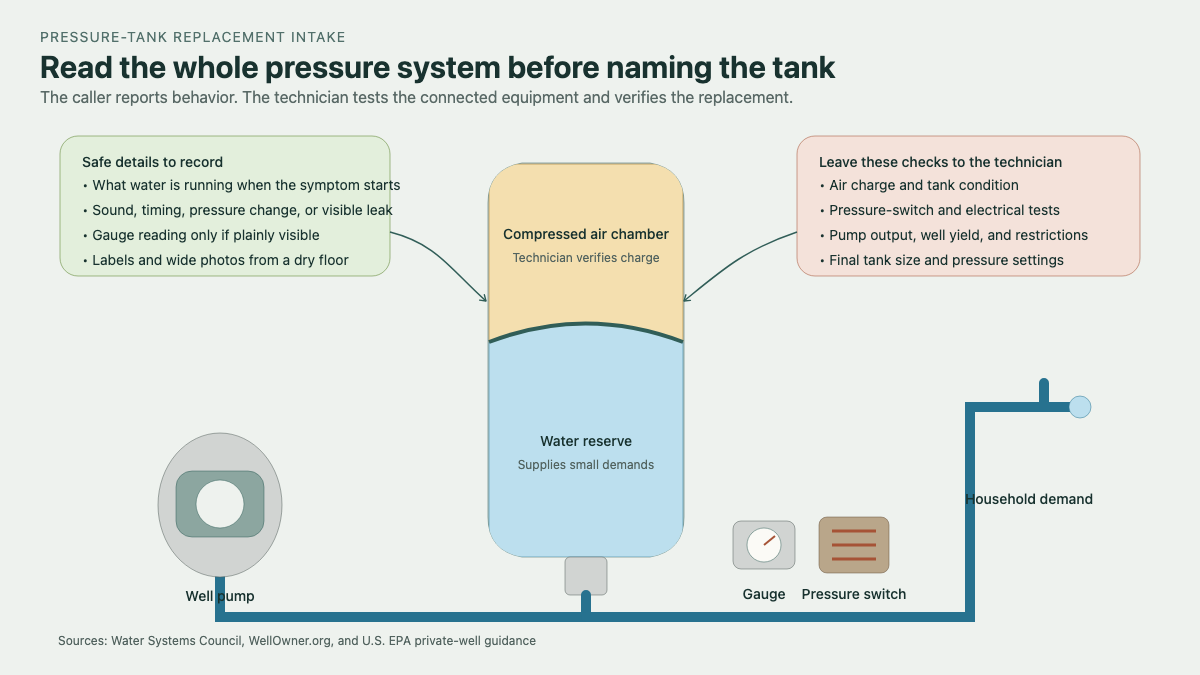
A pressure tank sits inside a connected private water system. The EPA’s private well overview describes the well, pump, casing, screen, piping, and related equipment as parts of that system. Inside the building, controls, valves, treatment devices, branches, and fixtures add more places where a complaint can begin.
Preserve the caller’s wording in the ticket: “Customer believes pressure tank failed.” Do not turn it into “Replace failed pressure tank” unless the diagnosis came from your technician or another identified professional whose report is attached. That small distinction protects the schedule. It also leaves room for a pressure-switch fault, pump problem, restricted filter, leak, unusual demand, or low-yield condition to be evaluated on site.
Ask who identified the tank. A neighbor’s opinion and a written service report are different evidence. If another contractor inspected it, request the report, estimate, photos, and any model or size they recorded. If the caller only saw an online symptom list, note that plainly.
Record one repeatable water-use scene
“Pressure is weird” does little for dispatch. Tie the complaint to one ordinary event. Ask what happens when the kitchen cold faucet runs by itself, when the shower starts, or when a toilet refills. Record whether the flow begins normally and fades, pulses, stops, or stays weak. Then ask whether the behavior changes when another fixture or appliance uses water.
Sound needs the same treatment. Where does the click, hum, knock, or vibration seem to come from? Does it happen while water is running, after the faucet closes, or when nobody is using water? If the caller can time the pattern from a safe location, write the observed intervals into the ticket. “Clicking fast” becomes “utility-room click about every twelve seconds while the kitchen faucet runs.”
The Water Systems Council’s pressure-tank sizing guide explains that a pressure tank supplies water between pump cycles and helps prevent rapid cycling. That function makes cycling behavior useful evidence. It does not make rapid cycling a phone diagnosis.
If the main complaint is repeated pump starts, use the dedicated well-pump short-cycling call intake. If the caller reports weak flow, first localize it with the whole-house versus one-fixture pressure check. Link those observations to the same service address.
Capture what can be seen safely
A gauge reading can help when the gauge is plainly visible from a dry floor. Ask the caller to read what it shows before, during, and after the named water demand. Mark every value as caller-reported. Do not coach anyone to tap the gauge, remove a cover, operate a drain, or reach past piping and wiring.
Visible water changes the call. Ask whether the floor is damp, actively collecting water, or dry now. Record the exact location: at the tank base, a fitting, the tank tee, a pipe joint, the pressure switch, the ceiling, or somewhere the caller cannot identify. If water is near electrical controls or the caller smells burning insulation, stop the observation and route the call under the company’s urgent safety rules.
Request photos by text or email. The useful set is short:
- One wide photo showing the tank, nearby pump or controls, pipes, filters, softener, floor, and ceiling
- Close photos of readable tank, pump, control-box, and treatment-equipment labels
- A photo of the gauge and tank connections taken from a safe standing position
- A photo of visible leakage or corrosion without moving, wiping, or opening anything
- The latest invoice or service label, especially after a recent pump, switch, filter, or plumbing repair
A label can identify the manufacturer and model. It does not prove that the same size should be installed again. Equipment may have been changed, the household demand may be different, or an old installation may need correction.
Separate tank identity from tank selection
Callers often want the office to quote from a tank’s outside dimensions. That is rarely enough. The Water Systems Council says tank selection depends on system demand, pump capacity, and well capacity. WellOwner.org’s water-pressure guide adds an important limit: a pressure tank holds reserve water for small demands, but it cannot provide sustained flow beyond the pump’s capacity.
This is why the intake should record household and property use. Note the number of occupied buildings, bathrooms, residents, irrigation zones, livestock waterers, treatment systems, and any recent addition that changed demand. Ask whether the goal is to replace a leaking tank, stop a cycling complaint, improve pressure during simultaneous use, or support a new load. Those requests may sound alike during the first minute. They do not describe the same design problem.
Penn State Extension’s low-yield well guidance distinguishes the limited storage in a pressure tank from larger intermediate storage used to manage peak demand. Keep that distinction in the office script. “We need a bigger pressure tank” may be a tank-replacement request, a demand problem, or a low-yield-system question. The field assessment decides.
Plan the physical route to the equipment
A correct part on the wrong truck still loses time if the tank is behind a locked crawlspace door or down a stair with a tight turn. Ask where the equipment is: basement, crawlspace, utility closet, garage, well house, barn, or exterior enclosure. Record the path from the parking area.
Get specific. Are there stairs? How many turns? Is the doorway narrower than the tank’s widest point? Is there room above the tank and around its connections? Are boxes, shelving, appliances, or stored fuel in the work area? Is the floor dry and firm? Can the service vehicle reach the wellhead if the technician needs to inspect more than the tank?
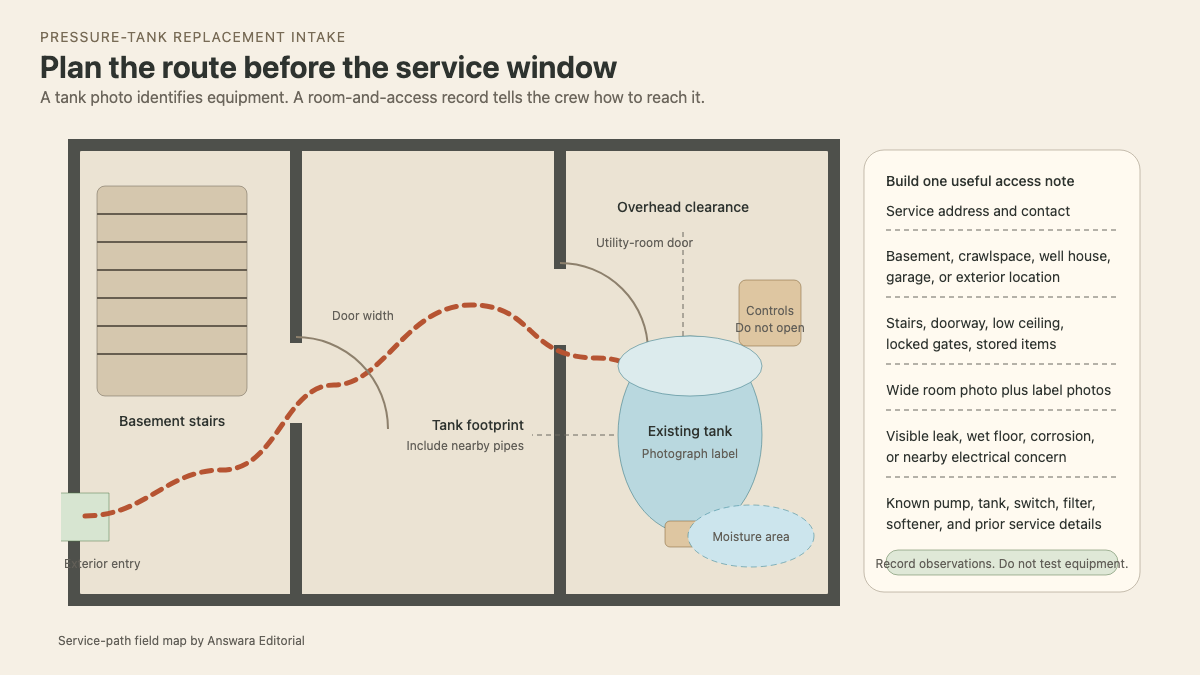
Do not tell the caller to clear a wet or electrically hazardous area. The office can ask for ordinary clutter to be moved only when the path is safe and company policy allows it. Pets, gates, tenant access, alarm codes, and an adult decision-maker belong in the appointment note too.
Build the work order the technician can trust
Before closing the call, read the record back in operational language. A useful note sounds like this:
“Water is available. The upstairs shower begins strong, then pulses while running alone. Caller hears a click near the basement tank about every fifteen seconds. Gauge is visible and caller reports it moving between two readings, which are attached as observations. Floor is dry. Existing tank and pump labels are in the photos. Equipment is down one straight flight, through a utility-room door, with shelving close to the left side. A filter was replaced last week. Customer requested tank replacement; diagnosis has not been confirmed.”
That note gives the technician a repeatable condition, equipment context, and service route. It makes no promise about the failed part or final price.
An AI receptionist can collect the same fields after hours when the contractor defines the safety stops and escalation rules. A person still owns the field diagnosis and quote. The best final sentence to the caller is concrete: “Maya will review your photos when the office opens at 8 a.m. and confirm whether this should be booked as a diagnostic visit or a verified tank replacement.”