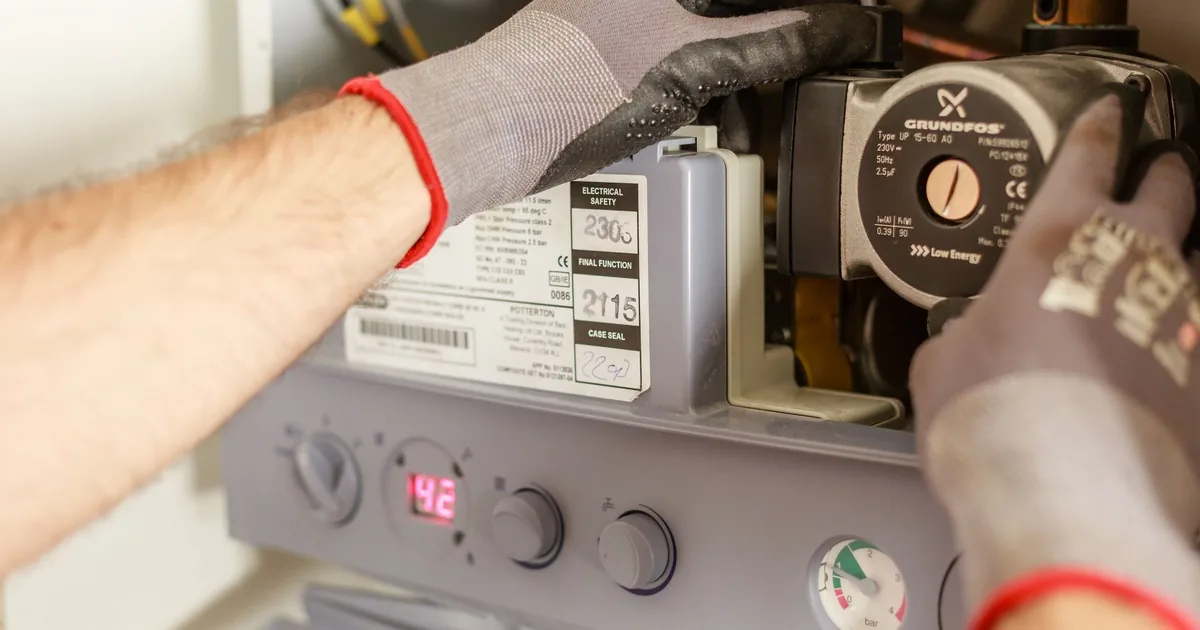
“The pump clicks on, shuts off, then starts again” is a useful complaint only after the office pins down what the caller hears. A pressure-switch click, a pump motor, pipes knocking, and a water-treatment unit can all be described as “the pump.” Ask where the sound comes from, whether a faucet or appliance is using water, and what the water does at the same moment.
For a well pump short-cycling service call, capture five things early: the repeating sound or visible component, the water use that triggers it, the length of the on and off periods, the pressure or flow behavior at a fixture, and any leak or electrical warning. Do not ask the caller to remove a control cover, touch wiring, drain a pressure tank, or adjust a switch. The technician needs an observation record, not a repair attempt.
Confirm what is actually repeating
Start with the caller's location. Are they beside a pressure tank in a basement, near an above-ground jet pump, outside by a well house, or hearing a faint click through a utility-room wall? If they can safely point to the equipment without touching it, ask what moves, lights up, hums, clicks, or stops.
Then tie the cycle to water use. A clean intake sounds like: “The motor runs for about eight seconds while the kitchen faucet is open, stops for twelve seconds, then repeats.” A vague intake says: “Pump bad.” The first record gives the field technician a repeatable condition. The second leaves the technician to rebuild the call in the driveway.
Ask whether the cycling happens with one small demand, such as filling a glass, only with a larger demand, such as a shower or irrigation zone, or even when nobody is knowingly using water. Those conditions should be written separately. Do not tell the caller what they prove. A running toilet, hidden leak, treatment cycle, pressure-system fault, control issue, or other system condition can create overlapping reports.
WellOwner.org's maintenance guidance lists frequent pump cycling among the signs that a water well professional should evaluate the system. That supports prompt service, but it does not identify the failed part over the phone.
Time the pattern under ordinary water use
Ask the caller to use a clock or phone timer while the system operates under an ordinary, safe demand. Record the approximate run time, the quiet interval, and the fixture that was open. Two observed cycles are usually enough to describe the pattern. The goal is a service note, so there is no reason to keep the equipment cycling for a long demonstration.
Do not impose a universal cutoff such as “anything under one minute is bad.” Pump size, tank design, pressure settings, fixture flow, and system type vary. A timer creates evidence for this property under this demand. It is not a pass-fail test.
The Water Systems Council's pressure-tank sizing guide explains that a pressure tank supplies water between pump cycles and helps prevent rapid cycling. It also says tank selection depends on system demand, pump capacity, and well capacity. That is why the office should record what was running during the timed observation.
If a pressure gauge is plainly visible from a dry floor, the caller may read it without touching equipment. Record the high and low readings they see and whether the needle moves smoothly, jumps, or appears stuck. Do not coach them to change settings or tap the gauge. Label the readings as caller-reported.
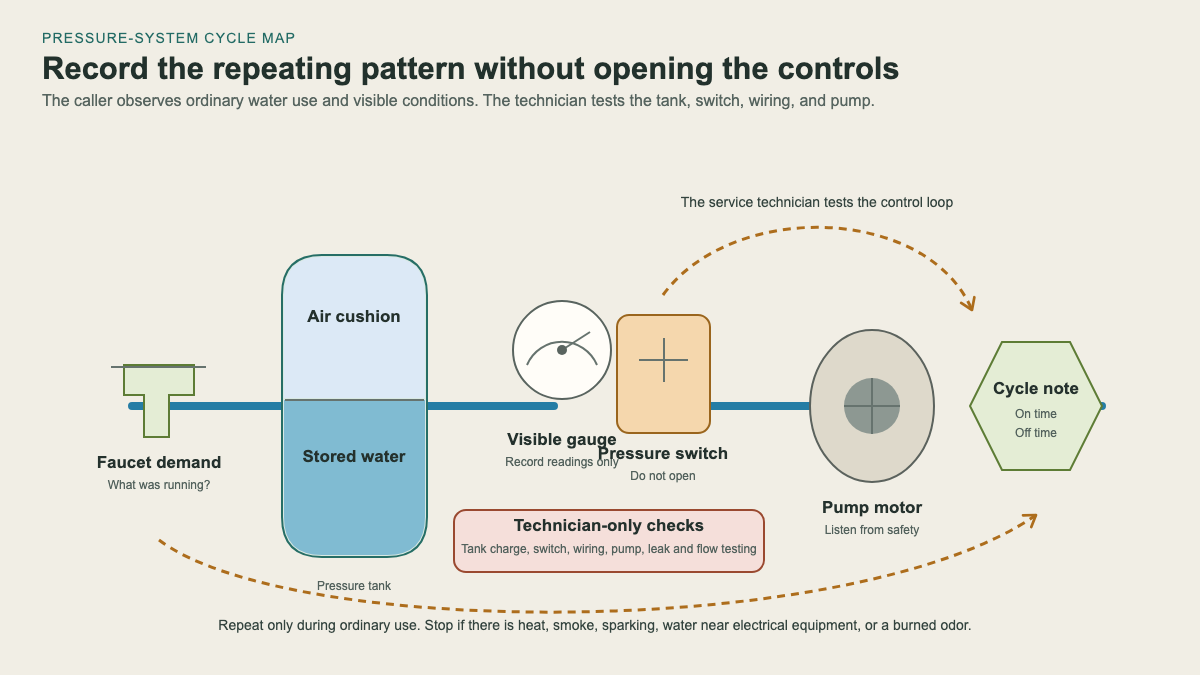
The map separates observation from testing. It also prevents a common call-handling mistake: jumping from “fast clicking” to “bad pressure tank” before anyone has established whether the sound is the switch, a relay, a treatment valve, or something else.
Ask what the water does at the fixture
The pump cycle and the water symptom belong in the same note. Ask whether flow stays steady, pulses, starts strong and fades, or drops when a second fixture opens. Compare hot and cold at one faucet if the caller can do so through normal use. Then ask whether the issue affects one fixture, one area, or the whole house.
A caller may report normal water at the kitchen sink and pulsing water in an upstairs shower. Another may report that every fixture surges in time with the clicking. Keep those patterns intact. Our guide to low-water-pressure well service calls provides a location-first intake when pressure or flow is the main complaint.
Ask whether water ever stops completely. A complete loss of water belongs on a different urgency path, especially when the home has livestock, sanitation needs, or medical equipment that depends on water. Use the office's no-water emergency call process when no fixture produces water.
Record recent changes and system history
The most useful history is concrete and dated. Ask when the cycling began and what work or event occurred shortly before it. A power outage yesterday, a pressure tank installed last month, a filter changed this morning, a new irrigation zone, a plumbing repair, or a sudden increase in household use gives the technician a sequence to investigate.
Pull the property record while the caller is still on the line. The WellOwner routine maintenance practices recommend keeping well logs plus records for the pump, controls, pressure tank, and related equipment. For repeat customers, the office may already have the pump model, tank model, installation date, pressure settings from the last visit, and prior technician notes.
Capture these fields in one ticket:
- Exact sound or component observed, plus where the caller stood
- Fixture or appliance running during the cycle
- Approximate on time and off time for two cycles
- Flow behavior and whether one fixture or the whole house is affected
- Visible gauge readings, labeled as caller-reported
- Cycling when no water is knowingly in use
- Recent outage, repair, tank work, filter service, irrigation change, or occupancy change
- Visible water, corrosion, heat, smoke, sparking, burned odor, or repeated breaker trip
- Known pump, tank, control, treatment, well-log, and prior-service details
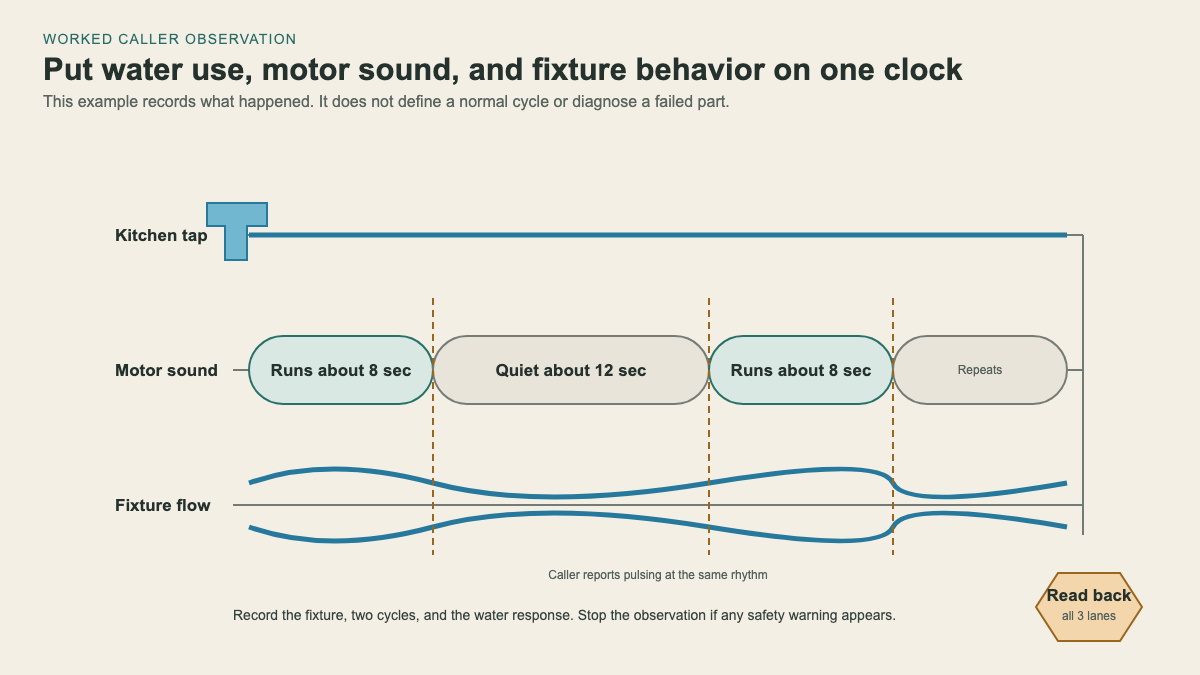
Read the ticket back. “Pump keeps turning on” might become: “Caller hears the motor beside the basement pressure tank. With the kitchen cold tap open halfway, it runs about eight seconds, stops about twelve seconds, and repeats. Water pulses at the same rhythm. Caller sees no active leak and reports no heat, smoke, sparks, or burned odor. Cycling began after a two-hour power outage last night.”
Keep electrical and pressure tests out of the call script
A caller who owns a multimeter may still be standing on a wet basement floor. Reception should never direct electrical testing, pressure-switch adjustment, control-box inspection, breaker-panel work, tank draining, or air-charge testing. Those steps require the right procedure, instruments, and site conditions.
WellOwner.org advises owners to contact a professional for burned wiring odors and damaged components. Its annual inspection guidance says a professional check may include system output, water levels where possible, pump motor performance, pressure tank function, and pressure switch contacts. The field visit is where those measurements belong.
Escalate smoke, sparking, a hot electrical component, a burned odor, repeated breaker trips, flooding, or water around electrical equipment according to company policy. Tell the caller to stay away from the affected area. Do not promise that shutting off one control will make the site safe unless the company's qualified technician has approved that instruction for the exact situation.
Assign the next step and one owner
Route the call based on the recorded symptom and safety screen. The next step may be an urgent technician callback, a same-day diagnostic visit, or a scheduled service appointment. State the appointment scope plainly. If the visit is diagnostic, say so and explain the company's fee policy without predicting which component will need repair.
An AI receptionist can gather the same cycle timing, demand condition, fixture behavior, equipment record, and safety screen after hours. The routing rules still belong to the contractor. A good script prevents the system from naming a failed part or coaching a caller through hands-on tests.
Close with a person, action, and time: “Maya has your timed cycle note and equipment history. She will call by 8:30 tomorrow morning to confirm whether the technician needs photos or a site visit.” The technician now has a repeatable symptom, and the caller knows who owns the next move.