“The well water smells bad” can describe four very different scenes. The caller may notice a rotten-egg odor at every tap, a musty smell only at the guest-bath sink, a bleach odor after recent service, or something sharp that reminds them of fuel. Booking all four as routine treatment calls would throw away the most useful information the office can collect.
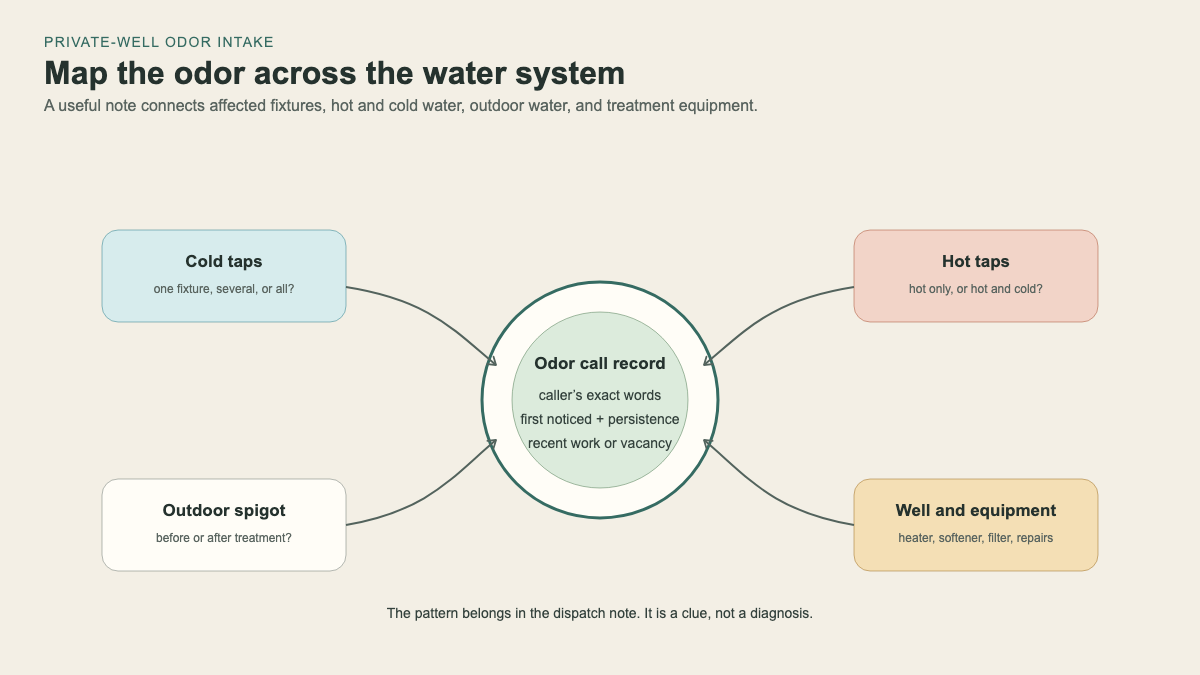
For a useful well water odor call, write down the caller’s exact words, which fixtures are affected, whether the odor appears in hot water, cold water, or both, and when it is strongest. Ask whether the smell follows a glass of water away from the sink. Check the outdoor spigot, recent vacancy, heater or treatment work, loss of pressure, and changes around the well. Fuel, solvent, sewage, illness, or a strong odor in an enclosed well space needs prompt safety routing under company policy.
The pattern helps the field team decide where to investigate. It does not identify a contaminant or prove that the water is safe.
Capture the caller’s words before interpreting them
Start with one plain request: “Describe the smell in your own words.” Record the answer as spoken. Rotten eggs, sulfur, swampy, musty, earthy, fishy, bleach, chemical, gasoline, sewage, metallic, and “like a wet basement” should remain observations in the note.
Do not quietly convert “rotten eggs” into a confirmed hydrogen sulfide problem. The Minnesota Department of Health explains that hydrogen sulfide can give water a rotten-egg odor, with possible sources in groundwater, the well, plumbing, or a water heater. It also notes that pollution is a rare possible source. That is enough reason to investigate, but it leaves several branches open.
Ask when the caller first noticed it. Was the home vacant for a week? Did the odor appear after a power outage, pump repair, water-heater replacement, filter change, softener service, well disinfection, flooding, or heavy rain? Does it happen at the first draw in the morning, after water has run, or throughout use? A timestamp and a recent-work note are worth more than an office diagnosis.
Intensity belongs in the record too. Use the caller’s comparison, such as faint, noticeable across the room, or strong enough that they left the area. Do not ask anyone to lean into a well pit, pump vault, basement corner, or well house to smell more closely. Minnesota health guidance warns that hydrogen sulfide gas can collect in low or enclosed spaces and says only well professionals with proper precautions should consider entering them.
Find out whether the odor is in the sink or the water
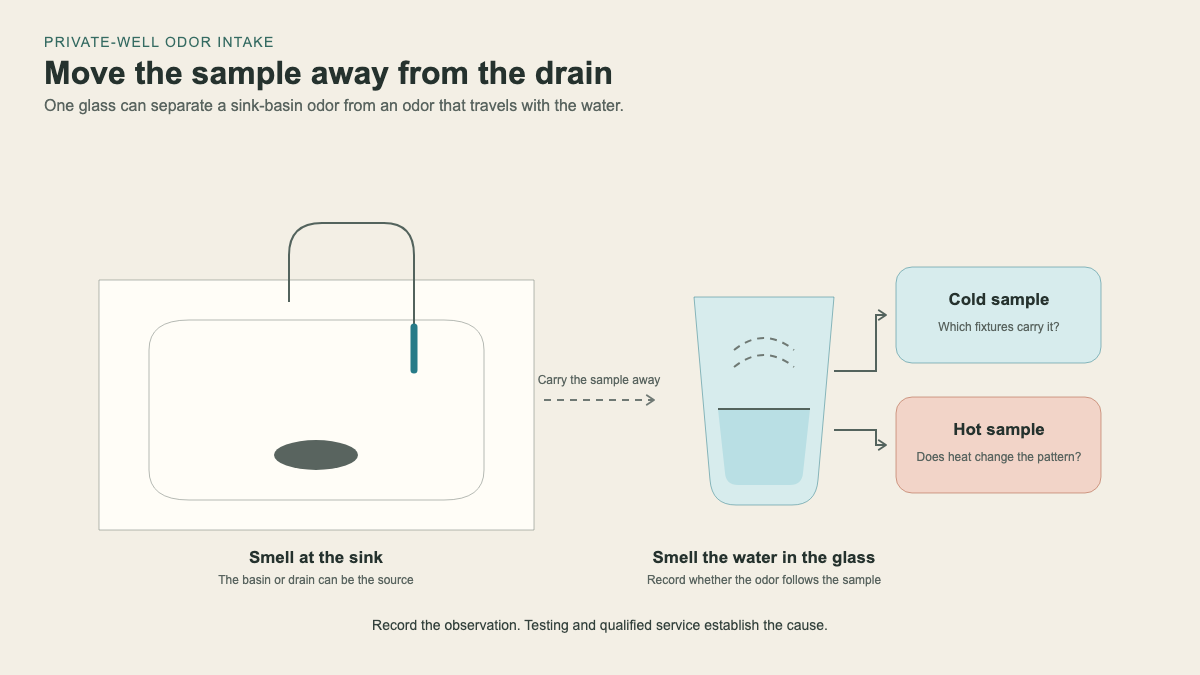
A caller standing over a drain can smell gas from the basin and assume it came through the faucet. The University of Georgia Cooperative Extension offers a simple distinction in its household water odor guide: fill a glass at the affected sink, step away, swirl the water, and check whether the sample itself has the odor.
Keep the request observational. The caller does not need to remove the trap, dismantle an aerator, open the well, change a heater setting, or add anything to the water. Ask what they notice at the sink and what they notice after carrying the glass away.
If the sink area smells but the glass does not, document that exact result for plumbing service. If the smell follows the glass, continue mapping the water system. Neither result is a final finding.
Map cold water, hot water, and untreated water
Move fixture by fixture. Ask about the kitchen cold tap, a second cold tap, hot water, an outdoor spigot, and any faucet that bypasses the softener or filter. Some homes have no untreated indoor tap, so record the plumbing layout as the caller understands it and let the technician verify it.
The University of Georgia guide says an odor at only certain faucets points the investigation toward those fixtures or their supply pipes. An odor at all faucets moves the main supply higher on the list. If the odor fades after water runs, household plumbing may deserve attention. A persistent odor can involve the source water or more than one part of the system.
Hot water is its own branch. Ask whether cold water from the same fixture smells normal. A hot-only rotten-egg report gives the plumber a reason to inspect the water heater, including its condition, recent idle time, service history, and anode arrangement. Do not tell the caller to remove an anode, raise the thermostat, disinfect the heater, or flush it. Those actions involve equipment, pressure, heat, scalding risk, and manufacturer instructions.
An outdoor spigot can help show whether the report exists before indoor treatment equipment. Ask whether the spigot is actually supplied before the softener or filter. Never assume. If the caller knows the bypass arrangement, record it. If not, mark it for verification.
Treat chemical and sewage reports as a separate lane
A rotten-egg description often dominates these calls, but the office has to listen for words that change the response. Gasoline, kerosene, solvent, turpentine, pesticide, sharp chemical, sewage, or detergent-like foam should not be folded into a routine sulfur-treatment appointment.
UGA Extension describes petroleum, gasoline, fuel-like, and solvent-like odors as potentially serious. Its guidance directs people to report the problem to the county health department. Follow the company’s emergency script, contact local health or environmental authorities as applicable, and escalate any suspected spill near the well.
Ask whether anyone feels ill or has eye, throat, or breathing irritation. Record who may have been exposed and the best callback number. Office staff should route medical questions to an appropriate healthcare professional, poison control, or emergency service under policy. They should not connect a symptom to the water over the phone.
Sewage odor deserves the same discipline. Ask whether there is wastewater backing up in the building, standing sewage near the well, flooding, recent septic work, or damage around the wellhead. Keep people away from active electrical hazards and enclosed spaces. Do not promise that disinfection alone will solve the problem.
When the caller asks, “Can we drink it?” use a hard boundary: “We cannot determine water safety from an odor description. A certified laboratory and your local health department can give you the right testing and sampling instructions.”
Separate the service appointment from the water test
A service technician and a laboratory answer different questions. The contractor may inspect the well, pump, pressure tank, water heater, plumbing, softener, filter, aeration equipment, chemical feed, or other treatment components within the company’s scope. The technician needs model numbers, alarms, leaks, pressure changes, maintenance dates, and prior work orders.
Testing establishes what is present in the sample under the laboratory’s method. The CDC says a change in smell is a reason to test well water. It advises well owners to use a state-certified laboratory and consult local health or environmental departments about contaminants of concern. Sampling location, container, preservation, timing, and the requested panel can all depend on that guidance.
Do not hand the caller a universal sample procedure copied from an old office note. Give them the certified laboratory or local agency contact, or follow the company’s established referral process. A service visit can proceed while testing is arranged, but the two records should stay linked.
This distinction also prevents overlap with a cloudy or discolored well water call. Appearance changes need their own testing and event record. Odor calls add the sink-versus-glass observation and the hot, cold, fixture, and equipment map.
Give the technician a note they can act on
A finished dispatch note should include the service address, caller and callback number, private-well status, caller’s odor words, first noticed time, persistence, and intensity. Add the affected cold taps, affected hot taps, outdoor-spigot result, and whether each fixture is before or after known treatment equipment.
Then add the context: vacancy, pressure loss, flooding, rain, nearby excavation, septic concern, pump work, heater work, filter or softener service, well disinfection, and any chemical use near the well. List symptoms, spill concerns, electrical hazards, and enclosed-space concerns in the escalation field. Attach earlier lab reports and equipment records when available.
Read the note back in ordinary language: “You first noticed a rotten-egg smell at the kitchen sink this morning. The odor follows a cold-water sample away from the drain and appears at both bathroom cold taps. Hot water smells stronger. The outdoor spigot before the softener also has the odor. The home was vacant for nine days, and no recent well, heater, or treatment work is known. You reported no fuel or solvent smell, flooding, illness, active leak, or electrical warning.”
If the caller also reports rapid pressure changes or a pump that starts and stops repeatedly, route that symptom under the company’s well-pump short-cycling intake. Keep the odor and equipment symptoms in one customer record.
An AI receptionist can collect this pattern after hours under a contractor’s approved rules. The script needs the same restraint as a trained human: capture the words, map where and when the odor appears, screen the safety lane, and assign the next owner.
Close with a named handoff. “Maya has your service note and will call by 9 a.m. about the inspection window. I also sent the county laboratory contact for sampling instructions.” That is a useful answer at 2 a.m., even though nobody on the phone has tried to name what is in the water.