“The well went dry” arrives as a conclusion. The homeowner may have lost water during the second load of laundry, noticed air at the kitchen faucet, and heard the pump run longer than usual. It has not rained much in weeks, so drought feels like the obvious cause.
Your office should treat drought as important context, then build the ticket from observations. Ask whether every fixture is affected, when the change began, whether water returns after the system rests, and what was using water beforehand. Screen for electrical hazards and immediate household needs. A well contractor still has to measure water levels and check the pump, controls, pressure tank, plumbing, and records before anyone can say the well is dry.
Treat drought as context, not a phone diagnosis
Dry weather can reduce groundwater recharge and lower the water available to a private well. The EPA’s drought guidance notes that wells can run dry when less water reaches aquifers or pumping increases. That makes recent rainfall, local drought conditions, and nearby well trouble useful details.
But the weather does not settle the service diagnosis. Penn State Extension lists several other reasons a well system may stop delivering water: a worn or failed submersible pump, an electrical or pressure-switch problem, a pressure-tank problem, or restricted flow caused by sediment or iron bacteria. A dropped groundwater level is another possibility.
Use neutral language in the work order. Write, “Caller reports no water at all fixtures after two loads of laundry; water returned for five minutes after a two-hour rest; county is under a drought declaration.” Do not write, “Well is dry and needs to be deepened.” The first note can be verified. The second one commits the technician to a cause and repair before testing.
If the loss was sudden and has no dry-weather pattern, route the call through your no-water well pump emergency intake. If water is still available but pressure has weakened, the whole-house versus one-fixture guide gives the office a narrower symptom record.
Screen hazards before discussing drought
Ask about safety near the top of the call. Is there standing water around the pressure tank, control box, well equipment, or electrical panel? Does the caller report smoke, sparking, a burning odor, unusual heat, damaged wiring, or a breaker that trips again after being reset?
Use the company’s emergency safety policy when any of those conditions are present. Keep the caller away from wet or damaged electrical equipment. Reception should not coach someone through removing a control-box cover, touching wiring, testing voltage, or repeatedly resetting a breaker.
Then identify the immediate water need. Record how many people are at the property and whether there are infants, older adults, medical needs, livestock, boarded animals, or a business that depends on sanitation. Ask what safe stored water is available now. A house with two adults and bottled water can still need urgent service, but its continuity plan differs from a dairy operation, veterinary boarding building, or home where a medical routine requires water.
Local boards of health, emergency management offices, public works departments, and water suppliers may have drought-specific resources. The exact path varies by jurisdiction. MassDEP’s private-well drought page, for example, tells Massachusetts residents to report a dry well locally and discusses bulk-water and municipal-connection possibilities. Build your office script from the agencies and rules in your own service area.
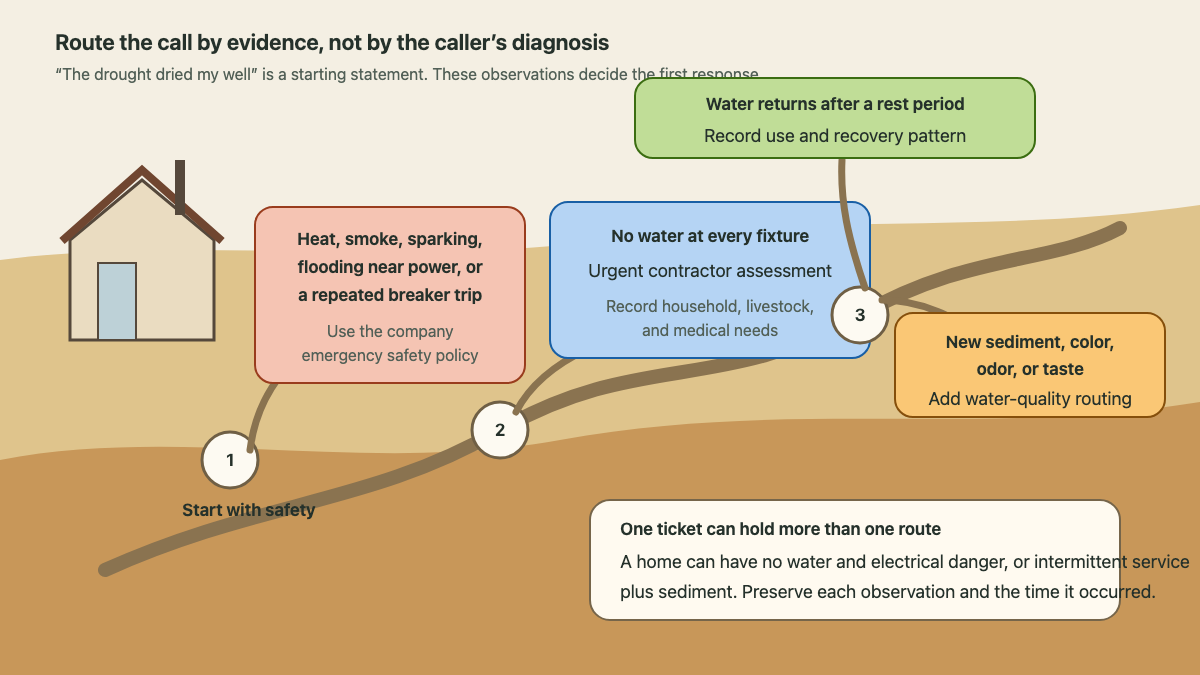
One ticket can carry more than one route. A caller may report complete water loss, a hot control box, and brown water just before the taps stopped. Preserve all three observations and their timing.
Capture the pattern around the last usable water
Start with location. Ask the caller to check whether the condition affects cold and hot water at more than one fixture, without opening equipment or performing electrical tests. Record whether an exterior spigot, detached building, barn line, or irrigation system behaves differently. “No water upstairs” is a different starting point from “No water anywhere on the property.”
Build a short timeline next:
- When was normal water service last confirmed, and which fixture was used?
- Did flow fade, pulse, spit air, or stop at once?
- What heavy water uses were running beforehand, such as laundry, showers, irrigation, livestock watering, pool filling, or a leaking toilet?
- Did water return after a rest period? If so, how long did the system rest, how much water returned, and when did it stop again?
- Were there recent outages, lightning, electrical work, pump service, filter changes, plumbing repairs, excavation, or nearby drilling?
- Did neighbors on private wells report a similar change?
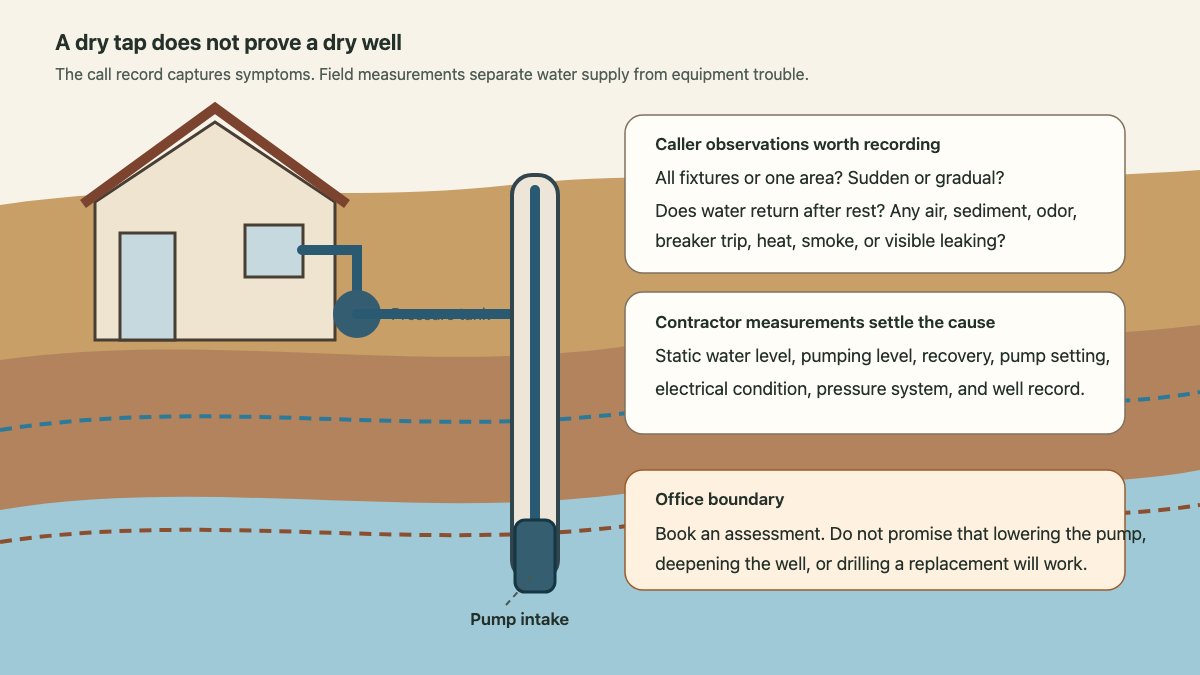
Water that returns after a quiet period is a particularly useful observation. Penn State describes a condition in which frequent pumping during showers or laundry temporarily drops the water level below a submersible pump. The well may recover enough to supply water again after demand stops. That pattern does not prove low yield because equipment and pressure-system faults can imitate parts of it. Record the times and uses. Let the technician measure.
Ask about sound only if the caller can describe it safely from normal living space. “Pump runs for a long time,” “rapid clicking near the tank,” and “air sputters at the faucet” are observations. Avoid asking the caller to stand beside hot, wet, damaged, or exposed equipment.
Add water-quality changes to the same record
Drought-related calls often start with quantity, yet the caller may also mention cloudy water, sand, orange staining, metallic taste, or air bubbles. MassDEP explains that a lower groundwater elevation can change how water enters a well and may draw more sediment. It can also change water chemistry. Those possibilities make the symptom worth recording, but they do not tell the office whether the water is safe.
Ask when the appearance, odor, or taste changed and whether it affects every cold-water fixture. Find out whether the caller has used the water for drinking or food preparation since the change. Then apply the company’s local water-quality policy, which should name the public-health authority and certified laboratories for the service area. Do not improvise a universal boil notice or testing panel.
Route a visible change through the separate cloudy or discolored well-water intake while keeping the loss-of-water assessment on the same ticket. The technician and any laboratory need the full sequence.
Gather records before the truck rolls
Ask for the original well completion report, sometimes called a well log. Useful fields can include the construction date, total depth, casing, reported yield at completion, water-bearing zones, and contractor. Do not treat an old completion yield as today’s measured capacity. It records conditions at construction.
Also request pump invoices or installation records, the reported pump setting, pump make and model, pressure-tank label, treatment-equipment list, and notes from prior service. Photos should be taken only from a safe standing position. The most useful set usually shows the wellhead and surrounding ground, the pressure tank and controls from several feet away, equipment labels, any visible leak, and a glass of changed water against a plain background.
Confirm access. Is the wellhead buried, in a pit, under a deck, behind a locked gate, or inside an enclosure? Can a service truck reach it? Note soft ground, steep drives, low branches, overhead lines, animals, and gate codes. Dry weather does not guarantee firm access, especially where irrigation leaks, springs, or recent tanker deliveries have softened the approach.
Book the assessment without promising the repair
Callers usually ask one of four questions: Can you lower the pump? Can you deepen the well? Do we need a new well? Will rain bring the water back? The honest office answer is that the contractor needs measurements and records before recommending an option.
Penn State and MassDEP both discuss lowering a submersible pump, deepening an existing well, or drilling a replacement. They also describe limits. A lower pump setting may be impossible or may bring more sediment. Deepening may fail to improve yield and can change water quality. A replacement well still depends on local geology, siting, permits, and construction decisions. Waiting for rain offers no dependable service date.
Close with an owned next step. “Jordan will review the well log and call notes by 9 a.m., then confirm whether we can send a pump technician or need a driller assessment first.” If your company charges a diagnostic or travel fee, explain what the visit includes and when payment is due.
A complete handoff can stay short: “No water at all fixtures since 6:40 p.m. after irrigation and one shower. Water returned for about eight minutes after a three-hour rest. Caller reports air at the kitchen faucet, no visible leak, no heat, smoke, sparking, or breaker trip. Two adults, one infant, and four horses are on site. Bottled drinking water is available overnight; livestock storage is limited. Well log and 2019 pump invoice attached. Locked north gate; owner can meet the technician at 7 a.m.”
That note gives the field team a place to start. It also keeps the office from selling a pump adjustment, well deepening, or replacement before a single water-level measurement has been taken.