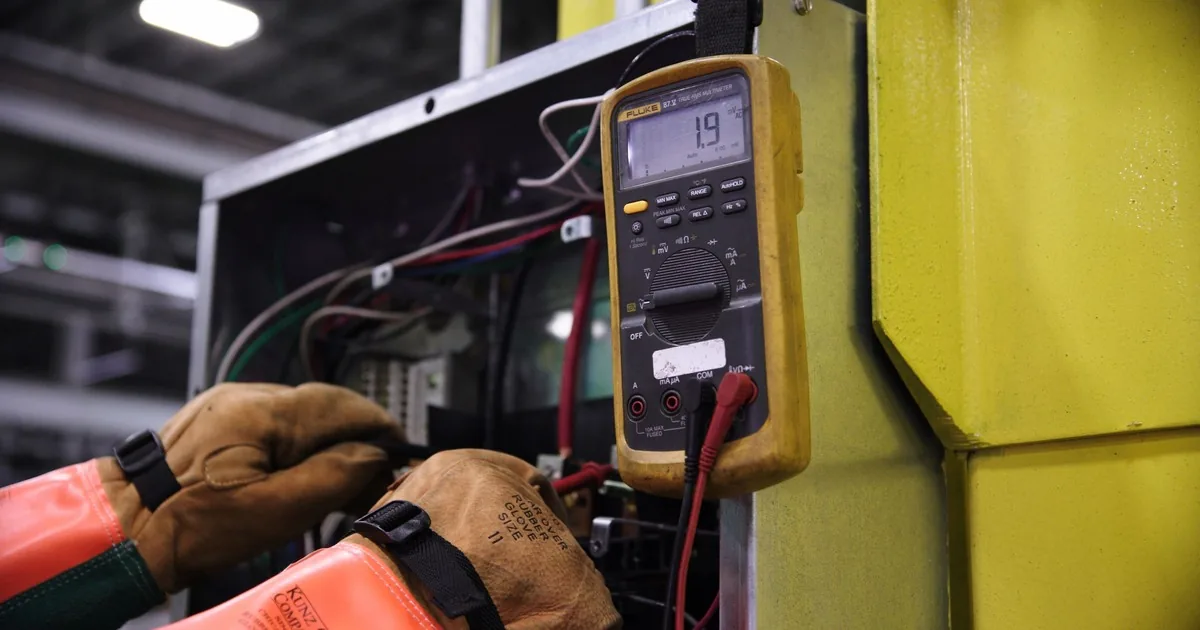
A homeowner calls at 6:40 a.m. and says, “The box clicks once, but the pump never starts. I need the control box replaced.” The first sentence is useful. The second is a requested repair, not a confirmed diagnosis.
A strong control-box service ticket records the water condition, exact sound and timing, visible information on the closed enclosure, breaker history, recent electrical or well work, and the installed pump or motor records. Screen for heat, smoke, sparking, burned odor, and water around electrical equipment before discussing an appointment. Nobody on the phone should remove a cover or test an energized part.
Keep the customer’s diagnosis in quotation marks
Write “customer requests control-box replacement” or “customer believes the control box failed.” That wording preserves the request without turning it into the technician’s finding.
Loss of water can originate in several places. Penn State Extension lists a worn submersible pump, a malfunctioning switch near the pressure tank, pressure-tank trouble, low well water, and sediment among the possibilities that may reduce or stop supply. Wiring, cable, protection devices, and the motor add other questions that require field tests. A click or hum can help locate a sound. It cannot identify the failed part by itself.
Ask who suggested replacement. The answer may be “a technician tested it yesterday,” “the neighbor had the same noise,” or “I found a video.” If a contractor already inspected the system, collect the company name, visit date, written findings, test results the customer has in hand, and any part number that was recommended. Do not paraphrase “possible bad control” into “bad control.”
Run the electrical hazard screen first
Ask whether the caller sees smoke, sparks, unusual heat, a scorched enclosure, exposed wire, or standing water near the pressure switch, control box, disconnect, or service panel. Ask about a burned odor. If one of those conditions exists, follow the company’s electrical or emergency escalation procedure and keep people away from the area.
WellOwner.org advises owners to bring burned wiring odors and electrical concerns to a water-well professional or qualified electrician. Its maintenance guidance also says that a breaker which trips more than once needs professional diagnosis. Reception should never coach repeated resets, tell a caller to hold an overload button, or suggest that switching one breaker makes opened equipment safe.
Record every action already taken. “Breaker reset once at 6:25; it tripped again immediately” is materially different from “breaker was off and has not been touched.” If the caller removed a cover before calling, tell them to stay clear under company policy. Do not ask them to put a hand back inside for a better photo.
For calls centered on repeated breaker operation, use the well pump breaker-tripping routing guide to collect the sequence without suggesting a reset.
Identify the control and motor from safe records
An external box is commonly associated with a three-wire, single-phase submersible motor, but the box still has to match the installed equipment. Franklin Water organizes its control boxes by motor application, horsepower, voltage, and control family. Its product lines can contain start capacitors, run capacitors, relays, overloads, or contactors in different combinations.
That is why “one horsepower” is incomplete. Ask for the manufacturer, model, catalog or part number, horsepower, voltage, and any serial number visible on the closed cover. Capture a straight, well-lit photo only when the enclosure is safely accessible and the company has a secure way to receive it. The photo should show the whole closed box and its label. A close-up that cuts off half the model number creates another callback.
Then look for the pump-installation record, prior invoice, well log, motor label photo, or old service ticket. WellOwner.org specifically recommends retaining records for the pump, controls, pressure tank, and well construction. A faded box label may be less useful than an invoice that names the motor installed below ground.
If the caller cannot find an external box, record that fact. Do not tell them one is missing. The system may use another control arrangement, and the person may be looking in the wrong location.
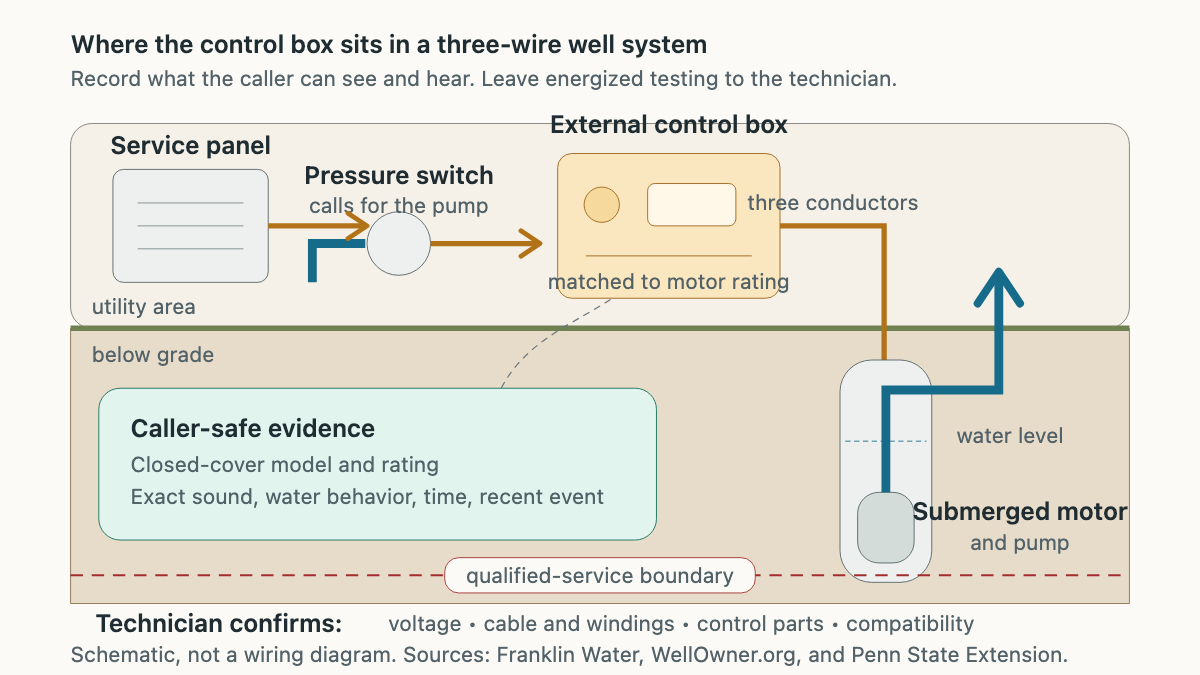
The cutaway is a location map, not a wiring diagram. It keeps four phone-safe observations above the service boundary: closed-cover identity, sound, water behavior, and timing. Voltage readings, cable and winding checks, internal component tests, and final compatibility stay with a qualified technician.
Record the symptom as a timeline
Start with the last normal water use. Ask which fixture was running, what the customer noticed next, and what the system did after that. Keep their words for sounds such as one click, rapid clicking, humming, buzzing, or silence. Note where the sound seems loudest without claiming its source.
Water behavior needs equal attention. Is the whole property without water? Does pressure fade during use? Does water return after waiting? Are hot and cold sides affected? Does an outdoor hydrant behave the same as the kitchen faucet? If rapid cycling is the complaint, the short-cycling intake guide covers timing, visible gauge behavior, and pressure-tank observations.
Ask about the events that changed the clock: outage, lightning, generator use, flooding, freeze, digging, electrical work, pressure-switch replacement, pump work, or a new protection device. Record sequence without assigning cause. “Water worked after the outage and stopped during the first laundry load” gives the field technician a clean boundary. “The outage fried the box” does not.
Any displayed light or code should be copied exactly, including punctuation. Do not translate it from memory. Ask whether the code stays on, flashes, clears, or returns, and whether the customer has a photo of the untouched display.
Separate a box visit from a pump-replacement quote
Some callers want a price for the box before anyone has identified the motor or tested the circuit. Explain the company’s diagnostic process in plain terms. The appointment is to inspect the well controls and determine the cause. Parts, scope, and price follow the technician’s findings and the customer’s authorization.
Avoid promising that the pump will stay in the well. If testing points beyond the control equipment, the contractor may need pump, cable, or well access. The well pump replacement quote guide explains which depth, access, property, and system records matter when replacement becomes the actual scope.
Ask how the loss of water affects the property now. Record occupants, livestock, tenant units, a home business, medical equipment that depends on water, and any approved alternate supply. Dispatch priority remains a company decision. Reception should not promise an emergency arrival slot before the schedule is confirmed.
Prepare the property for a diagnostic visit
Find the control equipment before the truck rolls. Ask whether it is in a basement, crawlspace, pump house, garage, utility closet, or outdoor enclosure. Record locked gates, steep or soft drives, pets, tenants, alarm instructions, parking limits, and the safest known path to the wellhead and pressure equipment.
Identify the person who can authorize diagnostic work and a repair. A tenant or property manager may report the symptom while an owner controls spending. Shared wells need the names of affected users and the person responsible for the equipment. Put secure access codes and account details in the customer system, never in public notes or casual text.
A useful read-back sounds like this:
“Whole house lost water at about 6:30 a.m. after one normal shower. Customer hears one click at the closed gray control box when a faucet opens, then silence. Box label photo and a 2021 pump invoice are attached. Label shows Sample Model CB-230; invoice lists a three-wire submersible motor, but technician must confirm the match onsite. Pump breaker was reset once before the call and held. No smoke, sparks, heat, burned odor, exposed wire, or water near electrical equipment reported. No cover was opened. Utility power failed briefly last night; water worked once after power returned. Control box and pressure tank are in the dry basement utility room. Wellhead is beside the north fence. Owner Jordan Lee will be onsite and can authorize diagnosis. Dispatch priority requires manager review because the home currently has no water.”
Read it back. Correct the model number, reset history, and timeline while the caller is still on the line.
An AI receptionist can collect these fields after hours if the contractor supplies the safety rules, escalation path, and equipment questions. The handoff should arrive as evidence, not as a repair decision. When the technician opens the service door, the first useful work should be testing the system that exists, not undoing a diagnosis made at 6:40 a.m.