“The home inspector said our chimney liner is cracked. How much will it cost to fix?”
That sounds like a repair quote. For the office taking the call, it is an inspection and records problem first. A cracked clay tile, an old camera image, debris near a cleanout, and a vague note in a real estate report are different pieces of evidence. None tells a receptionist which repair will fit the chimney.
Start by recording what prompted the call, whether anyone is in immediate danger, what appliance uses the flue, and which records already exist. Then schedule the evaluation your company actually provides. Keep spot repair, resurfacing, a metal liner, appliance work, and final pricing out of the first-call promise until a qualified person has seen the system.
Treat “liner repair” as a reported condition
Write down the caller's words before translating them. “The inspector saw a vertical crack on camera” is useful. So is “two orange tile pieces were in the cleanout after the sweep.” A work order that says only “needs liner” throws away the evidence.
Ask who raised the concern and when. Was it a home inspector, chimney sweep, HVAC contractor, firefighter, previous owner, or the caller? Did they inspect the full flue, look from one end, or mention an inaccessible area? Is there a written report, proposal, invoice, or video? If the caller has images, ask for the full set with labels and dates. One dramatic frame without its location can mislead the next person who sees it.
The safety reason for taking liner reports seriously is established. The U.S. Consumer Product Safety Commission explains that cracks and separation in an inner tile liner and surrounding masonry can allow hot flue gases to escape toward nearby combustible material. That guidance supports a qualified inspection. It does not support choosing a repair from a phone description.
Do not minimize the caller's concern. Do not confirm it either. A steady response works better: “I'll record exactly what the report says and arrange the next evaluation. The technician will confirm the condition and explain the appropriate scope after inspecting the system.”
Route active hazards before the quote lane
A consultation call can change lanes in one sentence. Ask whether there is an active fire, smoke entering the room now, a carbon monoxide alarm, falling masonry, or a chimney fire that has not been evaluated. Follow the company's emergency policy for any yes. If there is an active fire or alarm condition, the ordinary appointment script stops and the caller needs the appropriate emergency response.
After a suspected chimney fire, the caller may say everything looks normal. Hidden liner damage is the reason appearance is not enough. The Chimney Safety Institute of America describes an internal video inspection in which a camera is moved through the chimney and rotated to check component integrity and flue tiles for cracks.
Office staff should not guide a caller through a test fire, tell them to reach into a cleanout, or ask them to climb onto the roof for photos. Safe images taken from the room or ground can be attached to the record. Anything that requires opening a hot appliance, entering a confined area, or working at height belongs to the field team.
For a stable call with no active warning sign, note the last time the appliance was used and whether the company wants it left unused before the visit. State the company's real instruction. Avoid inventing a universal cool-down period.
Identify the appliance before talking about the liner
A chimney is part of a venting system. The office needs to know what enters it.
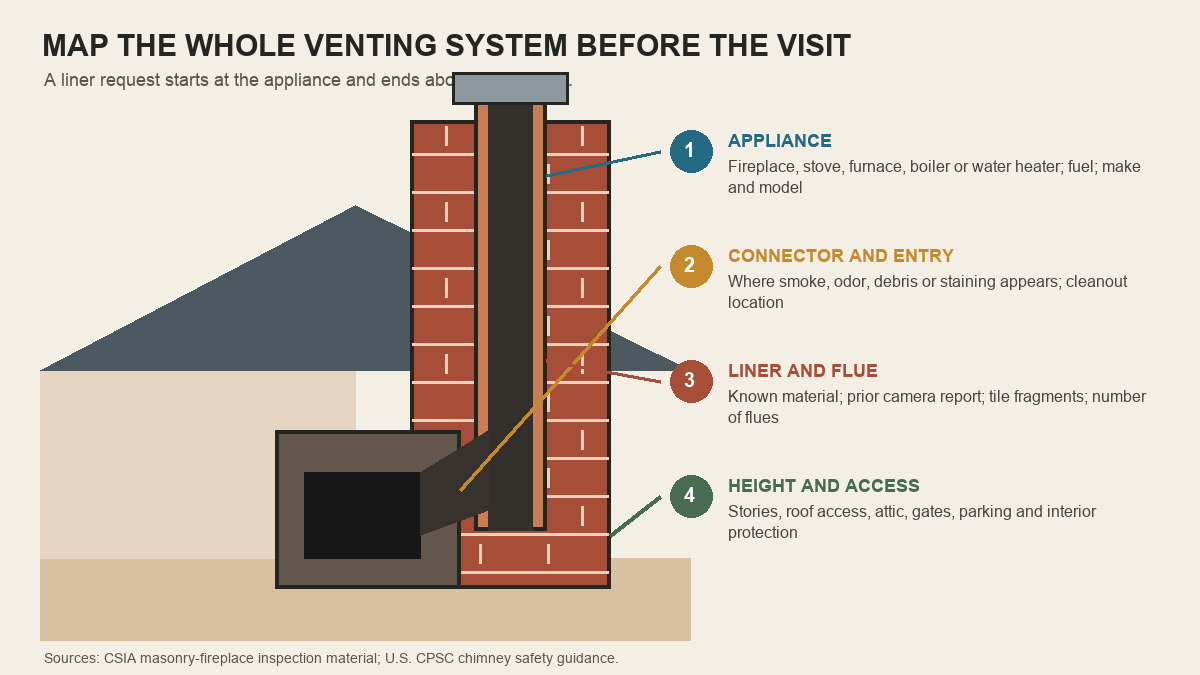
Ask whether the flue serves an open masonry fireplace, wood or pellet stove, fireplace insert, gas log set, furnace, boiler, water heater, or another appliance. Record the fuel. If the caller can read a make and model from a data plate without moving equipment, capture that too. Ask whether one chimney contains more than one flue and whether another appliance shares or adjoins the area.
Then locate the complaint. Did smoke spill at the fireplace opening? Is there odor near the cleanout? Were fragments found in the firebox, thimble, or chimney base? Did staining appear around an appliance connector? Has anyone changed the appliance or fuel since the last inspection?
These details do not diagnose liner failure. They tell the technician which system is involved and which records, tools, and access may matter. CSIA's masonry fireplace inspection material documents appliance, connector, flue, liner, dimensions, chimney height, and accessible areas. A front-desk intake can prepare those fields without pretending to perform the inspection.
Ask for records that change the field visit
The best pre-appointment packet is often already in the caller's email. Ask for the complete inspection report, camera images or video, prior repair proposal, sweep invoice, appliance installation record, and any permit or inspection paperwork the caller has. Keep the original dates and company names attached.
For a recent home purchase, identify who ordered the inspection and who owns the report. Note the closing date only if it affects access or scheduling. The workflow for chimney inspections before a home sale can help when an agent, buyer, seller, and current occupant all need updates.
Photos can fill practical gaps. Ask for the appliance from across the room, the connector if visible, the firebox or cleanout area, and a ground-level view of the chimney. The technician may also need roof material, approximate number of stories, attic access, gates, pets, parking limits, and whether furniture must be moved. A caller who lives in a condominium may need approval or access to a common roof.
Permit questions require the job address. Local rules differ. For example, the City of San José says a building permit is required there for structural chimney repair or relining. That is evidence of local variation, not a national rule. Tell the caller when and by whom local requirements will be checked. Never promise a permit outcome or timeline from a generic script.
Separate four kinds of evidence
Old reports, loose debris, operating symptoms, and a recent chimney fire should not land in the same appointment note.
An old report needs its date, author, complete findings, and images. Debris needs a safe photo, the place it appeared, and what happened shortly before it was found. Smoke, odor, or staining needs timing, appliance use, weather or wind observations when relevant, and alarm status. A recent chimney fire needs urgent routing, the date, any fire-service response, current use status, and prior records.
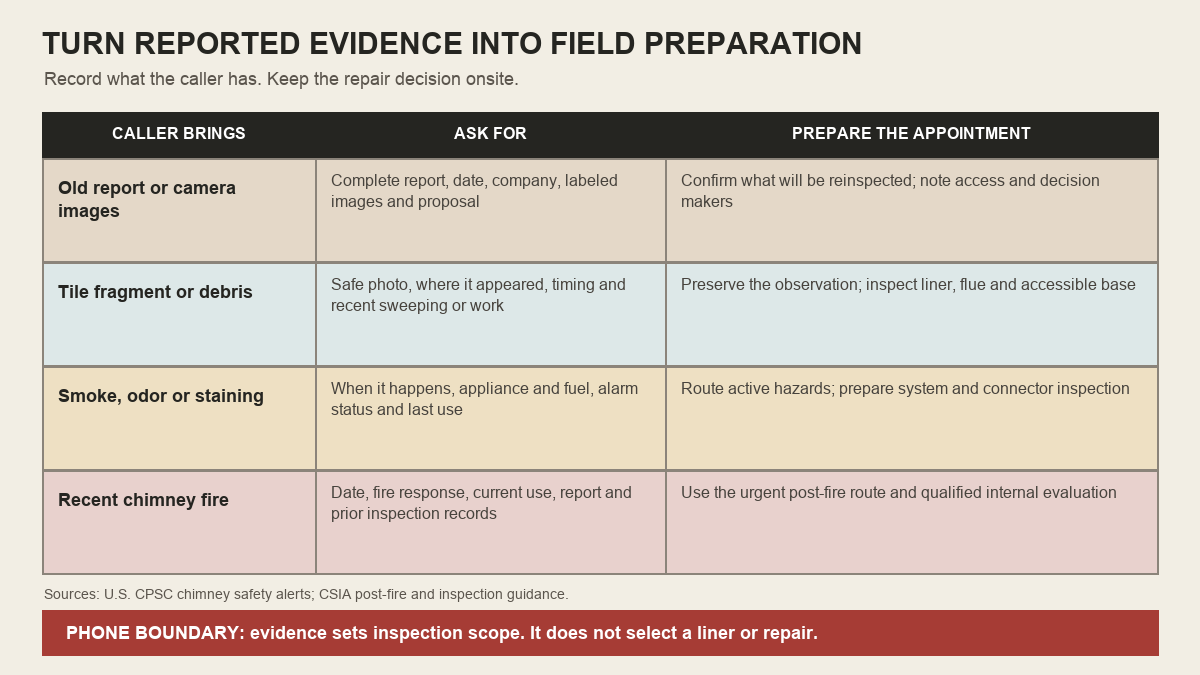
This distinction also keeps estimates honest. A caller may want a price for “a stainless liner” because another company mentioned one. Record the requested option, but do not turn it into the accepted scope. Liner material, dimensions, appliance connection, chimney condition, access, listing requirements, and local rules all belong in the field evaluation.
The same boundary applies to inspection levels. The article on Level 1 and Level 2 chimney inspection calls explains the triggers and intake differences. Use the company's documented standard to choose what can be booked. Do not have a receptionist improvise an inspection classification because the caller used the word “crack.”
Close with a precise appointment promise
Before ending the call, read back the trigger, appliance, fuel, location of the reported evidence, last use, records expected, access notes, and people who need the findings. Confirm whether the appointment is an inspection, a review of an existing report, a repair consultation, or a combination allowed by company policy.
Price language should name what is known. The office can quote an established inspection fee or explain how a consultation charge works if those figures are in the approved price book. It should not quote unseen liner work as though every flue has the same height, shape, connection, or condition.
A clean closing line is enough: “We have this booked as a liner evaluation. Please send the full report and images before the appointment. The technician will inspect the accessible system, document the findings, and discuss the repair scope after that review.”
That leaves the field team with more than “customer wants liner price.” They arrive knowing what started the concern, which appliance and flue are involved, what evidence exists, who controls access, and where the phone conversation properly ended.