A homeowner calls and says, “The gas fireplace needs a vent inspection.” The office still does not know whether the appliance sends exhaust through a sidewall terminal, a metal vent above the roof, or the masonry chimney left from a wood-burning fireplace. The caller may want routine service. They may also be reporting a carbon monoxide alarm or the smell of gas.
Start with safety, then identify the system. Ask whether a carbon monoxide alarm is sounding, anyone feels ill, there is an active gas odor, fire or exhaust is entering the room, or the appliance appears damaged. Urgent reports leave the routine calendar flow and follow the company’s emergency script. For an ordinary inspection request, capture the make and model, appliance type, fuel, visible vent route, exact symptom, timing, recent changes, service history, and access.
Route urgent reports before asking routine questions
One screening question belongs near the top of the call: “Is a carbon monoxide alarm sounding now, does anyone feel sick, do you smell gas, or is there active fire or exhaust in the room?”
Carbon monoxide cannot be seen or smelled. The U.S. Environmental Protection Agency says suspected exposure can cause headache, dizziness, confusion, nausea, fainting, and other symptoms. Its guidance tells people who suspect exposure to get fresh air immediately and seek prompt medical attention.
Reception should use approved emergency wording and the correct local contacts. Do not troubleshoot the alarm, ask the caller to relight the appliance, suggest opening or removing panels, or keep someone inside to complete intake. A gas odor, active fire, visible damage, or exhaust entering occupied space may require emergency services or the gas utility before a chimney or hearth appointment can be considered.
Once the immediate hazard has been addressed, the service office can document what happened and arrange the appropriate follow-up under company policy. Preserve the difference between “CO alarm sounded while fireplace was running” and “customer thinks the fireplace made carbon monoxide.” The first is an observation. The second is a diagnosis the call taker cannot make.
Identify the gas hearth before choosing the appointment
Callers use “gas fireplace” for several installations. Ask whether the unit has fixed glass, an open fireplace with ceramic logs, a metal insert inside an older fireplace, or a freestanding gas stove. Then ask for the manufacturer and model from a label, manual, invoice, or remote-control paperwork.
Do not send a caller searching inside a hot appliance. A wide photo of the full fireplace and a close photo of a safely accessible label are enough for office review. If no label can be found, record that fact. The field technician can determine what documentation and inspection steps are possible.
Fuel matters too. Record natural gas, propane, or unknown. Ask whether the caller knows of a shutoff nearby, but do not direct them to operate it during a routine intake script unless the company has approved wording for that exact situation.
The office should also confirm its service boundary. A chimney company may inspect a masonry flue that serves gas logs but may not repair a burner, valve, fuel line, electronic ignition, or sealed direct-vent appliance. Another hearth business may handle the appliance and vent as a listed system. Book what the company actually performs.
Map the visible vent path without diagnosing it
Three very different exhaust paths can sit behind the same caller phrase.
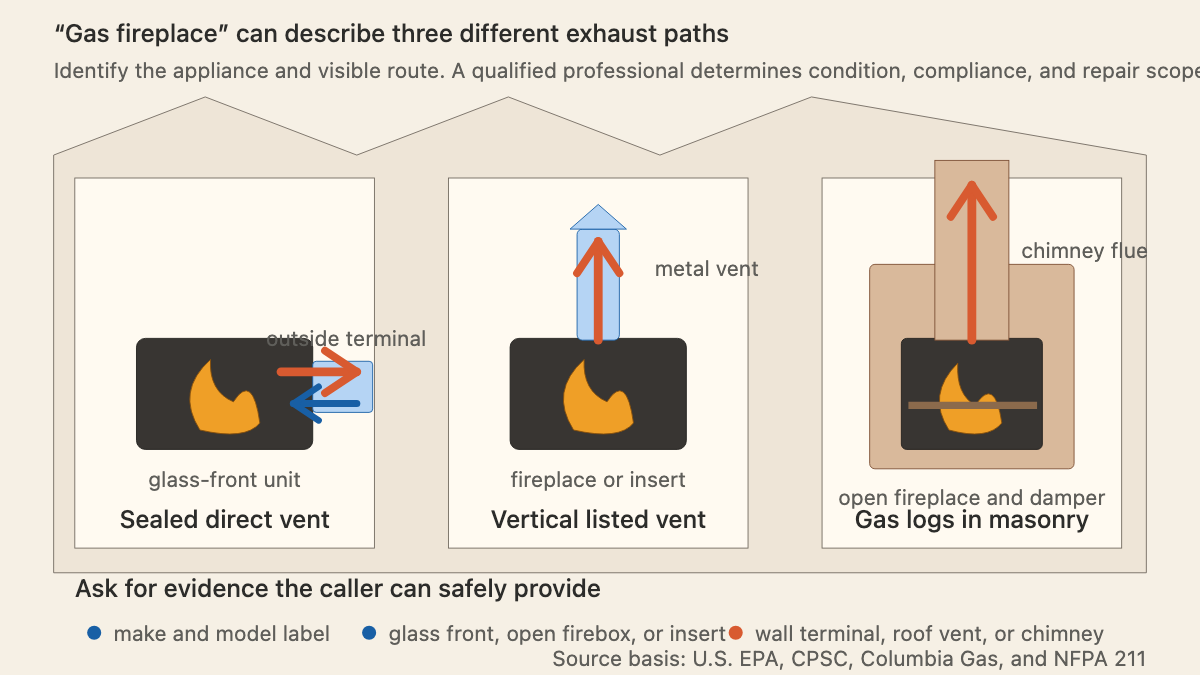
A sealed direct-vent fireplace commonly has fixed glass and a termination through an outside wall or roof. A vertically vented gas fireplace or insert may use a listed metal vent above the roof. Vented gas logs can use an open masonry fireplace and chimney. Those descriptions help route the call, but they do not prove how a particular system is built.
Ask the caller what they can see from the room and ground level. Is there fixed glass? Is the firebox open? Does a metal insert sit inside brick? Is there a round or rectangular terminal on the outside wall behind the appliance? Is there a chimney or metal vent above the roof? A photo of the exterior wall can be useful. Never ask a caller to climb a ladder or roof, remove a termination cover, open a sealed combustion chamber, or disconnect venting.
The NFPA 211 overview describes the standard’s role in safe flue-gas removal and the construction and installation of chimneys, fireplaces, and venting systems. Reception’s job is narrower. Collect enough evidence to choose the right service category and leave code, condition, and compatibility judgments to qualified personnel.
Record the symptom in the caller’s own words
“The vent is bad” gives the technician little to work with. Ask what the caller saw, heard, smelled, or experienced, and when it happened.
Useful details include soot on glass or nearby surfaces, repeated shutdown, delayed ignition, a pilot that will not remain lit, unusual odor during operation, moisture or staining near the appliance or vent, rust, visible gaps, debris at an exterior terminal, or a new noise. Record whether the symptom appears at startup, after the unit has run, only in windy weather, after heavy rain, or whenever another appliance or exhaust fan is operating.
A symptom can have more than one cause. Avoid telling the caller that yellow flame, soot, condensation, a failed pilot, or a cold room proves a vent defect. Columbia Gas of Virginia’s venting guidance advises professional review for proper venting, adequate air, blockage, and signs of deterioration such as rust, cracks, or holes. Those are field checks.
Ask about changes since the appliance last worked normally. A roof replacement, siding work, remodel, new windows, a powerful kitchen hood, storm damage, animal activity, an appliance conversion, or replacement of another fuel-burning appliance may matter to the technician. Capture the date and contractor when the caller knows them. Do not assign cause.
Gather service history and access before booking
Ask when the gas fireplace and its vent were last inspected or serviced, who performed the work, and whether a report or invoice is available. The U.S. Consumer Product Safety Commission includes fireplaces, chimneys, flues, and vents in its yearly professional inspection guidance for fuel-burning heating systems.
Then plan access. Confirm the appliance location, floor, parking, gates, pets, tenant notice, and whether an adult with authority to approve work will attend. Ask whether the exterior terminal is visible from the ground and whether attic, roof, crawl-space, or mechanical-room access may be relevant. The technician decides what access is needed and whether weather or site conditions permit it.
Preparation instructions should be specific to company policy and the appliance. Tell the customer when use must stop before the visit. Ask them to leave the appliance assembled, keep the route clear, and preserve manuals, remotes, service records, photos, and error information. Do not ask them to clean away soot or staining that may help document the complaint.
For a broader listed-system inspection, the factory-built fireplace intake guide covers labels, accessories, event history, and inspection scope. Calls about a furnace, boiler, or water-heater chimney belong with the heating-appliance flue guide.
Read back a field-ready ticket
A strong appointment note sounds like this:
“Caller requests inspection of a natural-gas fireplace in the first-floor living room. Fixed glass is present. The attached label photo identifies the manufacturer and model. A round exterior terminal is visible on the wall behind the fireplace in a ground-level photo. Reception did not confirm vent type, condition, or compliance.
“The customer reports dark residue returning to the upper corner of the glass after cleaning and two shutdowns during use last weekend. No gas odor, sounding carbon monoxide alarm, illness, active fire, or exhaust in the room was reported during intake. The symptom began after exterior siding work last month. The siding contractor and completion date are recorded.
“Last appliance service was approximately two years ago; the prior invoice is available. The homeowner will provide access to the fireplace, exterior wall, manual, remote, and service record. The office booked the company’s gas-hearth inspection category. Burner condition, vent integrity, safe operation, and repair scope remain field determinations.”
That note gives the field team a documented appliance, visible route, symptom timeline, recent change, and access plan. An AI receptionist can collect the same approved fields after hours, but urgent routing and technical conclusions must stay inside the company’s written safety and service rules.