A homeowner calls at 8:10 on Monday morning. The fire department came on Saturday night after the family heard a low roar in the chimney. The caller says the fire lasted only a minute and asks for “a quick cleaning” before the next cold evening.
That request needs a post-fire inspection route. First confirm that the active emergency is over and that the fire department released the scene. Tell the caller to follow the responding agency’s instructions and to leave the fireplace or stove out of use. Then capture the incident, the venting system, any use since the fire, and the records available for the inspector. The receptionist should never decide that a brief fire caused no damage or that cleaning alone will solve it.
First decide whether this is still an emergency
Before asking about appointment times, ask one direct question: “Is there smoke, flame, a roaring sound, an alarm, or unusual heat happening now?” If the answer is yes, stop the service intake and follow the company’s emergency script. The caller belongs with emergency responders.
Portland Fire & Rescue’s chimney safety guidance tells people who see or hear chimney-fire signs to shut off the fire’s air supply if they can do so safely, get everyone out quickly, and call 911 from outside. A chimney office should not improvise extra firefighting steps. Local responders control an active scene.
Some callers will say the flames stopped or the noise faded. That does not turn the call into routine scheduling. Ask whether the fire department responded and whether it released the property for reentry. If nobody called emergency services and the event was recent, use the company’s safety policy. Do not tell the homeowner that the danger has passed because the visible fire went out.
Once responders have released the scene, preserve their instructions. Record whether the caller was told to stop using the fireplace, stove, or connected appliance. The office should repeat that direction accurately, not replace it with its own safe-to-use judgment.
Open an incident file before offering a slot
A post-fire record starts with the event. Capture the date and approximate time, which appliance was operating, what the caller heard or saw, where smoke or flame appeared, and which agency responded. Ask for the incident or report number if one was provided.
Keep observations in the caller’s own terms. “Orange flames came from the chimney top” is useful. “Flue liner failed” is a technical conclusion and should not appear unless a qualified person documented it. The same rule applies when a caller says the fire was small. Write “caller reports noise and flame lasted about one minute.” Do not translate that into “minor fire.”
Ask whether the system has been used since the event. If it has, note when, how often, and what the caller noticed. Continued use does not prove that the chimney is sound. It gives the inspector another piece of history.
The equipment record should identify:
- the fireplace, insert, wood stove, furnace, or other connected appliance
- the fuel used when the event occurred
- whether the chimney is masonry or factory-built, if known
- any known liner, connector, or appliance changes
- the last cleaning, inspection, installation, or repair
- photographs, fire-department records, prior invoices, and manufacturer documents available
A homeowner may know only that the chimney is brick. Mark the liner and flue details as unknown. Photos of the appliance, connector, firebox, chimney exterior, and any material that fell into the fireplace can help the field team prepare, provided the caller can take them without entering a restricted area or climbing.
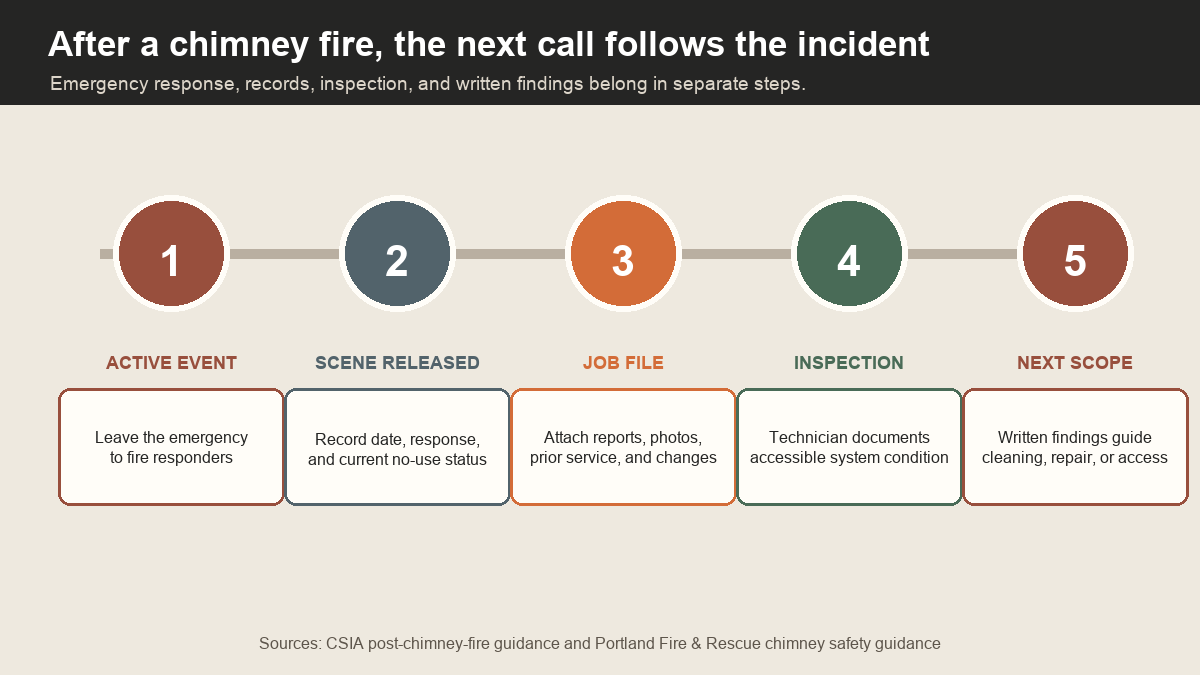
The timeline matters because each stage has a different owner. Fire responders manage the emergency. Office staff assemble the incident file. A qualified inspector examines the system. Written findings then guide cleaning, repair, further access, or another next step.
Route the inspection without diagnosing the flue
The Chimney Safety Institute of America says a Level 2 inspection is needed at minimum after a chimney fire. That is a useful routing boundary, but the receptionist still needs to follow the company’s inspection policy and technician review process. The office is identifying a post-fire event. It is not declaring the final field scope from a phone description.
CSIA’s after-chimney-fire guidance describes an internal video inspection in which a camera is moved through the chimney to examine its component parts. In masonry systems, the inspector looks at flue tiles and mortar joints for cracking or failure after high heat. Metal systems may be examined for joint separation, fatigue, warping, buckling, or open seams.
Those details explain why “just send someone to sweep it” is the wrong promise. Deposits may need removal so surfaces can be evaluated, but cleaning and condition assessment are separate questions. Hidden or inaccessible areas may also require a later decision after the inspector documents what can be seen.
An office already using a general Level 1 and Level 2 inspection intake framework should add a post-fire flag that cannot be removed by a receptionist. The flag tells the scheduler that the event history and inspection requirements need review before an ordinary maintenance slot is offered.
Ask about access while the file is open. Note locked gates, steep or icy roofs, attic access, pets, parking limits, solar panels, and any room the fire department restricted. Staff should never ask a caller to enter an unsafe area or climb onto the roof for a photo.
Keep phone staff inside a clear boundary
Post-fire callers often want immediate certainty. They ask whether the liner cracked, whether the house is safe, whether a sweep will fix the problem, and how much the repair will cost. The honest answer is that the condition must be inspected.
Use language that protects the record: “I can document what happened and route this for our post-fire inspection process. The inspector will determine what can be observed, what documentation can be issued, and whether another step is needed.” That gives the caller a real next action without borrowing the technician’s judgment.
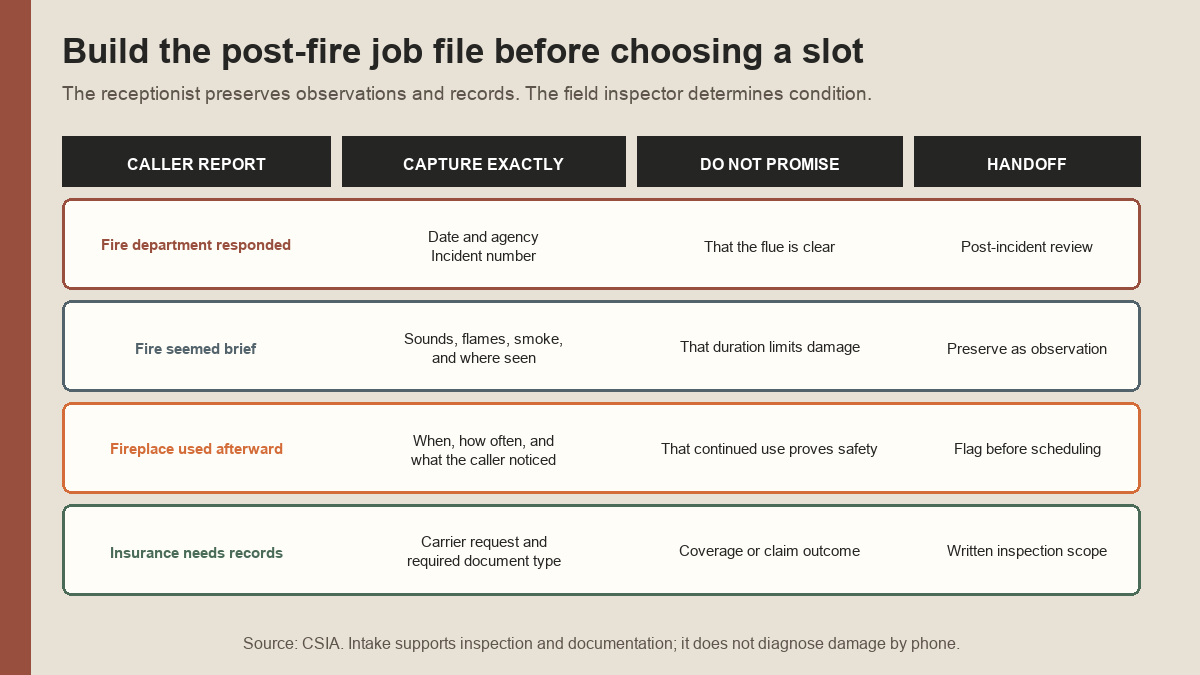
Do not infer damage from the event’s sound or length. CSIA notes that even a quickly controlled chimney fire can damage chimney structure. A loud event can be serious, and a quiet event can still leave conditions that need evaluation. Intake records the clues. Inspection decides what they mean.
The same boundary applies to current use. If a homeowner says they lit another fire with no trouble, record it and flag the file. Never answer, “Then it should be fine.” If the caller reports smoke entering the room or an alarm during later use, move back to the company’s safety route. The separate chimney smoke intake guide covers that handoff.
Handle insurance requests as documentation requests
A caller may contact the chimney company because an insurance adjuster asked for photographs, a written inspection, or repair estimates. Ask what document the carrier requested and when it is due. Get the carrier or adjuster contact details only when the customer authorizes that handoff under company policy.
CSIA advises having the sweep document damaged chimney sections or creosote with photographs during the evaluation. That supports a clear inspection record. It does not let the office promise that a policy will cover the event, that a carrier will accept a report, or that a particular repair will be approved.
Keep three items separate in the schedule and customer communication: the inspection service the company can perform, the written material included with that service, and any later estimate based on findings. A caller who needs an insurer’s custom form may require office review before booking. Ask for the form early.
Never coach the caller on what to say to improve a claim. Preserve the facts they report, the documents they provide, and the inspector’s findings. Insurance coverage belongs to the policy and carrier.
Give the technician a record that can survive handoff
Read the intake back before ending the call. Confirm the affected appliance and chimney, incident date, responder agency, scene-release status, no-use instruction, use since the fire, visible observations, known system changes, last service, available documents, insurance request, and access limits.
A strong note might read: “Caller reports chimney fire Saturday at about 10 p.m. while using masonry fireplace. Heard roaring and saw sparks above chimney. City fire department responded and provided incident number; report pending. Caller says department instructed no use. Fireplace has not been used since. Liner type unknown. Last sweep invoice dated two years ago. Photos of firebox and exterior available from ground level. Carrier requested written inspection with photographs. Steep rear roof; technician review required before appointment scope is confirmed.”
That note does not claim cracked tile, creosote severity, safe use, or covered damage. It gives the inspector a clean history and tells the office which records still need to arrive.
A receptionist or an AI answering service can collect the same fields after hours, but urgency rules should stay fixed. Active fire signs go to emergency responders. Released incidents enter the post-fire queue. Condition findings wait for the person with the camera, the system in front of them, and responsibility for the written report.