A caller says, “We lit the fireplace and now smoke is coming into the living room.” The office has two jobs in the next minute. First, find out whether the caller needs emergency help. If the situation is stable, gather the observations that will help a chimney professional prepare for the visit.
Do not diagnose a smoky fireplace by phone. A partly closed damper, a blocked flue, house pressure, fuel, weather, fireplace dimensions, or several conditions together can produce similar reports. Good intake preserves those clues without turning them into a verdict.
Make the safety handoff before asking service questions
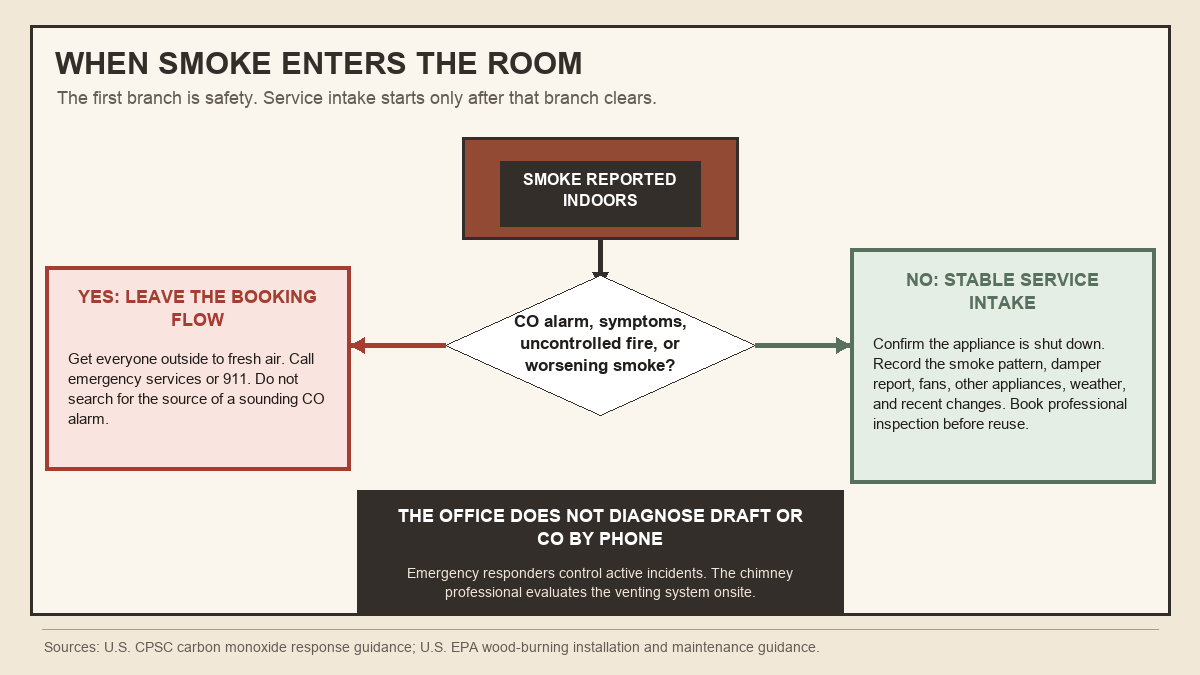
Begin with the people in the house. Ask whether a carbon monoxide alarm or smoke alarm is sounding, whether anyone feels headache, dizziness, weakness, nausea, chest pain, or confusion, and whether there is an uncontrolled fire or smoke that is getting worse.
A sounding carbon monoxide alarm ends the normal booking conversation. The U.S. Consumer Product Safety Commission tells occupants to move outside to fresh air and call emergency services, the fire department, or 911. They should not search for the source first. If anyone has possible carbon monoxide symptoms, or if fire or smoke presents an immediate danger, route the caller to emergency help.
Keep the wording short: “Please get everyone outside to fresh air and call 911. We can discuss chimney service after emergency responders say the scene is safe.” Do not keep collecting model numbers while the caller remains in a smoky room.
A stable call sounds different. The appliance is shut down, the smoke is no longer worsening, no alarm is sounding, and nobody reports symptoms. The EPA’s wood-burning maintenance guidance tells homeowners who smell smoke indoors to shut down the appliance, open a window, make sure the flue is open, carefully check the venting system, and call a professional installer or chimney sweep. The office can confirm that the appliance is no longer being used and move into service intake.
Record what smoked, when it started, and where it went
Once the safety branch is clear, identify the appliance. Is it an open masonry fireplace, a factory-built fireplace, a wood stove, a pellet appliance, or a gas fireplace? Ask whether the smoke came from the firebox opening, a stove door, a pipe joint, another fireplace, or somewhere near the chimney structure. “Smoke in the house” does not tell the technician which opening spilled.
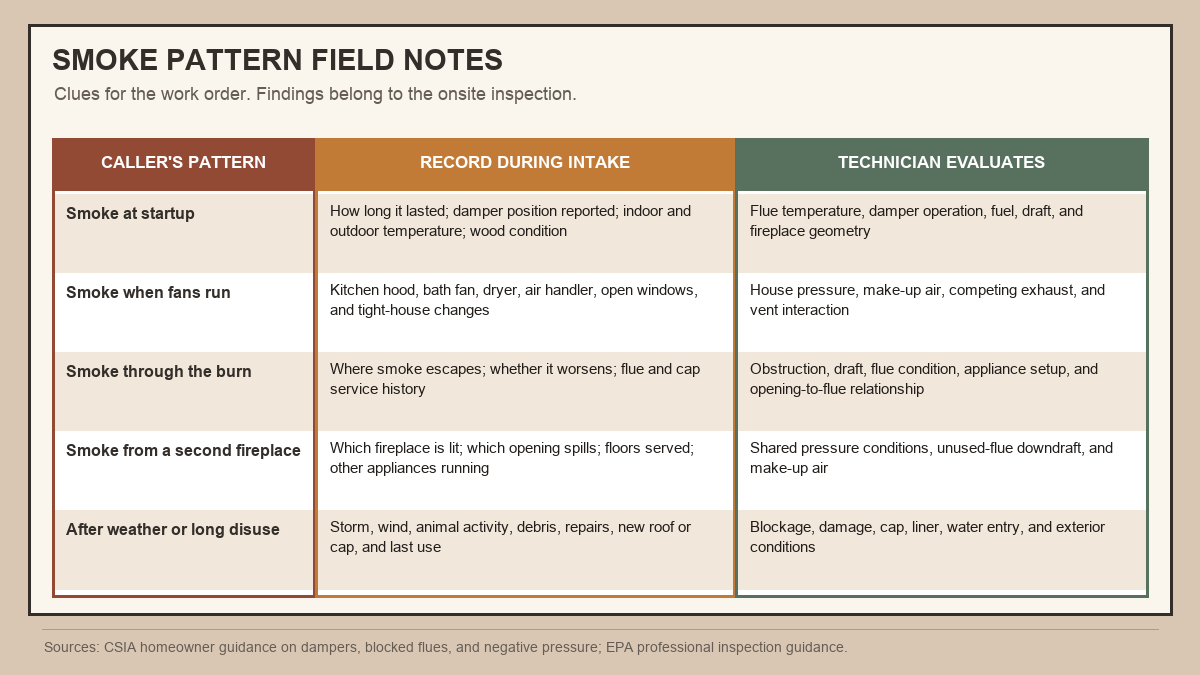
Timing carries useful information. Did smoke enter the room before the fire established, only when another fan started, after the fire had burned for a while, or throughout the burn? Did it stop when a window was opened? Was this the first fire of the season? Has the same setup worked normally before?
Write the caller’s observation as reported. “Smoke began when the kitchen hood turned on” is useful. “Negative pressure caused backdrafting” is a diagnosis the office cannot support from that sentence alone.
The same discipline applies to quantity and duration. Ask the caller to describe what they saw in plain terms: a brief wisp at startup, a steady stream at the top of the opening, smoke from a second fireplace, or a room that quickly became hazy. Avoid asking them to relight the appliance to recreate the event.
Ask about the damper, flue, and recent changes
The damper question belongs near the top of a wood-fire intake: “Was the damper fully open before the fire was lit?” If the caller is unsure, record that. Do not coach someone to reach into a hot firebox.
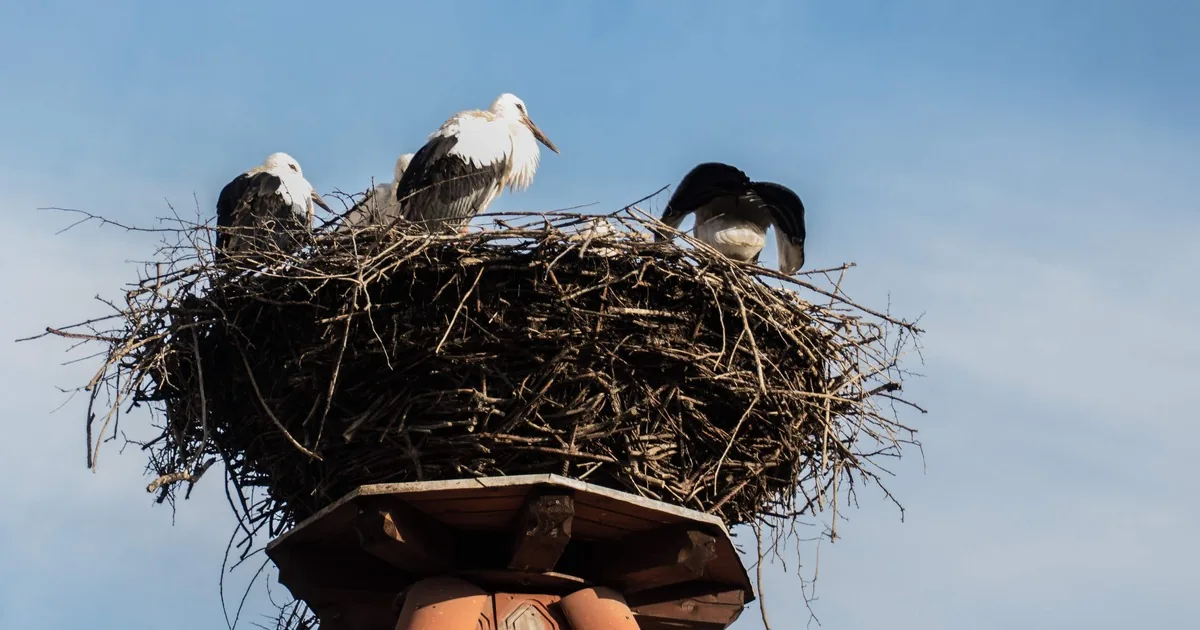
The Chimney Safety Institute of America’s homeowner guidance explains that a damper that is closed or not working correctly can create a smoky room and a fire hazard. CSIA also notes that bird nests and debris can block a flue. Those facts support inspection questions, not a promise that opening the damper or sweeping the chimney will solve the complaint.
Ask when the chimney was last inspected and swept, whether anyone has seen animal activity near the cap, and whether debris has fallen into the firebox. Record any recent chimney fire, storm damage, roof work, cap replacement, liner work, masonry repair, or appliance change. A caller may mention a roaring sound, flames at the chimney top, cracked masonry, or debris after a storm. Those details can change the urgency and the inspection scope, so flag them for technical review.
Fuel belongs in the record too. For a wood-burning appliance, note the wood species if known, where it was stored, and whether it seemed wet, hissed, or produced heavy smoke. The EPA says a properly installed and correctly used wood-burning appliance should create very little smoke; repeated visible or smelled smoke signals a problem. The office still should not reduce the call to “wet wood” without an inspection.
Fans, tight houses, and a second fireplace matter
A fireplace depends on air moving through the house and up the flue. Ask what else was running when the smoke appeared: kitchen exhaust hood, bathroom fan, clothes dryer, central vacuum, furnace, boiler, water heater, or another fireplace. Also ask whether windows and exterior doors were closed.
This is especially useful when smoke appears at an unused fireplace. CSIA describes a common pattern in tight homes: the operating fireplace exhausts household air, the house develops negative pressure, and make-up air is pulled down an unused chimney. That downward air can carry smoke into the living area. The office should record which fireplace was burning, which opening released smoke, the floors they serve, and which fans or fuel-burning appliances were operating.
Recent house changes can alter the pattern. New windows, air sealing, a powerful range hood, a remodeled kitchen, a replacement furnace, or a new dryer vent may belong in the work order. The caller may see no connection because the fireplace itself did not change. The technician needs the wider picture.
Book an inspection before the appliance is used again
A smoke complaint is an inspection call, even when the caller thinks a quick cleaning will fix it. EPA and the U.S. Fire Administration recommend professional chimney inspection as part of annual heating maintenance. A new indoor-smoke event gives the office a more immediate reason to have the venting system evaluated before reuse.
Do not promise the inspection level, repair, price, or same-day return to service until company policy and a qualified person have reviewed the facts. The reported event may call for a broader scope than routine annual service. An office that needs help choosing between inspection scopes can use the trigger framework in Level 1 vs. Level 2 Chimney Inspection Calls.
Set access expectations while booking. Ask whether the technician can reach the fireplace, appliance connector, basement or utility area, attic access, and chimney exterior. Note steep roofs, locked gates, pets, tenant access, shared chimneys, and parking limits. If the caller has photos or video from a safe location, attach them to the work order. Never ask for roof photos or any image that requires approaching a hot appliance.
For a rental or managed property, identify the occupant, owner or manager, person authorizing work, and person who should receive the report. Chimney scheduling gets messy when the person at the house cannot approve the inspection scope. The same party-and-report discipline used for pre-sale chimney inspections helps here too.
Leave the technician a call record worth reading
A useful work order lets the technician picture the event before loading equipment. Capture:
- appliance and fuel type, plus every flue and fireplace involved
- exact opening where smoke entered and the room or floor affected
- whether any alarm sounded, symptoms were reported, or emergency services attended
- fire status when the call ended and confirmation that the appliance is out of use
- when smoke began, how long it continued, and what changed when it stopped
- reported damper position, fans and other appliances running, window and door position
- recent storms, chimney work, roof work, house air-sealing work, or appliance changes
- last inspection and sweeping date, known animal activity, fallen debris, photos, and access limits
End with a clean boundary: “We have recorded what happened and will have the chimney professional evaluate the system onsite. Please do not use the appliance again before that inspection. If an alarm sounds, anyone develops symptoms, or smoke or fire becomes an immediate danger, get outside and call 911.”
That script does more than fill a calendar slot. It keeps an urgent safety branch out of the service queue, gives the technician observations instead of guesses, and leaves the homeowner with one clear next step.