A homeowner calls because one pool-deck panel has dropped beside the coping. Their first photo is a close-up of the crack. It leaves out the drain six feet away, the loose coping stone, the narrow screen-door opening, and the fact that the pool is losing water.
For a pool-deck concrete crack or settlement call, record the damage location, crack pattern, vertical offset, drainage behavior, coping and pool-shell symptoms, surface finish, previous repairs, pool status, and access. Send the record for an on-site assessment. Reception should not choose grinding, sealing, lifting, resurfacing, partial replacement, or a full deck replacement from a phone description.
Locate the damage around the pool
Start with a simple orientation. Ask whether the damage is on the house side, deep end, shallow end, equipment side, or a corner. Record the closest fixed landmark: steps, ladder, skimmer, drain, screen-enclosure post, diving board, handrail, or door.
Get the approximate deck dimensions and the number of affected panels. A caller may say “the whole deck is cracked” when three cracks cross one poured section. Another caller may report one crack while several panels have shifted. Ask whether the deck is concrete, pavers over concrete, exposed aggregate, stamped concrete, coated concrete, or an unknown surface.
Then identify the caller’s immediate concern. Common answers include a raised toe edge, water collecting near the house, loose coping, flaking under bare feet, a crack that has widened, or a cosmetic mismatch before a resurfacing project. The concern shapes the visit, though it does not settle the repair method.
Describe the crack and movement without diagnosing it
Ask where the crack starts and ends. Does it follow a control joint? Does it run toward the coping, a drain, a post, or the house? Is one side higher? Has a gap opened between deck sections? Note loose fragments, surface scaling, exposed aggregate, rust-colored staining, hollow-sounding areas reported during normal walking, and failed material in an old repair.
The National Ready Mixed Concrete Association’s guide to cracking concrete surfaces describes several crack forms and contributing conditions, including shrinkage, settlement, support, jointing, finishing, curing, moisture, and temperature. A close photo cannot distinguish all of those conditions. The office should preserve observations and dates.
Ask when the caller first noticed the change and what happened beforehand. Useful context includes heavy rain, drainage work, excavation, a plumbing repair, tree removal, pool renovation, deck coating, or a long period with the pool empty. Record the sequence without assigning blame.
Previous work deserves its own note. Ask about flexible sealant, rigid patch material, overlays, grinding, slab lifting, replaced panels, or coping repair. Find out when it was done and whether the same area moved again. Old invoices and dated photos can help the estimator understand what changed.
The American Concrete Institute’s concrete repair guide places condition assessment before repair-method and material selection. It also warns that differences between old concrete and new repair materials can contribute to differential movement and cracking. That is a sound reason to avoid prescribing a patch during intake.
Keep the coping and pool shell in the record
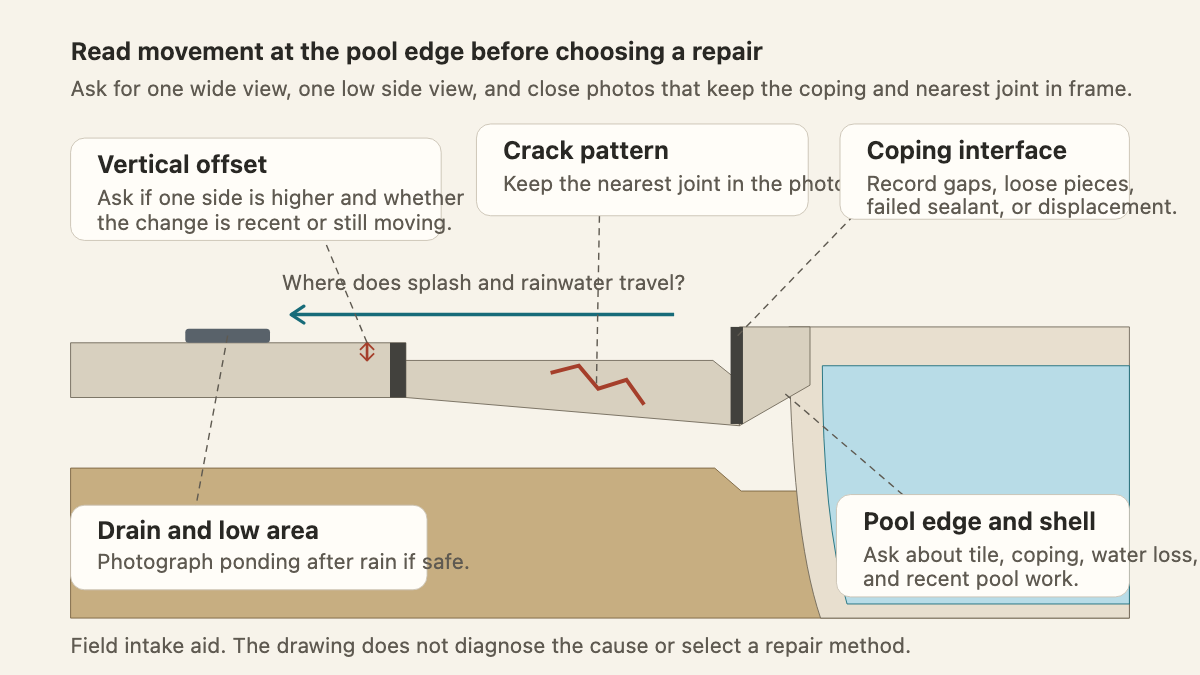
Pool-deck work sits next to a separate structure. Ask whether the deck has pulled away from the coping, pushed against it, dropped below it, or lifted above it. Record cracked or loose coping, missing joint material, broken waterline tile, new gaps, and any point where the pool edge feels unstable.
Ask whether the pool appears to be losing water and whether a pool professional has tested it. A wet patch beside a crack does not prove a plumbing leak. A falling water level does not prove the deck caused it. These reports may require coordination with a pool contractor before a concrete scope is finalized.
Public-pool rules offer a useful illustration of why the interface matters, even though a residential property may follow a different local code. Indiana’s public swimming pool deck rule requires a watertight joint where coping meets a concrete deck, calls for protection against relative movement, and addresses control joints, drainage, slip resistance, and sharp edges. The office should ask which jurisdiction governs the address and leave compliance decisions to the contractor or designer.
Follow splash water and rainwater
Ask what happens after swimmers leave, after the deck is washed, and after rain. Does water move toward a drain, the yard, the pool, the house, or the settled panel? Where does it stand? Has the pattern changed since the concrete moved?
Record deck drains, channel drains, roof downspouts, irrigation, screen-enclosure gutters, nearby planters, and any uphill landscaping. One wide photo taken after rain can show a water path that dry close-ups miss, provided the caller can take it without crossing a slippery or unstable area.
Drainage requirements vary by jurisdiction and project type. The Indiana rule, for example, tells public-pool designers to drain splash water, cleaning water, and rainwater away through perimeter areas or deck drains. Use that as a prompt to document water behavior, not as a universal residential specification.
Avoid promising that leveling one panel will correct drainage. The estimator needs elevations, drain condition, surrounding grade, and the intended discharge point before making that call.
Ask for a photo set that preserves context
Request photos in a useful order:
- one wide view that shows the affected side of the pool;
- one low side view across any vertical offset;
- one close view of each crack with the nearest joint or coping edge visible;
- one view of drains, downspouts, and observed ponding;
- one view from the work area back toward the gate or screen door.
A ruler may help show scale if it can be placed without kneeling near a loose edge or stepping onto an unsafe panel. Do not ask the caller to probe a crack, remove joint material, lift coping, drain the pool, or test a slab with tools.
The best photo set lets the estimator connect the crack to the panel layout, pool edge, water path, and access. It also reveals what remains unknown.
Separate a concrete visit from a broader pool problem
Some calls need more than a concrete estimator. Route for human review when the caller reports active water loss, a fresh void, loose coping at a frequently used entry, broken tile near the waterline, movement at a diving-board or handrail base, exposed sharp material, or a rapidly changing height difference.
Do not tell the caller that the pool is structurally damaged. Do not assure them that it is safe. If the surface presents an immediate trip, cut, or instability concern, advise them to keep people away from the affected area and let the contractor set the next step.
This page owns pool-deck intake. A general concrete patio repair or replacement call covers slabs beside the house, while concrete slab settlement versus foundation repair intake helps when movement appears tied to the building.
Confirm finish, access, and pool status
Ask what result the caller expects. A functional repair may remain visible beside weathered or decorative concrete. Record color, texture, coating, stamping, exposed aggregate, previous resurfacing, and any desire to preserve a border or drain line.
Crew access can change the estimate. Note the narrowest gate or screen-door width, turns, steps, slopes, overhead enclosure members, soft ground, septic areas, and whether equipment must cross a neighbor’s property. Ask where removed concrete could be staged and how far the deck is from legal truck parking.
Confirm whether the pool is full, in use, covered, winterized, or already scheduled for renovation. Note water-treatment equipment, hoses, pool furniture, pets, locked barriers, and appointment restrictions. Reception should not direct the caller to drain or refill the pool.
Close with a field-ready summary
Read the record back. A useful summary sounds like this: the affected area is on the deep-end equipment side; one panel has dropped beside the coping; a branching crack runs toward a channel drain; water stands at the low edge after rain; two coping pieces feel loose; the pool owner has noticed water loss but has not had it tested; and access is through a thirty-six-inch screen door.
Confirm the site contact, appointment window, photo attachment, gate status, pets, and any separate pool-company visit. Flag safety and water-loss reports for prompt human review. Keep the promise narrow: the contractor will inspect the deck, pool-edge interface, drainage, finish, and access before recommending a scope.
An AI receptionist can capture the same fields after hours and route urgent reports to a person. The script must keep diagnosis out of intake.
A good pool-deck call gives the estimator the whole edge condition. The crack, coping, water path, pool status, and equipment route should already be visible before the truck leaves the yard.