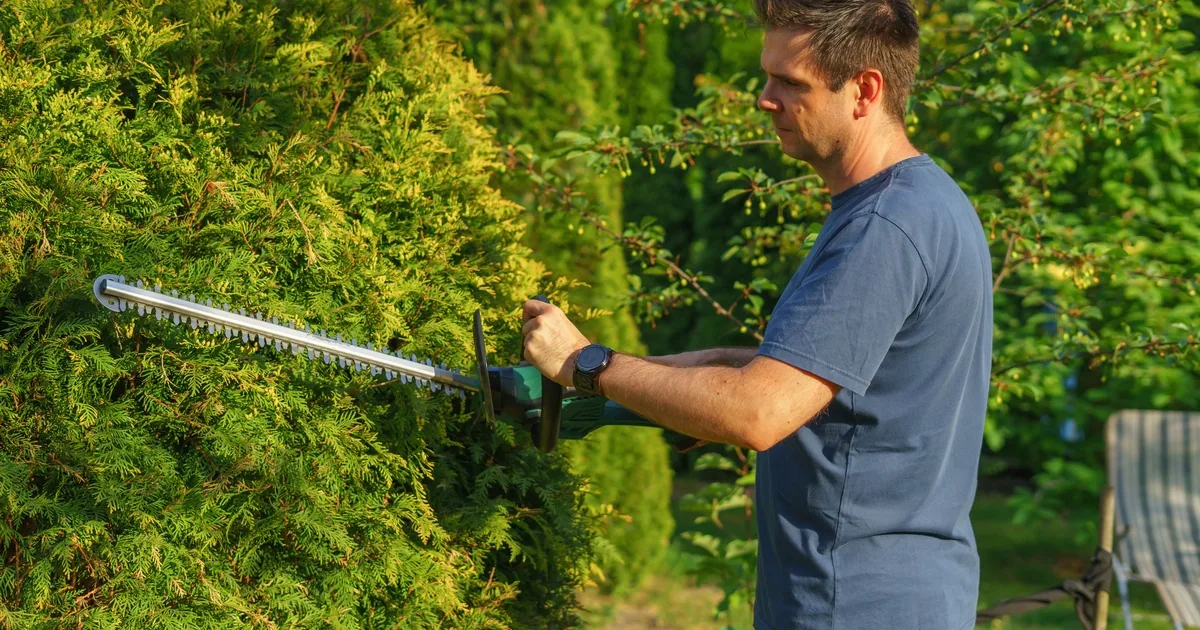
“I have some bushes that need a trim. What would you charge?” That sentence can describe six boxwoods below a window, a hundred feet of privet beside a road, or an overgrown evergreen screen that now requires ladder work.
A useful shrub and hedge trimming call records the plant type if known, number and length of planting sections, approximate height, current condition, requested result, access, nearby obstacles, cleanup preference, and scheduling reason. The office can then assign an estimate, a routine maintenance visit, or a specialist review. Pruning method and a firm price should wait until the crew can see the plants and site.
The most important question is simple: what does the customer want to be different when the work is done? “Trim everything” is too vague for a work order.
Translate “trim” into a visible result
Ask what prompted the call today. The customer may want to clear a walkway, lower a hedge below a window, restore a formal edge, remove dead branches, open a sightline at a driveway, keep growth away from siding, or prepare a property for an event. Record that outcome in plain language.
Then ask the caller to describe the planting. Is it one shrub, a row of separate shrubs, or a continuous hedge? How many sections are there, and where are they located? A note such as “one hedge along front walk and three shrubs below living-room windows” is more useful than “front yard trimming.”
Words such as shape, reduce, thin, cut back, and rejuvenate do not mean the same job. If a caller wants a six-foot hedge reduced to three feet, preserve both numbers in the record and mark the request for site review. Some plants tolerate major reduction. Others may show bare wood, lose their intended form, or respond poorly when cut beyond green growth.
University of Minnesota Extension distinguishes pruning for plant health, intended landscape purpose, appearance, and protection of people or property. It also cautions against shearing every shrub into a tight geometric form. That is why the intake should capture the desired result without prescribing the cut.
Record plant identity and timing without diagnosing
Ask whether the customer knows the plant name. Useful answers include boxwood, privet, arborvitae, yew, juniper, lilac, hydrangea, azalea, rose, or “unknown evergreen.” Never turn an uncertain description into a confident label. Request one wide photo showing the entire plant and setting, plus a closer photo of foliage and branching if the company accepts images before the visit.
Plant identity matters because species and growth habits respond differently. Penn State Extension notes that arborvitae, hemlock, and yew can tolerate shearing as hedges, while many needled evergreens will not produce new growth after a cut reaches bare brown wood. Its guidance also explains that a sheared evergreen hedge is generally wider at the bottom so sunlight reaches the lower foliage.
Flowering time belongs in the note too. Ask whether the shrub flowers and, if so, whether it has already bloomed this season. UMN Extension advises that many early-flowering shrubs are pruned after bloom, while other plants are commonly pruned during dormancy or before new growth. Local climate, species, plant condition, and the purpose of the work still control the actual timing.
Do not tell the caller that a specific date is safe based on a photo or common name alone. A clean response is: “I will note that it flowers in spring and that you want the height reduced. The estimator will confirm the right timing and approach for that plant.”
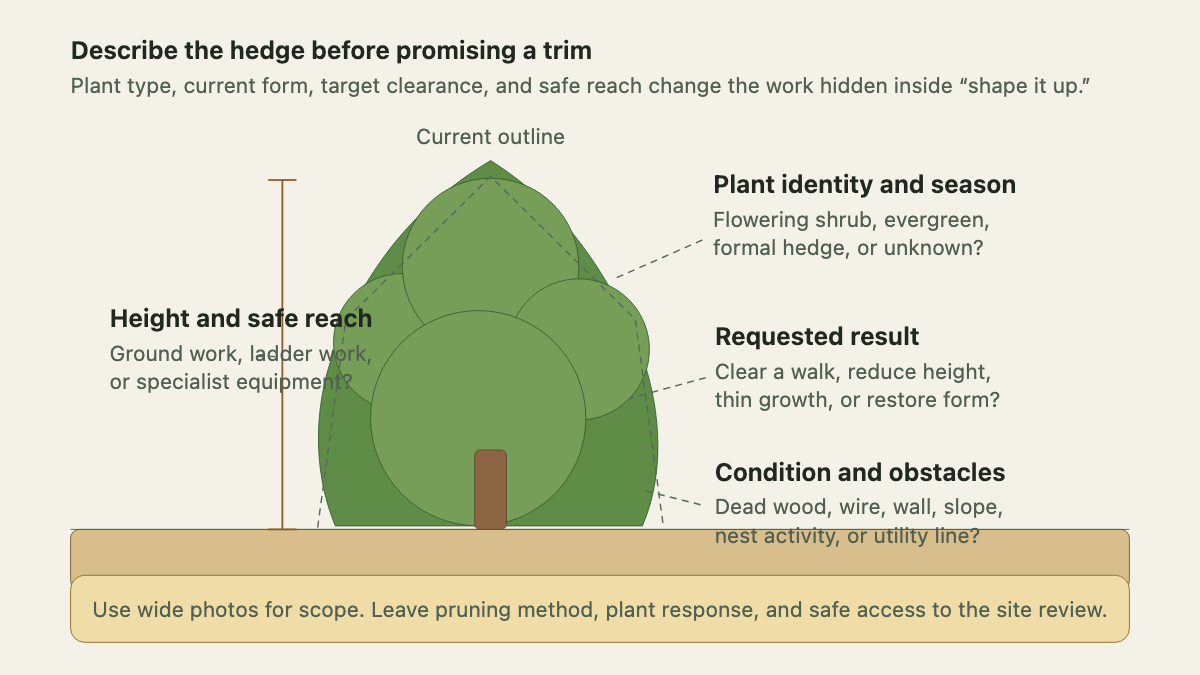
The profile gives the estimator a starting point. It does not diagnose plant health or approve a drastic reduction.
Measure scope in sections, not guesses
Callers rarely know the linear footage of a hedge, and asking for an exact measurement can create bad precision. Start with landmarks. Does the hedge run from the porch to the driveway, along one property side, around a patio, or across several disconnected beds? Ask for approximate length only when the customer can provide it safely.
Height should be described with a reference and a location. “About chest high along most of the walk, then taller than the garage door near the corner” is useful. So is “six separate shrubs below windows, each roughly waist high.” Do not ask anyone to climb a ladder or step into traffic to measure.
Capture depth when it affects access or the desired clearance. A hedge that has grown across half a sidewalk creates different work from one that only needs its top leveled. Ask what must remain clear: windows, meters, air-conditioning equipment, signs, gates, parking spaces, sidewalks, doors, security cameras, or neighboring property.
Condition changes scope as well. Record dead sections, broken limbs, storm damage, vines woven through the hedge, wire fencing inside the growth, heavy weeds at the base, or a sudden color change. Office staff should describe those observations as reported. They should not identify a disease or promise recovery.
If the request includes branches large enough to resemble tree work, work near overhead utility lines, or material beyond the company's normal equipment and training, route it according to company policy. UMN Extension tells readers not to prune near utility wires and recommends qualified professionals for large-tree work.
Put access and safety in the dispatch note
A tidy front hedge may hide a difficult work area. Ask where the crew can park, which gate they should use, and whether the gate is locked. Note steps, steep ground, retaining walls, soft beds, pool barriers, narrow side yards, low branches, irrigation heads, landscape lighting, decorative edging, pets, and areas that must stay open.
Height alone does not determine the safe method, but it flags a routing decision. Does the caller expect work above normal standing reach? Is the ground level where equipment would be placed? Are there wires, a roof edge, a busy sidewalk, or vehicle traffic beside the hedge?
OSHA's landscaping standards page points employers to requirements involving walking-working surfaces, ladders, hand protection, and portable powered tools. The office does not perform a hazard assessment over the phone. It does make sure the field team sees the relevant conditions before arrival.
For work beside a public sidewalk, road, school entrance, or commercial doorway, ask when pedestrian and vehicle traffic is lowest. Record any property rules for parking, noise, gates, loading areas, or site contacts. A commercial request may belong with the company's broader landscaping resource library when it includes recurring mowing, beds, litter, irrigation checks, and seasonal work beyond trimming.
Define cleanup before the crew arrives
“Haul everything away” sounds clear until the crew finds clippings mixed with old yard waste, thorny vines, landscape fabric, wire, and branches from a different project. Ask what debris the customer expects the company to handle.
The booking note should state whether the company's quoted scope includes raking beneath the shrubs, blowing nearby hard surfaces, bagging, chipping, hauling, placing clippings at the curb, moving them to an on-site compost area, or leaving them in a designated pile. Use the company's actual policy. Do not imply that disposal fees, municipal pickup, or dump access are included unless they are written into the service.
Ask where clippings can travel from the hedge to the truck. A narrow gate, finished interior courtyard, long staircase, pool deck, fragile planting bed, or neighbor-controlled path can add handling. Confirm whether parked vehicles, patio furniture, toys, grills, or decorations must be moved before the appointment and who will move them.
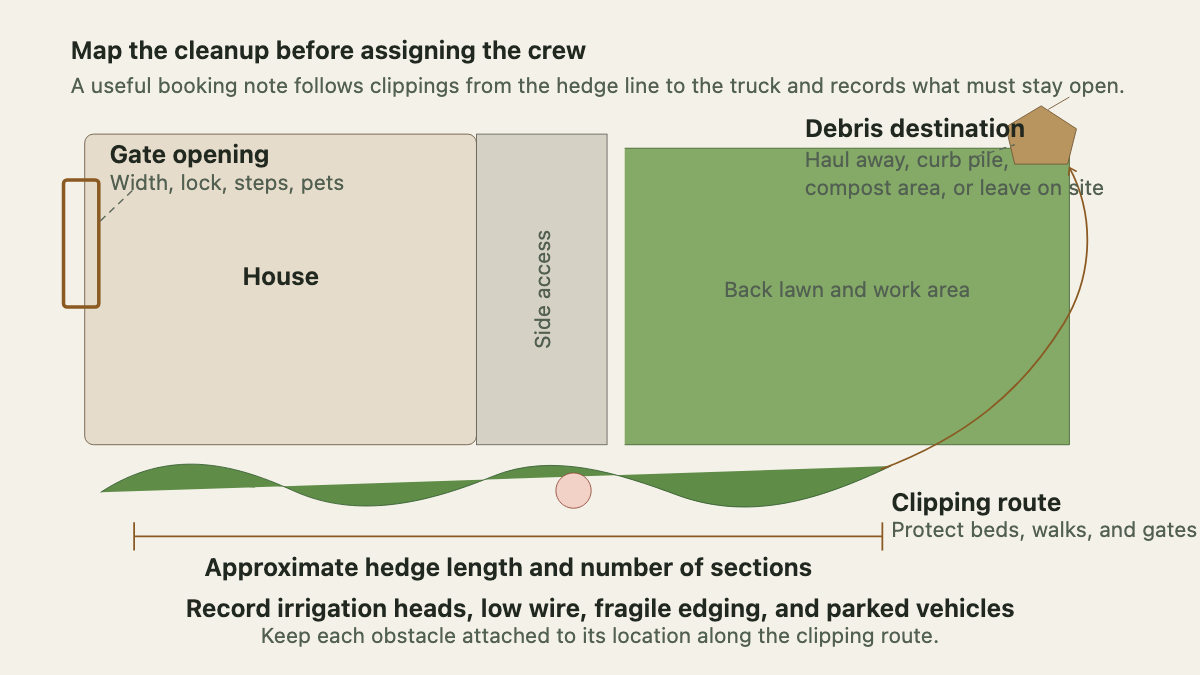
Photographs help here. Request one image from far enough away to show the hedge and access route in the same frame. Close foliage photos cannot reveal a locked gate or the distance to the truck. If standing water or downspout discharge affects the work area, route that concern through a separate landscape drainage consultation so the trimming ticket does not absorb an unrelated diagnosis.
Close with a work order the crew can trust
Read the main facts back: “I have one continuous evergreen hedge along the west side, roughly shoulder high for most of its length. You want the walkway clearance restored and the top evened, but you are not asking for a major height reduction. Access is through a locked side gate, there is low-voltage lighting at the base, and you want clippings hauled away under our written cleanup policy.”
Then confirm the appointment type, arrival window, site contact, image-submission method, and any estimate fee. If plant identity, drastic reduction, utility proximity, ladder access, traffic control, or disposal remains uncertain, flag it for review before assigning a standard production slot.
An AI receptionist can collect the same scope, plant, height, access, and cleanup fields after hours when it follows the landscaper's service boundaries and escalation rules. The field decision remains with the estimator or crew lead. A good call record gives that person a clear picture of the plants, the requested result, and the route every clipping must take before the truck leaves.