“The front door closes, but it does not lock unless we pull it.” A dispatcher can easily hear that as a bad lock. The technician may arrive and find a loose closer arm, a sagging hinge, a latch striking the frame, swollen weather seal, or building pressure that changes when the air handler starts.
The best intake does not pick a failed part. It records one complete door cycle, then maps the symptom to the opening. Ask which door is affected, what happens as it opens and closes, where the latch meets the strike, whether security is compromised, and whether the opening has a fire label, panic hardware, access control, or an automatic operator. Photos help, but a short video of the full cycle often tells the technician more than a tight shot of the lock.
Identify the exact opening first
“Front door” is too vague for a strip center, clinic, school, apartment building, or warehouse. Record the business name, street address, suite, floor, and a plain description such as “south employee entrance beside loading bay two.” Ask whether it is an exterior perimeter door, an interior tenant door, a stairwell door, or a shared entrance managed by the landlord.
Then capture the door and frame material. Common descriptions include aluminum storefront, hollow metal, wood, and all-glass. Note whether it is a single door or one leaf of a pair, and whether the caller pushes or pulls it from the side where the symptom is easiest to see. A photograph showing the whole opening from several feet back can reveal the closer mount, frame, threshold, hinges, handle set, and connected hardware in one view.
Ownership matters too. A retail manager may control the lock but need landlord approval for frame work. A tenant may report the issue while a property manager handles the invoice. Record who may authorize diagnosis, who may approve added work, and who can meet the technician with keys or credentials.
Watch one complete close cycle
Ask the caller to describe the door from open to latched. Start with a normal opening angle. Does the door resist suddenly near full open? Does it stay where released, drift slowly, race through the main swing, pause before the frame, slam during the final movement, hit the strike and bounce, or reach the frame without the latch catching?
Those observations belong in the ticket as seen and heard. “Door slams during the last few inches” is useful. “Closer valve is bad” is a diagnosis that reception cannot confirm.
Allegion’s LCN instructions separate backcheck, main speed, and latch speed because they act during different parts of travel. The same instructions warn that improper regulation can cause oil leakage, damage, or injury. That is why the office should avoid giving universal adjustment directions over the phone. The exact closer model, mounting, door width, weight, condition, and environment matter. A technician can identify the unit and test the opening on site.
Ask whether the behavior is constant. Exterior doors may change with wind, weather seal compression, or pressure across the opening. The U.S. Access Board’s door guidance specifically notes wind, gasketing, HVAC systems, and door weight as factors in exterior swing-door operation. A caller who says “it latches before opening time but not after the kitchen exhaust starts” has supplied a strong field clue without naming a cause.
Map the symptom to three physical zones
A commercial opening works as one assembly. The closer moves the leaf. Hinges or pivots carry it in the frame. The latch must meet the strike cleanly. Weather seals, thresholds, door bottoms, panic hardware, and access-control parts can add resistance or change what “locked” means.
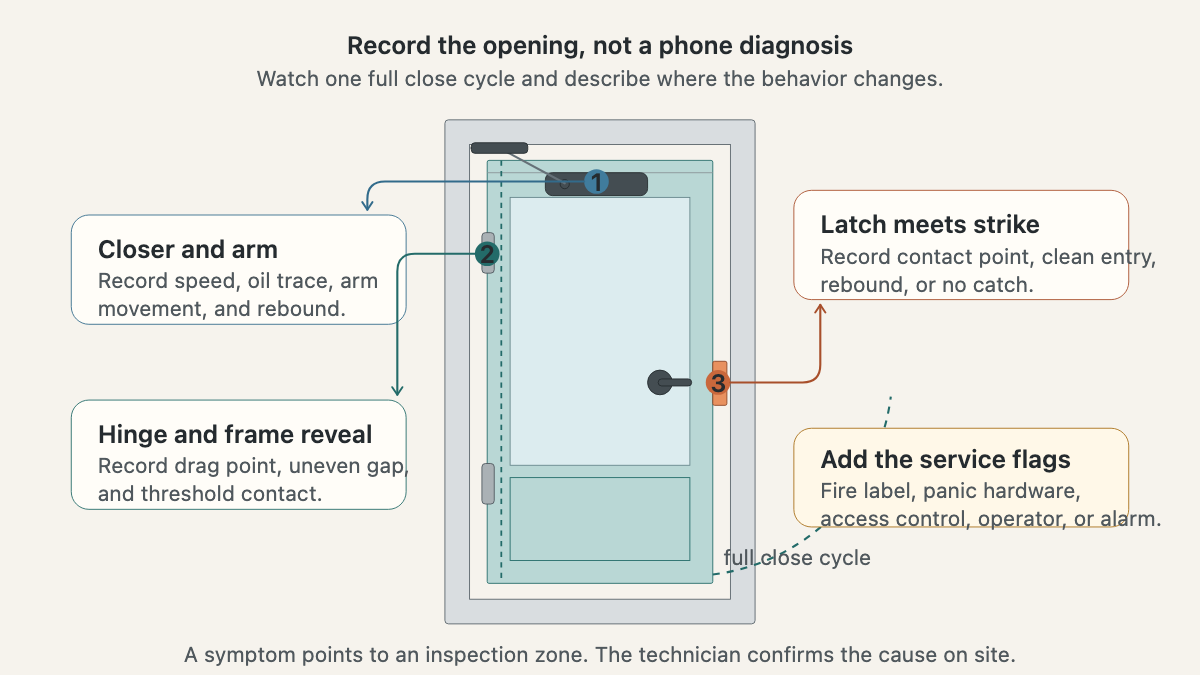
At the top, ask about the closer body and arm. Is there an oily trace, a loose fastener, a bent arm, a cover hanging down, or movement at the mounting point? Ask for an overall photo and a closer photo with any brand or model markings visible. Nobody should climb a ladder solely to get the image.
Along the hinge side, ask whether the gap between door and frame looks even. Does the door rub at the top corner, scrape the threshold, drag only near closed, or move up and down when the handle is lifted? Record loose or missing screws only as observations. A caller should not remove hinges, covers, or rated labels for intake.
At the latch side, ask where contact occurs. The latch may enter the strike cleanly, hit above it, hit below it, rub one side, or enter and then rebound. If the caller can safely take a close photo with the door open, request the latch edge and strike together. Keep fingers clear of the closing path.
The three-zone record prevents a parts-first dispatch. A lock can work on an open door while the assembled opening fails to latch. A closer can move smoothly while the leaf drags. A strike can show fresh contact marks caused by movement elsewhere.
Separate security impact from hardware symptoms
Ask whether the door currently secures without someone holding, pulling, or pushing it. Can authorized staff lock and unlock it from each required side? Has anyone started propping it open? Is the opening stuck locked, stuck unlocked, or merely inconsistent?
Route an unsecured perimeter opening according to the locksmith’s urgent-service policy. Record who is on site and what temporary site-security procedure management has chosen. Reception should not recommend improvised restraints, blocked exits, or changes that could interfere with egress.
If a card reader, electric strike, magnetic lock, request-to-exit device, door position switch, alarm contact, or automatic operator is present, list it. Ask what the credential reader shows and whether the physical latch reaches the strike. A green reader light with a door that never catches is a different report from a reader that denies every credential. The access-control quote call guide gives a fuller framework for doors, users, hours, power, network, and approvals when the project extends beyond mechanical service.
Do not collect alarm codes, administrator passwords, master credentials, or other secrets in an ordinary dispatch note. Record who controls them and whether that person will be present.
Flag fire doors and accessible routes
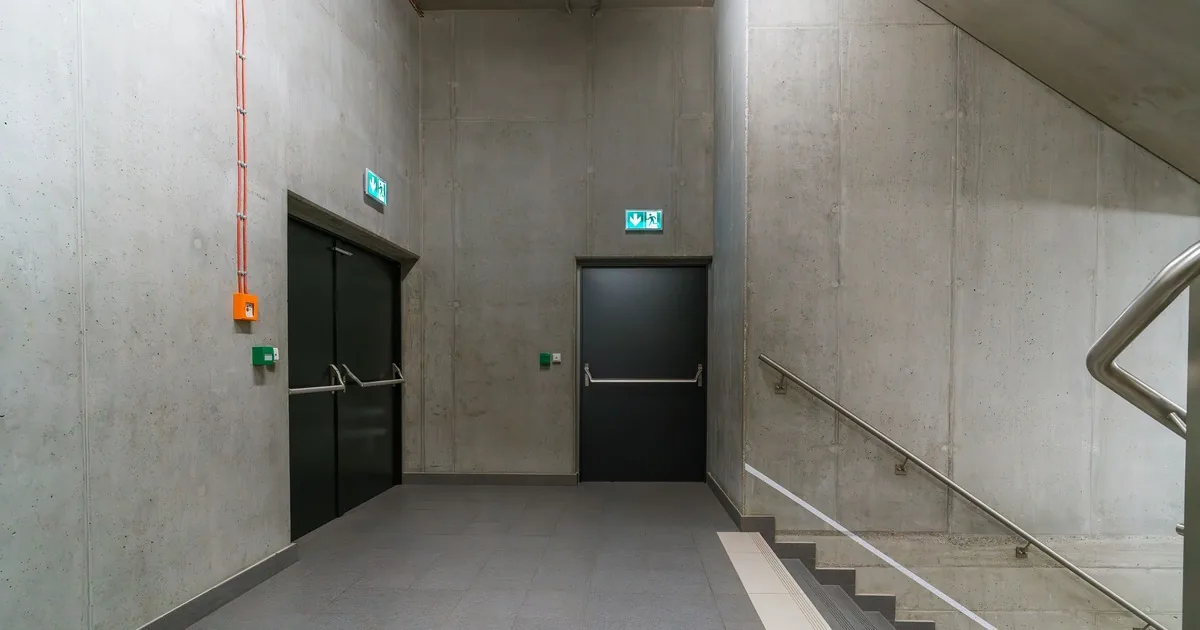
Ask the caller whether the door or frame has a fire-rating label. Stairwell, corridor, storage, mechanical-room, and occupancy-separation doors deserve this question even when the caller thinks the job is a simple closer adjustment.
NFPA’s fire-door guidance explains that fire doors must be kept closed and latched or arranged to close automatically during a fire. A rated door that will not close or latch should be marked clearly on the ticket and routed under company policy. Do not advise the caller to wedge it open while waiting.
Also ask whether the opening is on an accessible route and whether users report that it is hard to open, closes too quickly, or catches mobility devices. Avoid promising compliance based on a phone description. The Access Board separates closing speed, opening force, maneuvering clearance, and hardware operation, while also recognizing exceptions for exterior hinged doors and fire doors. A qualified person needs to inspect and measure the actual opening under the rules that apply at that site.
Build a ticket the technician can use
A dispatch-ready door closer and lock alignment ticket should contain:
- exact door location, use, material, swing, and single or paired configuration
- full-cycle behavior during opening, main swing, final approach, latch contact, and rebound
- visible closer-body, arm, mounting, hinge, frame, threshold, latch, and strike observations
- current security state and whether the problem changes with wind, weather, or building systems
- fire label, panic hardware, access-control equipment, alarm contact, or automatic operator
- photos of the whole opening and hardware, plus a short safe video when available
- site contact, authorization, access hours, loading or parking limits, and billing party
Set the appointment as inspection and service for the opening. Explain the company’s diagnostic or service charge and how added parts or labor are approved. Do not promise that an adjustment will solve the problem, that a particular closer fits, or that the technician can alter connected access-control hardware without the right authorization and scope.
Read the ticket back in concrete terms: “South employee entrance at Sample Street Pharmacy. Single aluminum storefront door with surface closer and electric strike. Door moves normally through the main swing, slows near the frame, then the latch hits below the strike and bounces open. Staff can secure it only by pulling from inside. No oil is visible. The hinge-side gap appears wider at the top. A fire label has not been confirmed. Manager Dana Ruiz can authorize mechanical service; the landlord approves frame work. Three full-opening photos and one close-cycle video are attached.”
An AI receptionist can collect these bounded fields after hours and apply the locksmith’s urgency rules. The technician still owns the diagnosis. The office has already done the valuable part: it has turned “the lock does not line up” into a precise record of the opening in motion.