“The key is gone and payroll needs the drawer open.” That sounds like a small lock job. The cabinet may be a common office lateral file with an orderable key, a worn cylinder that needs inspection, or a labeled security container outside the shop’s ordinary service policy. The receptionist cannot tell which one from “gray filing cabinet.”
Start with five facts: who made the cabinet, which series or model it belongs to, what appears on the lock face, whether any drawer is open, and who can authorize access to the contents. Then record the failure and the site conditions. That gives the locksmith a usable ticket without turning the call into a lesson on opening the cabinet.
Identify the cabinet before discussing a key
Ask the caller to stand back and describe the whole piece. Is it a tall vertical file with narrow drawers, a wide lateral file, a small pedestal under a desk, a fire-resistant records cabinet, or a government security container? How many drawers does it have? Is it freestanding, built into a workstation, bolted to another unit, or fixed to a wall or floor?
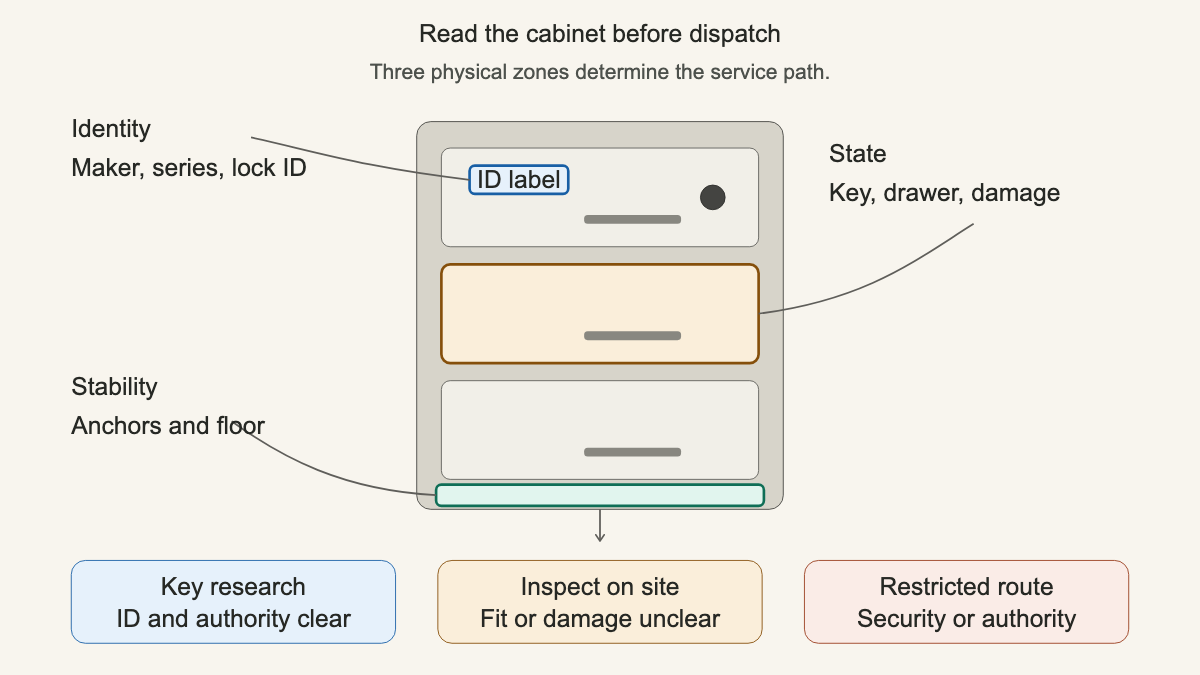
Look for the manufacturer label and product series. It may be inside an open drawer, on the back, along a frame edge, or under the top. Ask for a wide photograph of the cabinet, a straight-on view of the affected drawer, and a close image of the label and lock face. The caller should cover employee names, file labels, access numbers, and visible records before sending anything.
Cabinet identity matters because replacement keys and lock parts are sold by defined families. Steelcase, for example, lists FR-series replacement keys for its file cabinets and office furniture by key number. That does not make an FR key suitable for another Steelcase series, much less another manufacturer. Record the letters and digits exactly as shown. Do not promise a match from a blurry photo.
The intake note should read like equipment identification: “Four-drawer lateral file, Steelcase label visible, series unknown, FR marking on lock face, top drawer closed, lower three drawers closed.” “Metal cabinet” is too thin to dispatch.
Describe the failure one part at a time
“Locked out” can hide several different conditions. Ask whether the caller has any key. If a key is present, does it enter fully, turn partway, turn freely, bind under pressure, or remain stuck? Is it bent, cracked, or broken inside the cylinder? A visible fragment belongs in the broken-key intake guide, with the cabinet details attached.
Next, ask what the cabinet does. Does the lock move while the drawer stays shut? Is one drawer open while the others will not move? Does a handle lift without releasing the drawer? Is the drawer crooked, overloaded, or rubbing the frame? Are there pry marks, a loose lock face, a dent near the latch side, or evidence that the cabinet was dropped during a move?
Do not coach the caller to force a key, pry a drawer, shake the cabinet, or hold one drawer open while pulling another. Those actions can damage the key, linkage, drawer slides, or cabinet. They also muddy the original failure. Preserve the condition for inspection.
A readback catches contradictions: “You have one working key, but it no longer turns. The top drawer is open, the second drawer is closed, and the third drawer is partly extended.” That is richer than a ticket marked “needs new lock.”
Keep the cabinet stable while the call is open
A lateral file is furniture with moving weight. An open drawer changes its balance, and an open drawer full of paper can be heavy. Ask whether the cabinet rocks, leans, has separated from the wall, or sits on an uneven floor. If it moved recently, record whether it was emptied first and whether its anchors or ganging hardware were reinstalled.
Some lateral files use a safety interlock that limits how many drawers can open at once. Herman Miller’s Meridian interlock instructions warn against altering that system because opening multiple drawers can create a tip hazard. Reception does not need to identify the mechanism. It needs to record an open-drawer pattern and tell the caller to stop forcing the cabinet.
OSHA’s office-safety guidance says filing cabinet drawers should remain closed when they are not in use and office files should be kept in safe operating condition. Use that as a conservative boundary. If a drawer is hanging open in a walkway, keep people away from it and ask the site contact to follow the workplace’s safety procedure. Do not give repair instructions over the phone.
Verify authorization and protect the records
Ask who owns the cabinet and who controls the records. The caller may be an employee standing beside it, while authorization belongs to an office manager, landlord, records officer, medical practice administrator, attorney, school official, or government security contact.
Capture the caller’s name, organization, callback number, relationship to the cabinet, billing contact, on-site contact, and person who may approve access or replacement. State the shop’s identification and authorization requirements before dispatch. A photo of a badge or business card is information to review through the approved channel, not automatic permission.
Contents change how the visit should be handled. Ask whether the cabinet holds personnel files, medical records, client documents, checks, legal files, keys, medication, or classified or controlled material. Do not request names or record details. The answer helps the shop decide whether a witness, records custodian, privacy procedure, or restricted-service referral is needed.
A cabinet labeled as a GSA-approved security container, a safe, or specialized fire-resistant records unit should not enter the ordinary office-furniture queue. Record the full label and route it under company policy. Never promise that an ordinary replacement cylinder preserves a certification, rating, fire protection, or security approval.
Choose the service path before setting the appointment
A clear identity, readable lock marking, working authorization path, and undamaged cabinet may support replacement-key research before a truck visit. The office still needs to confirm series compatibility and shop policy. A stamped number is a clue, not a guarantee.
Book an inspection when the make or series is unknown, the key turns without releasing the drawer, the cabinet is damaged, one drawer is stuck open, the linkage may be involved, or a replacement part cannot be confirmed. Record whether the technician can reach the rear and sides, whether an elevator or loading dock is required, and whether building security needs a certificate of insurance or advance vendor registration.
Use a restricted route when labels or contents place the cabinet outside routine service. The same applies when authority remains disputed. Reception should pause the booking and ask for the proper owner, records custodian, facilities manager, or security contact.
For a normal service visit, state what the quoted charge covers. It may cover inspection and diagnosis, with keys, cylinders, linkage parts, or additional labor subject to identification on site. FTC estimate guidance recommends describing the work, materials, timing, and price in writing. That discipline works for a two-drawer pedestal too.
If the office wants several cabinets keyed into a planned system, move the request into a commercial master-key consultation. Capture cabinet counts, departments, access groups, existing key families, and expansion needs as a separate project.
An AI receptionist can collect cabinet identity, authorization, condition, safety flags, and building-access details after hours. The routing rules should stop at the same boundaries a trained dispatcher uses: no bypass advice, no assumed key match, and no ordinary booking for a restricted container.
The best final readback is concrete: “Three-drawer lateral file in the second-floor records room. Manufacturer label and lock-face photos received. No key is available. All drawers are closed, the cabinet is anchored, and there is no visible damage. The records manager will meet the technician and approve work after inspection.” The locksmith arrives knowing what stands behind the office door.