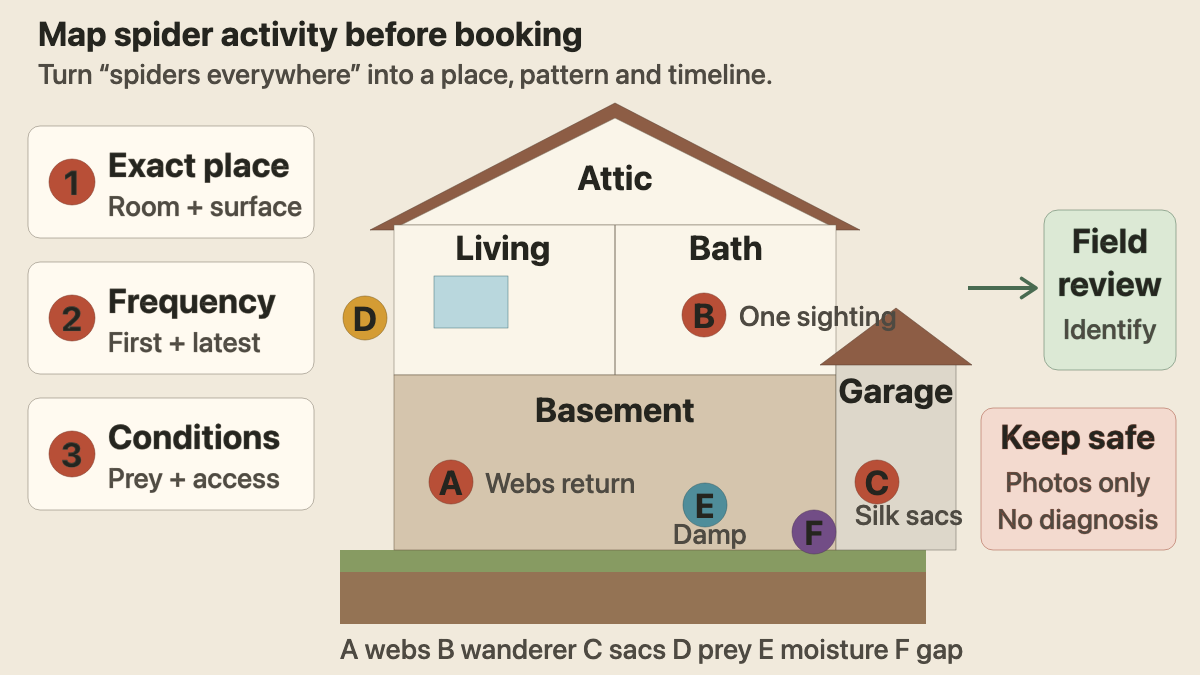
A homeowner calls after seeing “spiders everywhere.” One appeared in the bathtub this morning. Old cobwebs hang above the basement water heater, and three silk sacs sit behind boxes in the garage. A porch light draws moths beside the back door every night.
Those details describe several inspection zones, not one confirmed infestation. Ask where each spider, web, or sac appeared; when it was first and most recently seen; how often activity returns; whether other insects are present; and which attics, crawl spaces, garages, or exterior areas can be reached safely. Book the company’s approved inspection or service. Leave species identification, treatment selection, and medical questions to the qualified person responsible for them.
Pin every report to a place and surface
“Upstairs” is too broad for a field note. The useful version is “one fast-moving spider on the upstairs bathroom floor at 6 a.m. Tuesday.” Record the room, the exact surface, and whether the sighting was indoors or outside. For exterior activity, name the side of the structure and the nearest feature: porch light, eave, window frame, woodpile, shrub, deck, foundation vent, or garage door.
Then separate the evidence. Was it a live spider, a dead spider, an empty web, an occupied web, a silk sac, or a shed skin? Did the spider stay in a web, retreat into a gap, or run across an open surface? A caller can report those observations without touching anything.
The University of Minnesota Extension’s household spider guide explains why the distinction matters. Web-building spiders often occupy calm, undisturbed areas and remain near their webs. Hunting spiders move after prey and may appear without a capture web. Basement corners, crawl spaces, closets, window wells, foundations, and low vegetation can support different activity patterns.
Ask for a photo when the company accepts one and the caller can take it from a safe distance. A useful image shows the spider or web in place, plus a wider view of the surrounding corner, wall, box, or doorway. Reception should record “caller suspects a brown recluse” as the caller’s statement. It should never convert that statement into a confirmed identification.
Turn “a lot” into a sighting timeline
Frequency gives a technician context. Ask when the first sighting occurred, when the latest one occurred, and how many separate sightings the caller remembers. Break the count down by location. Five spiders over a summer around exterior lights reads differently from five live spiders found in the same basement room this week.
Time of day can help too. Record whether activity appears after dark, during morning cleaning, when storage boxes are moved, or after a door has stood open. Note recent weather shifts, construction, deliveries, firewood brought indoors, or stored belongings moved from a shed. These facts do not prove a cause. They help the technician decide where to look first.
Web history is especially useful. Ask whether a web is old and dusty, newly occupied, or repeatedly rebuilt after cleaning. Record the date it was removed and how soon it returned. For silk sacs, note the number and exact location, but do not ask the caller to open, crush, or carry them.
There is no universal phone threshold that turns occasional spider activity into an infestation. The EPA’s integrated pest management framework starts with identification and monitoring, then considers prevention, action thresholds, and control choices. The office collects the observations. The field inspection interprets them.
Record the food, shelter, moisture, and entry clues
Spiders eat other arthropods. Ask whether the caller has also noticed flies, moths, gnats, ants, crickets, roaches, or other insects. Pin those sightings to the same map. Moths around a porch light, small flies near a floor drain, and insects caught in a basement web all give the technician a better starting point than “the house is clean.”
Storage conditions belong in the note without judgment. Cardboard boxes, clothing piles, seldom-moved furniture, utility voids, attic insulation, firewood, and shelving can create quiet inspection areas. Ask which spaces are crowded and whether the customer can provide access. Do not direct anyone to crawl into a confined area or shift unstable stacks before the appointment.
Moisture may shape where insects and some spiders are found. Record dripping pipes, damp crawl spaces, floor drains, sump areas, condensation, and rooms that stay humid. Also capture exterior vegetation touching the structure, damaged screens, worn door sweeps, foundation cracks, utility penetrations, vents, and gaps around windows.
University of Minnesota Extension recommends an integrated approach that may include removing individual spiders, vacuuming webs and sacs, reducing clutter, monitoring with sticky traps, reducing insect prey, repairing screens, trimming vegetation, and sealing gaps. It also notes that broad surface treatments and foggers are ineffective for spider control. Reception should describe the company’s actual service policy and let a licensed technician choose any pesticide use allowed by the label and local rules.
Ask the questions that change access and preparation
A dispatch-ready record should cover the people, animals, and work conditions at the property. Ask whether children or pets use the affected rooms, whether anyone has a strong fear that could affect access, and whether the customer has applied any spray, dust, fogger, essential oil, or pest product. Record product names and application dates when available. A label photo is better than a color description of the bottle.
Capture these fields before confirming the visit:
- service address, property type, approximate size, and requested appointment type
- exact sighting locations, surfaces, first and latest dates, counts, and time patterns
- live spiders, dead spiders, occupied or empty webs, silk sacs, and safe photos
- other insects, moisture, storage, exterior lights, vegetation, screens, doors, vents, and utility gaps
- access to the attic, basement, crawl space, garage, shed, closets, and exterior perimeter
- children, pets, sensitive areas, prior products, recent deliveries, and moved storage
- caller-reported species concerns, bite concerns, and items reserved for field review
Preparation should match written company policy. One business may ask customers to leave webs in place for inspection. Another may request photos before routine cleaning. The pest treatment preparation guide explains how to give service-specific instructions without improvising. If the caller is reporting activity after a recent visit, use the warranty and callback intake so the technician receives the prior service date, treated areas, warranty terms, and new evidence.
Keep species and health claims out of the booking promise
Color is weak identification evidence. “Brown spider” can describe many unrelated species, and common names vary. Geography matters as well. Penn State Extension’s regional spider guide is useful for Pennsylvania and the Northeast, but its range makes it a poor identification key for a caller in Arizona or Florida.
Reception can ask whether the spider is still visible, whether the caller has a clear photo, and whether the company has a safe specimen policy. Never instruct a caller to catch a spider, reach behind storage, or approach one they fear may be medically important. A suspected black widow or brown recluse report should be marked for the company’s approved escalation path and professional identification.
Handle bite concerns with the same boundary. Pest control staff do not diagnose a bite from a skin description or confirm which animal caused it. A caller with pain, swelling, breathing trouble, spreading symptoms, or another urgent health concern needs guidance from an appropriate medical professional or emergency service. The pest appointment can document where a spider was seen, but it cannot answer a clinical question.
Avoid promising a “spider-free home.” University of Minnesota Extension notes that eliminating every spider from a home is difficult and unnecessary. A defensible booking promise names the visit: inspection, targeted service, monitoring, exclusion review, web removal, or another company-approved scope pending site findings.
Read the record back in concrete language: “Three silk sacs behind boxes along the west garage wall, first noticed Sunday. Tangled web above the basement water heater returned twice after cleaning this month. One live spider crossed the upstairs bathroom floor Tuesday morning. Moths gather at the rear porch light, and the screen door has a torn lower corner. Customer applied an aerosol along the garage baseboard four days ago and will send the label photo. Garage and basement are accessible; attic access requires the technician to call on arrival. Species and treatment remain pending field review.”
That note gives the technician a house to inspect and a sequence to verify. An AI receptionist can collect the same approved fields after hours and route identification concerns, pesticide exposures, access problems, and health questions to a person. The value sits in the map, the timeline, and the careful handoff.