A homeowner calls because the kitchen sink takes a minute to empty. Five minutes later, another caller says the kitchen sink, downstairs shower, and laundry standpipe are all slow after a weekend full of guests. Those calls need different intake, even though both callers use the same phrase.
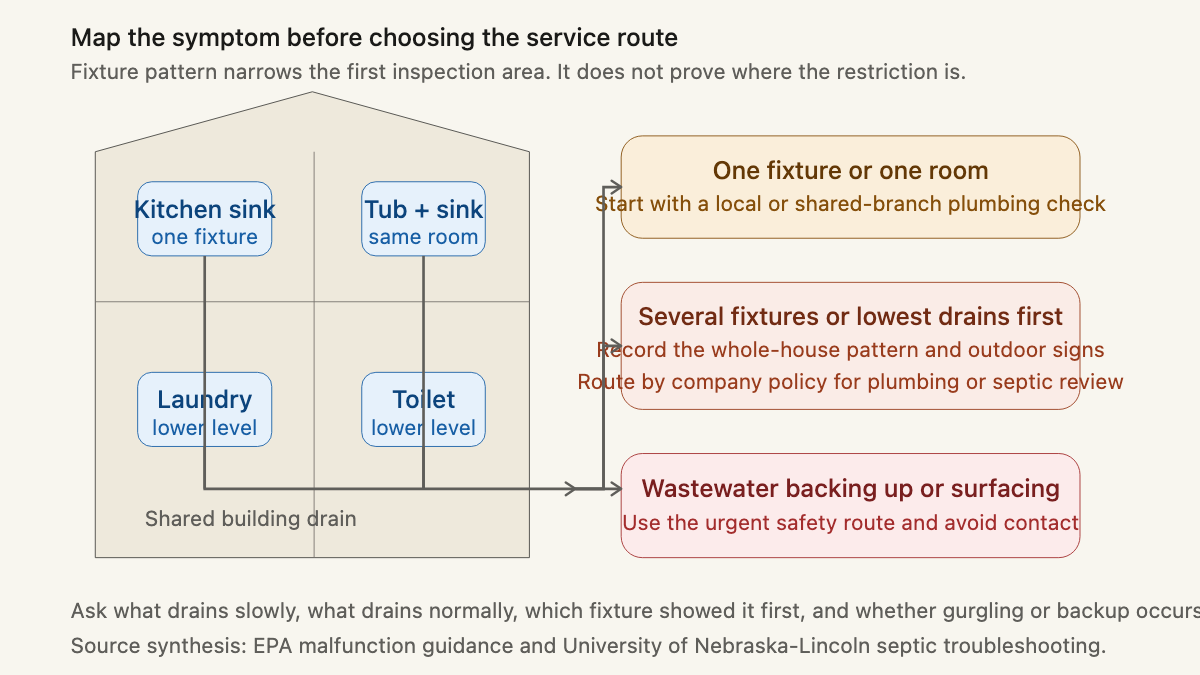
Start with the pattern. Ask which fixtures are slow, which still drain normally, and where each fixture sits in the house. One slow sink often deserves a local plumbing check first. Several slow fixtures, especially on different branches or at the lowest level, raise the value of a broader building-sewer or septic review. Active backup, wastewater surfacing outdoors, or sewage exposure belongs on the urgent route defined by your company.
That pattern guides dispatch. It does not locate the fault. The office should collect observations and send the field professional a clean record.
Count the affected fixtures before discussing the tank
The first useful question is specific: “Which drain showed the problem first?” Follow it with “What else is slow right now?” Ask the caller to name fixtures, not rooms. “The bathroom is slow” could mean a sink, tub, toilet, or all three.
A single affected fixture can point toward the fixture trap or its branch drain. Two fixtures in the same bathroom may share a branch. Slow drainage at the kitchen, laundry, and a lower-level shower creates a different pattern because the symptom crosses several fixture groups. The University of Nebraska-Lincoln troubleshooting guide lists possible restrictions in house plumbing, the sewer line between the house and treatment system, the tank, distribution components, and the soil treatment interface. The caller cannot tell you which location is responsible.
Ask what still works normally. A toilet that flushes normally while one sink drains slowly is useful context. So is a lower-level shower that gurgles when an upstairs toilet flushes. Record the sequence in the caller’s own words. Do not turn it into a diagnosis in the dispatch note.
A concise note might read: “Kitchen sink began draining slowly Tuesday. Upstairs tub and both toilets operate normally. No gurgling, backup, alarm, yard odor, or wet area reported.” That gives a plumber or septic technician evidence they can use. “Possible full tank” does not.
Screen for backup and outdoor warning signs next
Once you know the fixture pattern, ask whether water or wastewater has come back up through any drain. Use plain language. Some callers hear “backup” and think only of a toilet overflowing. Ask about the shower, tub, floor drain, laundry standpipe, and lowest plumbing fixture too.
If sewage is present, tell the caller to avoid contact and follow your company’s safety and escalation policy. The EPA’s septic malfunction guidance warns that backed-up sewage may contain harmful pathogens. Reception should not coach a caller through opening a tank, removing a lid, entering a wet area, or testing electrical equipment.
Then move outside through questions only:
- Is there standing water, damp or spongy soil, or wastewater near the tank or drainfield?
- Is there a strong sewage odor near the system? Is an alarm sounding or flashing?
- Did the caller notice unusually green growth over one part of the treatment area during otherwise dry weather?
- Is the system area flooded, frozen, driven over, or blocked from service access?
EPA lists very slow drains, plumbing backup, gurgling, standing water, damp areas, and sewage odors among common signs of a malfunction. The University of Minnesota Onsite Sewage Treatment Program also identifies indoor backup, surfacing wastewater, odors, and alarms as warning signs. Any one observation still leaves several possible causes. A cluster of indoor and outdoor symptoms gives dispatch a stronger reason to use the septic-service route.
Keep local policy in charge. The office can mark an urgent condition without promising an arrival time or naming a failed component.
Ask what changed before the drains slowed
The timing often improves the handoff. Ask whether the problem appeared suddenly or worsened over days. Then ask what happened beforehand.
Useful details include a house full of visitors, several laundry loads, a running toilet, heavy rainfall, a power outage, recent pumping, drain cleaning, construction, or a change in occupancy. Water-use history matters because every gallon entering the plumbing has to move through the onsite system. Maintenance history matters too, though a remembered pumping date does not prove the current condition of the tank or drainfield.
Avoid turning the call into an interrogation. Six focused questions usually create a better record than twenty disconnected ones:
- Which fixture was slow first, and when did it start?
- Which fixtures are slow now, and which still work normally?
- Is anything gurgling, backing up, or overflowing?
- Is there an alarm, odor, wet soil, or wastewater outdoors?
- What changed recently in water use, weather, power, occupancy, or service history?
- Where are the tank, risers, cleanouts, and service access, if the caller knows?
The caller may not know the tank location or system type. Record “unknown.” Never ask them to uncover a buried lid or walk through suspected wastewater to find it.
Explain why the phone cannot choose the failed part
A septic property has several connected inspection zones. Wastewater moves through fixture branches, the building sewer, the tank and outlet, distribution components, and the soil treatment area. Pumped systems add mechanical and electrical parts. A restriction or operating problem at different points can produce similar complaints inside the house.
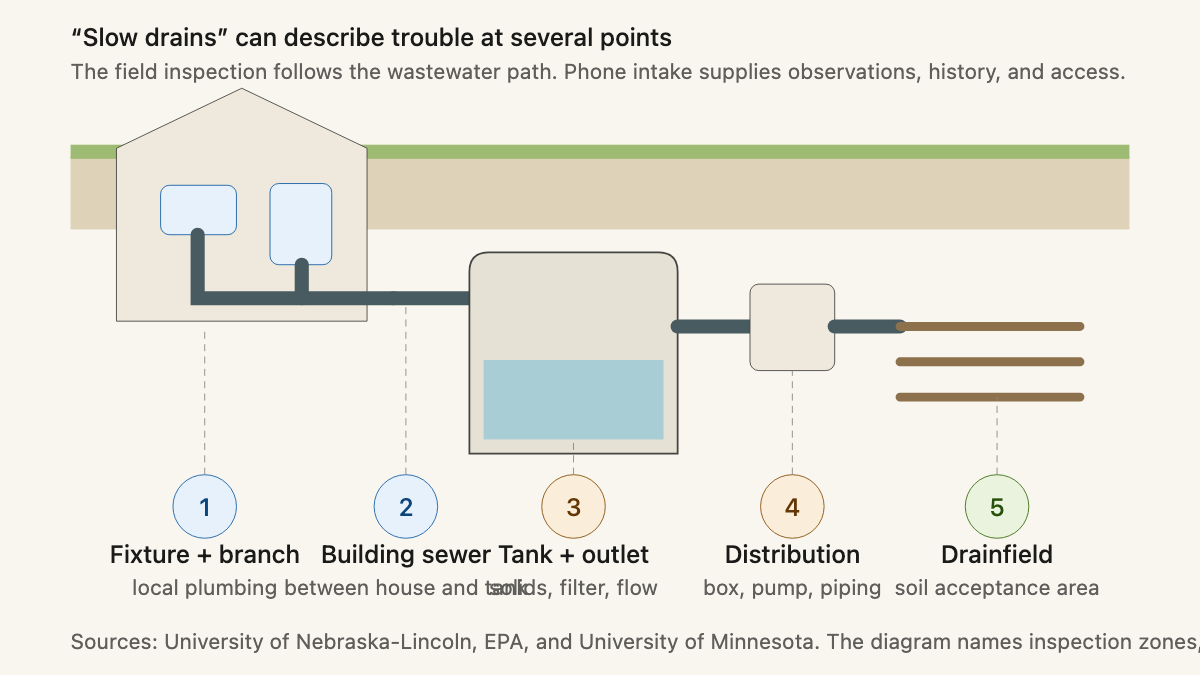
That is why “one sink or the whole house?” is a routing question. It is not a diagnostic test. A field professional may need to inspect accessible plumbing, review records, evaluate tank levels and components, examine the building sewer, or assess the treatment area. The appropriate scope depends on the property and the service company.
This boundary also prevents a common scheduling mistake: automatically booking a pump-out whenever a caller says “slow drain.” Pumping may be due based on inspection and maintenance history, but it does not clear every house-plumbing blockage, repair every damaged line, or restore every impaired drainfield. The Answara guide to septic pumping and backup call intake gives routine pumping and active backup their own scheduling paths.
Build a dispatch note the field crew can trust
A strong handoff separates reported facts, unknowns, and the route selected. Put the affected fixtures and first symptom near the top. Add backup or exposure status next. Then record outdoor observations, recent events, system history, and access.
For example:
“Three fixtures affected: kitchen sink, laundry standpipe, and basement shower. Basement shower gurgles after upstairs toilet use. No wastewater indoors. Caller reports damp soil near the downhill edge of the drainfield after two dry days. No alarm heard. Four adults moved into the home last month. Last pumping date unknown. Gate code confirmed; dog will be secured. Routed for septic-system review under standard priority policy.”
That note avoids a guessed cause. It still tells the technician why the septic route was chosen.
If only one fixture is affected and there are no broader warning signs, your policy may route the job to a plumber or ask the customer to begin with a local drain evaluation. If several fixtures are involved, the lowest drains react first, or outdoor signs appear, a septic provider may be the better first call. Some companies handle both scopes. Others coordinate with a plumbing partner.
Reception should state the next step carefully: “I’ve recorded which fixtures are affected and the conditions you observed. The field professional will inspect the property and determine where the restriction or system problem is.” That sentence sets an honest expectation.
Keep the routing logic consistent after hours
Slow-drain calls often arrive when the experienced dispatcher has gone home. A written intake path keeps the evening answer from collapsing into “leave a message for the technician.” An AI receptionist can ask the same approved questions after hours and flag backup or exposure language, provided the company defines the route and escalation rules.
Review those rules with field staff. If technicians repeatedly ask for the same missing detail, add it to intake. If the office keeps receiving photos that show nothing useful, specify what view helps and make photo requests optional and safe. The best script grows out of actual handoffs.
A caller should finish with one clear instruction: avoid sewage contact, expect a plumbing check, expect a septic review, or wait for the company’s callback under a stated policy. The crew should open the job record and see the fixture pattern, warning signs, recent changes, and a safe path onto the property.