A caller says, “We bought a lot and need a septic system.” They may have a street address, a tax parcel number, a house plan, or none of those. They may also ask for a price and installation date before anyone has evaluated the soil.
The useful response is to establish the project, collect the records that already exist, and explain the next professional step. Start with the property address or parcel ID, the proposed building and bedroom count, water and sewer status, known wells and waterways, prior soil or permit work, site access, the decision-maker, and the caller’s deadline. Then route the request according to the authority and qualified professionals who handle that address.
Reception should never pick a system type, interpret soil, promise permit approval, or turn a preliminary plan into a construction date.
Identify the parcel before discussing the project
A name and phone number are not enough. Ask for the street address if one has been assigned. For vacant land, collect the tax parcel number, county or municipality, subdivision and lot number when available, and the owner’s name as it appears on the property record. Confirm whether the caller owns the land, has it under contract, represents the owner, or is gathering information before making an offer.
That distinction changes the next step. An owner may be ready to authorize a site evaluation. A prospective buyer may need a feasibility conversation and permission to enter the property. A builder may already have surveys and architectural drawings. Record the role without deciding whether the caller has legal authority to apply for a permit. The permitting office or your company’s policy should settle that.
Ask whether the parcel has an assigned address. Some jurisdictions require one before a local septic application can move forward. Summit County Public Health, for example, tells applicants to obtain an address assignment and check whether sanitary sewer is available. That is a local example, not a nationwide sequence. It shows why the job address belongs at the top of the intake note.
Capture the building the system would serve
“What are you building?” is too broad by itself. Ask whether the project is a new single-family home, an accessory dwelling, a replacement home, a major addition, or another use. For a proposed home, collect the planned bedroom count and note whether the plans are preliminary or complete.
Bedroom count matters because local design rules may use it when establishing wastewater flow and sizing requirements. Virginia Cooperative Extension describes that relationship under Virginia rules. The receptionist should record the number shown on the current plan, not calculate a tank volume or treatment-area size from it. Those determinations belong to the designer and reviewing authority.
Also ask where the project stands:
- Is there a survey, boundary plan, or preliminary site plan?
- Has a house footprint, driveway, garage, deck, pool, or outbuilding been drawn?
- Is the building permit still conceptual, submitted, or issued?
- Has an architect, engineer, soil evaluator, builder, or septic designer joined the project?
- Is the caller replacing an old proposal, or starting with a vacant parcel?
The office needs the current drawing set, even if it consists of one PDF and a sketch. Label each file with its date. A revised house location can make an older soil report hard to apply, and a different bedroom count can change the design basis.
Map known lot features without judging them
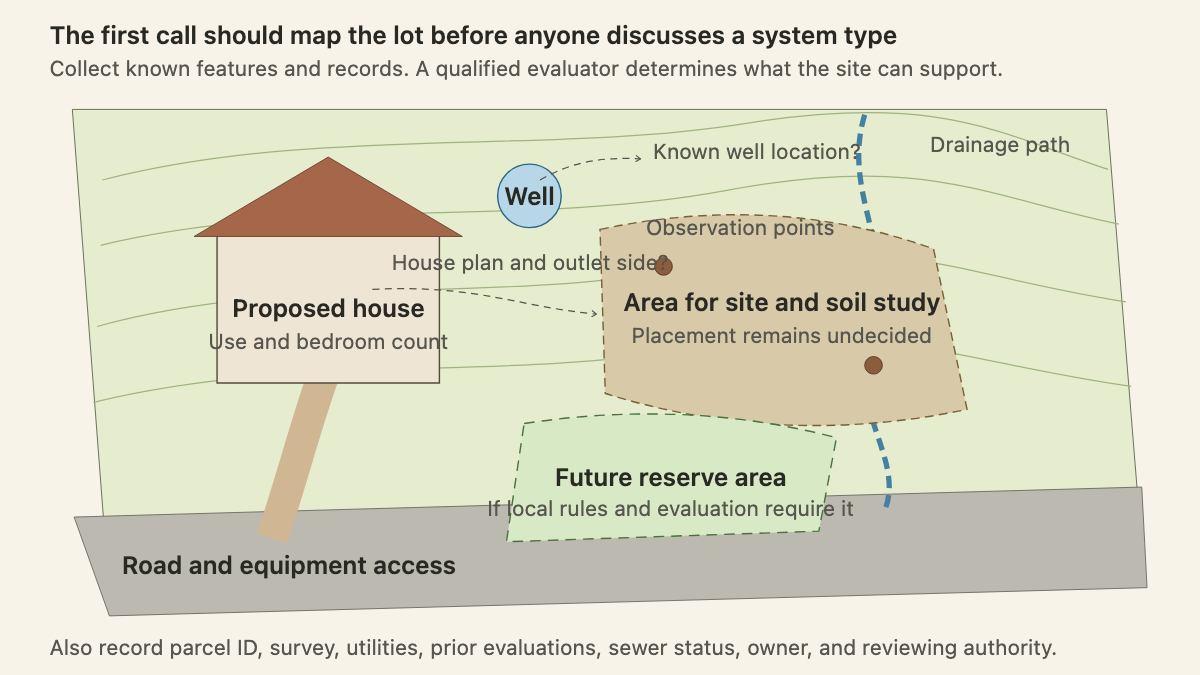
The next questions create a rough site record. Ask what the caller knows about private wells, public water, streams, ponds, wetlands, drainage swales, flood-prone ground, steep slopes, rock, filled areas, utility easements, property lines, and existing structures. Record observations and document sources separately.
“Owner sees standing water near the rear corner after rain” is useful. “Rear corner fails for septic” is a conclusion the office cannot support. The same boundary applies to a neighbor’s old percolation result, a listing description that says “septic approved,” or a contractor’s recollection from another lot in the subdivision.
The U.S. Environmental Protection Agency says system type can depend on lot size, slope, soil conditions, home size or occupancy, local rules, and budget. EPA also notes that local programs assess soil treatment capacity and set separation distances from features such as buildings, driveways, property lines, and surface water. The exact requirements come from the authority responsible for the address.
Ask about access too. Can a field evaluator reach the likely study area? Are there locked gates, livestock, loose dogs, tenants, dense brush, active construction, or hunting restrictions? Who can authorize entry? A clean calendar slot is worthless if the evaluator arrives at a locked farm gate with no local contact.
Treat soil work as a professional handoff
Callers often ask whether they need a “perc test.” Use the term they used in the notes, then describe your company’s actual service and the local process. Jurisdictions do not all use the same field methods, professional titles, forms, or approval steps.
Virginia Cooperative Extension explains that a qualified evaluator may consider soil drainage, shallow or restrictive soils, wells, slope and contour, gullies, drainageways, floodplains, and seasonal high water conditions. Summit County Public Health describes a site and soil evaluation as the step used locally to determine the size, location, and type of system that can be installed.
That evidence supports a simple phone boundary. Reception can schedule an evaluation, collect old reports, and note visible site conditions. It cannot read the lawn, interpret a soil profile, select a conventional or advanced system, or tell the caller that a proposed area will pass.
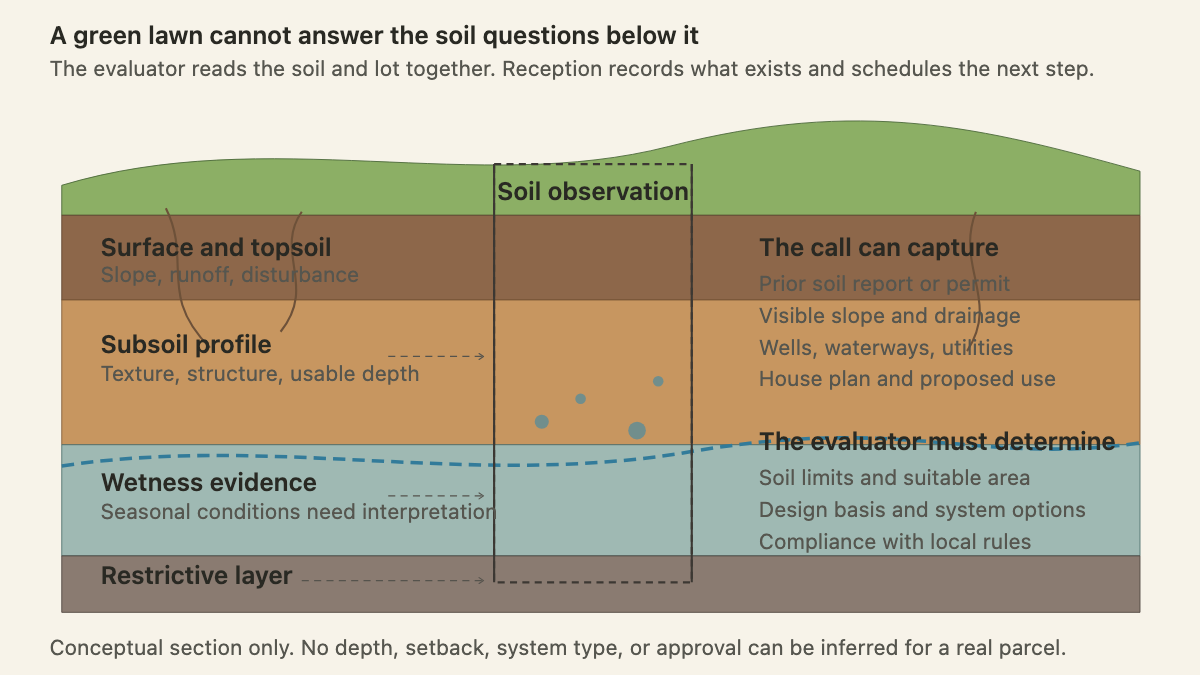
If prior soil work exists, request the complete document. Capture the evaluator’s name, date, parcel identification, proposed use, plan revision, and any authority reference number shown. Do not reduce a report to “passed” or “failed” in the dispatch note. The conditions, approved area, expiration rules, and next required submission may matter more than that shorthand.
Find the reviewing authority and permit status
EPA states that new-system permits are generally issued by a local health or environmental permitting authority, and a municipality may require additional permits. The agency does not keep a national property-level septic database because individual onsite systems are regulated by states, tribes, and local governments.
The office should maintain a verified jurisdiction directory for its service area. For each address, that directory can identify the likely health department, environmental office, tribal authority, municipality, or state program and link to the current application page. Give callers the approved contact or explain which part your company handles. Avoid quoting a fee, processing time, setback, or required test unless it comes from the current authority guidance for that property.
Ask these permit-status questions in plain language: Has anyone contacted the reviewing authority? Is there an application or project number? Has a site evaluation occurred? Does a design exist? Was anything approved, denied, returned for revision, or allowed to expire? Are inspection records or written comments available?
A caller may use “permit” to describe a soil report, an installation authorization, a building permit, or a document from a prior owner. Request the file. Its title and issuing office are more reliable than the caller’s label.
Separate the deadline from the promise
New-system calls often arrive with a closing date, loan deadline, construction start, or planned move. Record the date and who imposed it. Then state what your office can schedule now.
A safe response sounds like this: “I have your parcel number, four-bedroom preliminary plan, survey, and the county application number. Our designer will review those before we confirm the field visit and tell you which local step comes next.”
Do not promise that the field evaluation, design, permit review, installation, and final inspection will fit the requested date. Each stage may depend on a different person or agency. Weather and site access can affect fieldwork too. The office can own callbacks and document handoffs without claiming control over every calendar.
Give the evaluator one usable consultation note
The final note should let a professional understand the project without replaying the call. Use a stable order:
- Caller, owner, decision-maker, and permission-to-enter contact.
- Address, parcel ID, municipality, subdivision, and lot number.
- Proposed use, current bedroom count, and plan revision date.
- Public water or known well, plus sewer-availability status if checked.
- Survey, site plan, prior soil work, permits, comments, and project numbers received.
- Known slopes, drainage, waterways, easements, utilities, structures, and access limits.
- Requested deadline, its source, and the exact next step promised by the office.
Keep the files with the note. Write “unknown” where the caller does not know. Do not fill gaps with assumptions.
This intake also creates the first clean record for future service. Once the system is installed, drawings and permits can help crews answer tank location and access questions before pumping. If the owner later asks about ongoing coverage, the office can use the separate guide to septic maintenance plan signup calls.
An AI receptionist can collect parcel, project, records, and access fields after hours, then route the package under the company’s policy. The evaluator still decides what the site supports. A strong handoff ends with one concrete sentence: “Owner requests a new four-bedroom home on parcel 18-442, survey and preliminary plan attached, private well proposed, no prior soil report located, county authority identified, and owner available Tuesday morning to provide gate access.”