A caller says she wants luxury vinyl plank in “about 900 square feet.” She has measured the living room and bedrooms, but the hallway is missing, the kitchen has tile, one bedroom has carpet, and nobody has discussed closets or the step down into the den. That number is useful as a starting point. It is not a finished scope.
The office should turn the call into a clear measurement or estimate appointment. Capture the rooms, the existing floors, the selected product if there is one, access constraints, and any condition that needs field review. Keep customer measurements labeled as preliminary. The estimator still confirms dimensions, transitions, substrate condition, product requirements, and removal work at the property.
First identify what the caller is asking you to provide
“LVP installation” can describe several different jobs. One homeowner wants a contractor to supply material and install it. Another already bought click-lock planks and wants labor only. A third is still comparing samples and needs an in-home measurement before choosing a product.
Ask which of those situations applies. If material has been selected, request the manufacturer, collection, product name, and installation instructions printed on the box or linked by the seller. A photo of the box label is often easier than spelling a long collection name over the phone. Record where the material was purchased and whether it is already at the property.
Do not promise that a customer-supplied product is suitable for every room or substrate. Manufacturer instructions differ. CALI’s installation guide puts responsibility on the installer and homeowner to determine whether jobsite conditions and the subfloor are acceptable for the selected flooring. Shaw’s vinyl installation overview also tells customers to discuss subfloor readiness and any underlayment with the installer or retailer.
The appointment note should say “customer-supplied material, product details attached, suitability pending site review.” That protects the field conversation from a promise the office never meant to make.
Map the full room scope, including the awkward edges
Start with a room-by-room list. Ask which bedrooms, living areas, halls, closets, pantries, laundry rooms, stairs, landings, and bathrooms are included. Then ask how those spaces connect. A continuous run through a living room, hall, and kitchen creates different layout and transition questions than three separate bedrooms behind doorways.
Customer measurements help with early planning, but label each one as customer supplied. Request length and width for every rectangular area and note irregular shapes, bay windows, angled walls, islands, cabinets, floor registers, hearths, and built-ins. The estimator should verify the measurements before ordering material or issuing a binding installation scope.
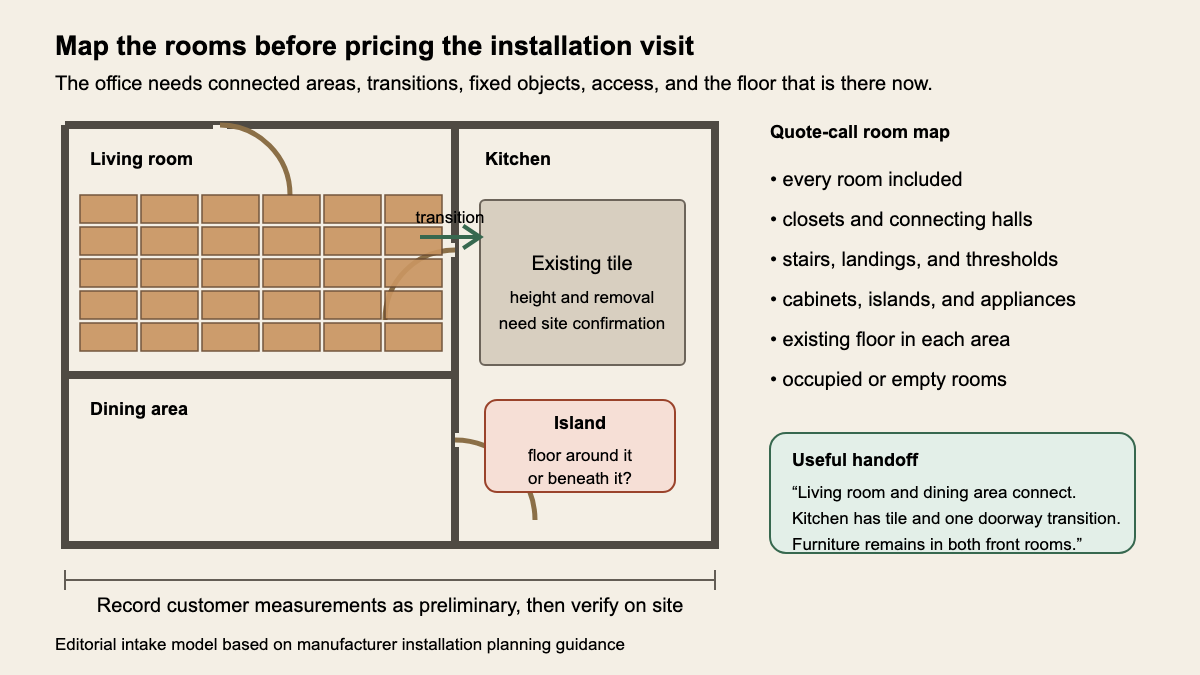
Ask about thresholds at every edge of the proposed work. What floor meets the new LVP at the front door, bathroom, stair top, fireplace, patio door, and rooms outside the project? Are there visible height changes now? Does an exterior door sweep close to the current floor? These answers do not select a transition piece by phone. They tell the estimator where to look.
A useful scope note might read: “Living room, dining area, hall, and two closets are included. Kitchen tile remains for now. One open doorway connects the dining area to the kitchen. Customer reports a small height difference there. Measurements are attached and require field verification.”
Record the flooring that is there now
Ask for the current surface in each included room. Common answers are carpet, sheet vinyl, vinyl tile, ceramic tile, laminate, hardwood, or bare concrete. If the caller is unsure, request clear photos near a doorway, floor vent, or damaged edge without asking anyone to lift or break material.
Then separate removal from installation. Is the customer asking your crew to remove and dispose of the old flooring? Has another contractor already quoted removal? Will the rooms be empty, or is furniture moving part of the request? Are appliances, toilets, vanities, or cabinets involved? The office should record these as scope questions, not casually include them.
Age matters when old resilient flooring or adhesive may be disturbed. Staff should never identify asbestos from a photo or the caller’s description. The EPA advises against sanding or trying to level asbestos-containing flooring or backing. If the caller reports very old tile, backing, or adhesive and removal is possible, flag the material for company review and any assessment required under local rules. Do not tell the customer to scrape up a sample.
Damage deserves its own note. Record loose tiles, curled sheet flooring, cracked grout, soft areas, staining, odor, or a recent leak. A water-damaged room may need a separate inspection path before installation planning continues. The water-damaged flooring call guide shows how to capture the source, material, and affected area without diagnosing hidden damage by phone.
Keep the floor assembly open for field verification
The visible surface is one layer. Beneath it may be an attached pad, separate underlayment, old flooring, plywood or oriented strand board, patching compound, or a concrete slab. The phone call rarely establishes the condition of those layers.
Ask whether the home is on a slab, crawl space, basement, or upper story if the caller knows. Record any known soft spots, ridges, cracked tile, loose boards, squeaks, patched areas, or moisture history. A report of repeated noise may also benefit from the squeaky-floor intake guide, especially when access below could affect inspection.
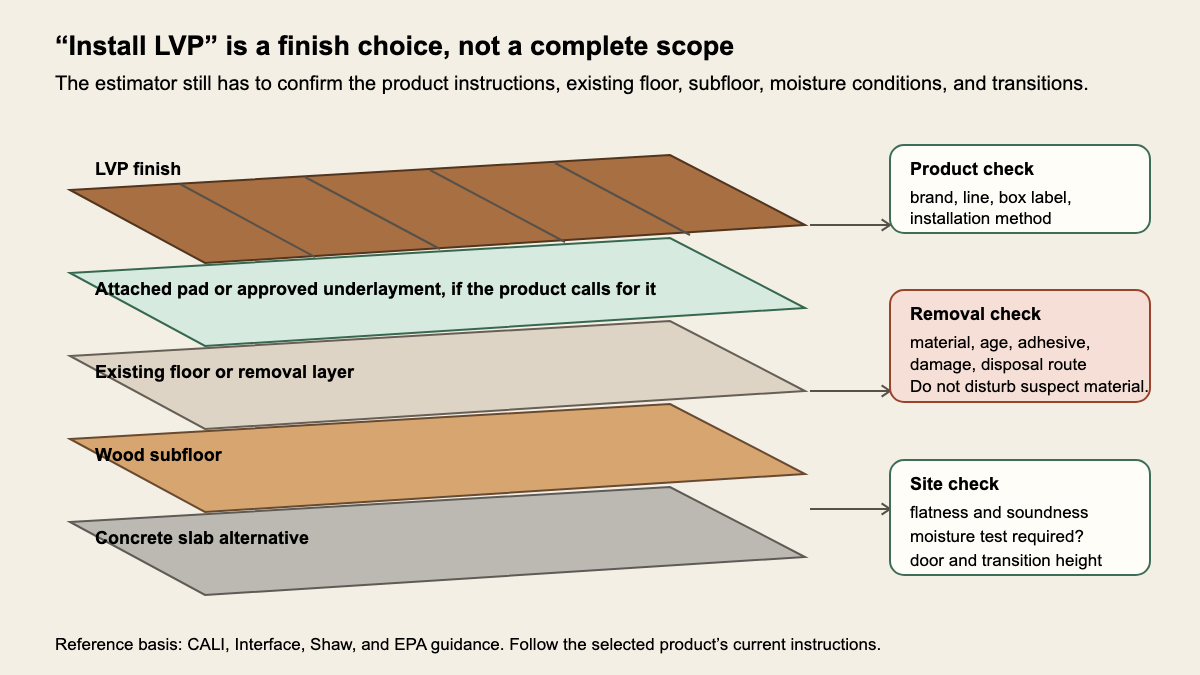
Avoid universal claims about acclimation, underlayment, moisture limits, or allowable flatness. Interface’s LVT instructions discuss material storage, room conditions, substrate preparation, and layout. CALI publishes its own product-family instructions. The current instructions for the selected product, along with the actual site and substrate, should control the installation plan.
The office can ask whether HVAC is operating, whether construction is still underway, and whether material is stored flat in a conditioned part of the property. Record the answers. Let the estimator decide what follows from them.
Capture occupancy, access, and schedule constraints
Installation planning changes when the home is occupied. Ask whether people will remain in the home, whether pets need to be secured, and which rooms contain furniture. Record stairs, elevator reservations, parking limits, gated access, long material carries, and building work-hour rules.
For kitchens and laundry areas, ask which appliances sit in the scope and whether the caller expects the flooring company to move them. Do the same for toilets, pedestal sinks, pool tables, aquariums, safes, and adjustable shelving. Do not imply that the crew will disconnect gas, water, or electrical service unless company policy and the scheduled trade support it.
Ask for the preferred project window and any hard deadline, such as a move-in date or tenant turnover. Phrase the handoff carefully: “The customer hopes to finish before October 10. Schedule and duration are pending measurement, product availability, site review, and final scope.” A date the caller wants is useful. It is not a promise.
Build the estimator’s handoff in five parts
A clean LVP quote-call record should include:
- request type: material and labor, labor only, or measurement and product selection
- product details: manufacturer, collection, installation method if known, seller, quantity on hand, and box-label photos
- room scope: every included room, closet, hall, stair, fixed object, threshold, and customer-supplied measurement
- existing conditions: current flooring by room, removal request, visible damage, moisture history, known substrate, and suspect old material
- logistics: furniture, appliances, occupancy, pets, access, parking, building rules, and requested timing
Close with an expectation the field team can honor: “We’ve recorded the areas, current floors, product details, and access notes. The estimator will verify measurements and site conditions before finalizing the installation scope.”
That sentence keeps the quote call useful and accurate. When the installer cannot answer during a job, a trained receptionist or AI receptionist can collect the same fields and send a consistent handoff. The crew arrives knowing which rooms connect, what lies underfoot now, and which questions still belong at the property.