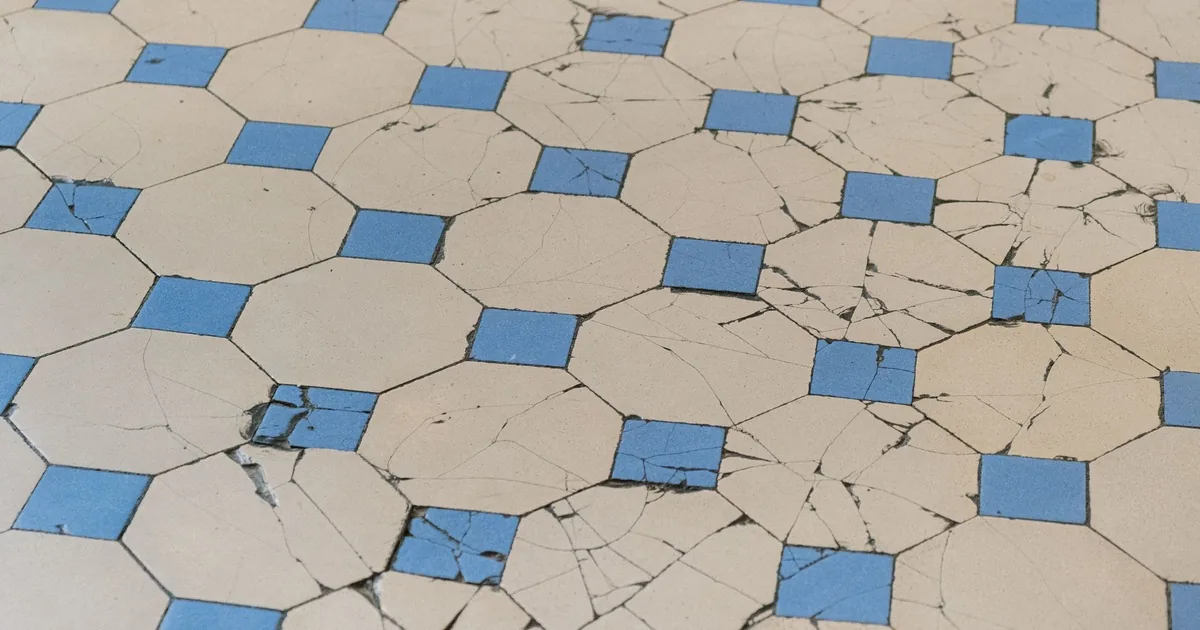
A homeowner calls about one cracked kitchen tile. Two minutes later, the office learns that the crack continues through a grout joint, three nearby tiles sound different, and the original floor was installed before the current owner bought the house. That is no longer a simple “replace one tile” booking.
Good intake gives the estimator a map, not a diagnosis. Record where the damage begins, whether it continues across tiles or grout, which pieces move, what happened before the change appeared, and what matching material is available. Promise an inspection and a scope decision. Do not promise that one tile can be replaced invisibly.
Start with the pattern, not the cause
Ask the caller to stand back and describe the whole area. Which room is affected? Is the damage in an open field, at a doorway, beside a cabinet, around a floor register, near an exterior door, or at the edge of a shower or tub? A fixed reference point makes the note usable. “Crack starts at the pantry threshold and crosses two 12-inch tiles toward the island” beats “two cracked tiles in kitchen.”
Then capture continuity. Does the line stop inside one tile, cross a grout joint, follow a grout joint, or continue into another material? Are there several separate chips, or one connected path? Has the crack changed since the caller first noticed it? Ask for dates in the caller’s own terms: “first seen after the refrigerator was moved last Saturday” is evidence; “the refrigerator caused it” is a conclusion.
The Tile Council of North America’s cracked-tile guidance explains that concrete movement can reflect through a bonded tile layer. It also says the exact cause cannot be established without inspection. That boundary matters at the front desk. A continuous line is worth documenting, but it does not authorize the office to label a slab crack, framing problem, or installation defect.
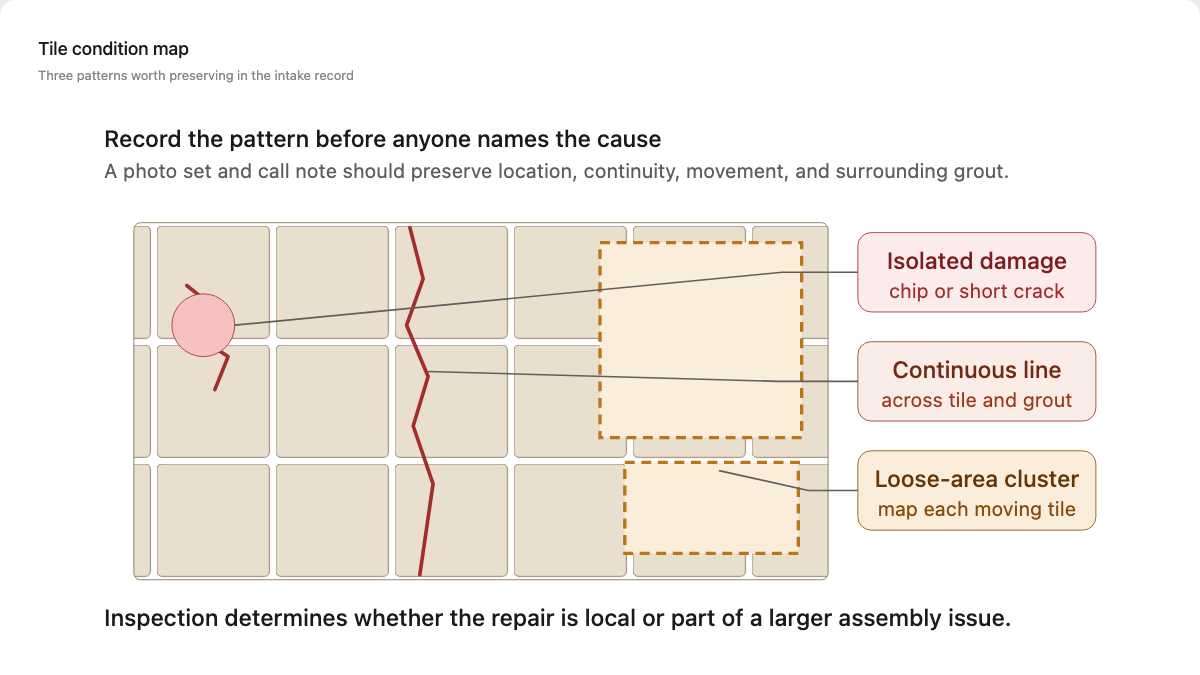
Request a wide photograph that includes walls, doors, cabinets, fixtures, and transitions. Follow it with close views of each damaged tile and the surrounding grout. If the customer can do so without moving heavy objects or entering an unsafe area, a short video taken while walking around the perimeter can show location better than ten unlabeled close-ups.
Separate cracked, loose, and hollow reports
Use the caller’s words first. A cracked tile has a visible break. A loose tile may rock, shift, rise at an edge, or release grout around its perimeter. A hollow-sounding report usually means the customer hears a different tone when walking or tapping, but sound alone does not tell the office what is happening below.
TCNA’s hollow and loose tile guidance says some floors can sound hollow even when the tile is bonded or when the assembly intentionally separates layers. It also lists several possible reasons tile can lose bond, including movement, substrate conditions, contamination, moisture, and mortar coverage. The same source warns that only an on-site inspection can evaluate the cause. Write “customer reports a hollow sound across four tiles.” Do not turn that report into “four tiles are debonded.”
Ask whether any piece visibly moves under ordinary foot traffic. Do not ask the caller to pry an edge, strike the floor with a tool, lift a tile, or test an area that may be sharp or unstable. If fragments are loose, route the call under the company’s safety policy and ask the customer to keep people and pets away until the area can be made safe.
Surrounding grout adds context. Record missing sections, powdering, widening joints, recent regrouting, sealant at a perimeter, and cracks that reappeared after a prior repair. If the caller’s main concern is a bathroom joint with no loose or cracked tile, the caulk and grout intake guide may fit better. A moving tile or repeated crack belongs in the tile inspection record.
Ask what changed around the floor
A useful history is short and factual. Ask when the damage was first seen and what changed beforehand. Furniture or appliance moves, a dropped object, a remodel, new cabinets, radiant-heat use, a plumbing leak, floodwater, or work in an adjoining room may affect the inspection plan. They are events, not verdicts.
Moisture needs its own route. Ask about active leaks, recurring dampness, staining, odor, wet grout, shower use, appliance supply lines, and whether a plumber or restoration company has visited. An active source should be addressed under company policy before a routine tile repair proceeds. The water-damaged flooring intake guide covers source status, material boundaries, timing, and the room below.
Find out what is under the tile if the caller knows: concrete slab, wood-framed floor, cement board, mortar bed, uncoupling membrane, heated assembly, or unknown. Preserve “unknown.” Ask whether there is a basement, crawl space, finished room, or another unit below the area. The field professional decides what can be verified without unnecessary demolition.
Prior work matters too. Record the installation year, installer, builder, invoices, product records, previous cracked-tile repairs, and any warranty contact. If the same location has been repaired before, say when and what the customer remembers. Do not assign blame among the tile maker, installer, builder, or homeowner.
Build a matching record before discussing availability
Start with material already on site. Ask whether the customer has spare tiles, unopened cartons, cut pieces, a purchase receipt, a product sample, or photographs from the original installation. A dusty box in the garage may hold more useful information than a phone photo of the floor.
Photograph every side of the carton label. Capture the manufacturer, series, color name, nominal size, finish, product or item number, shade or dye-lot code, caliber code, and any date or run identifier. Keep the original spelling and punctuation. Do not “clean up” a code that looks odd.
Marazzi’s tile FAQ defines shade as the tile’s coloration and reflectivity and caliber as its facial dimension. The manufacturer notes that natural materials and separate production runs can create variation. It recommends requesting the original shade when possible and comparing current samples before purchase or installation when that shade is unavailable.
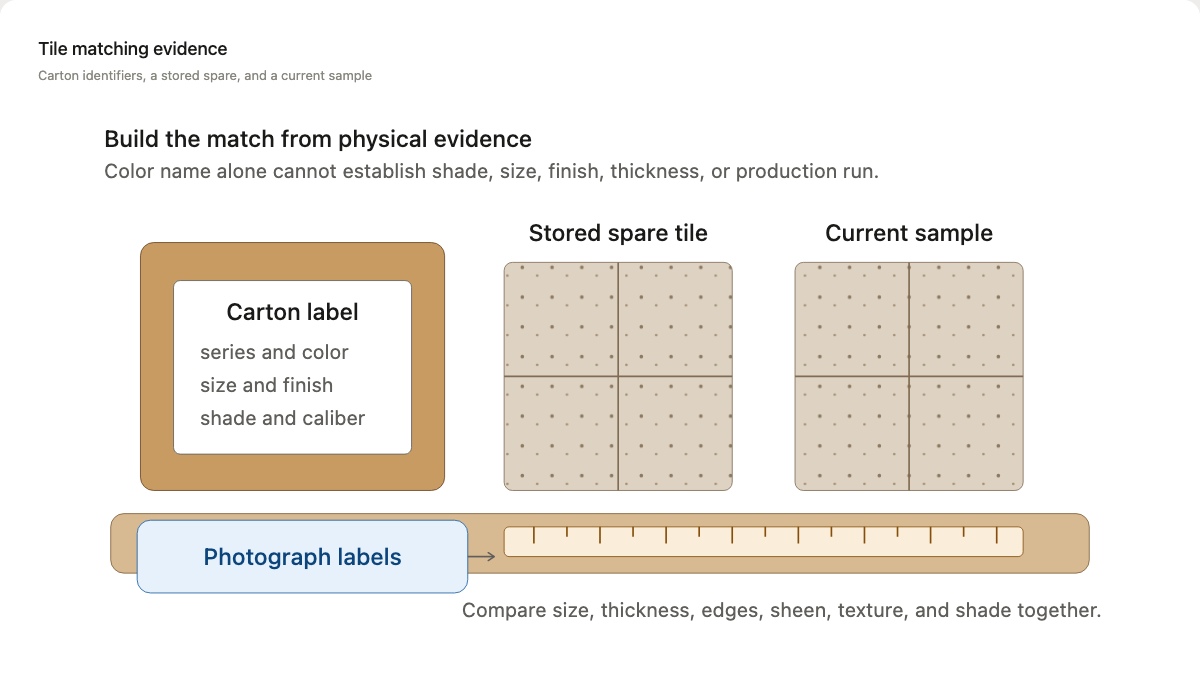
Ask for one photo of the spare tile beside the installed floor in indirect daylight, plus a second photo under the room’s normal lighting. Include a ruler or tape measure without covering the edges. The estimator may also need thickness, edge profile, surface texture, sheen, pattern variation, grout width, and signs of wear. Phone images are useful for screening. A physical sample comparison controls the material decision.
If no spare or label exists, write that plainly. The next step may involve a distributor search, a sample review, a donor tile from a concealed location, a deliberate contrasting repair, or a larger replacement area. Those are field and design decisions. The receptionist should avoid phrases such as “we can definitely match it” or “that pattern is discontinued” until someone has verified the product and supply.
Define the area and the appointment
Count affected tiles by room, but also record the connected field. Tile may continue under an island, through a doorway, beneath appliances, or into a hall. Ask whether the same tile appears in closets, a pantry, a laundry room, or another floor. Those locations can matter for matching and access even when they look undamaged.
Capture practical constraints: occupied home or vacant property, children and pets, furniture, appliances, parking, elevator rules, gate codes, working hours, tenant notice, and who can approve a change in scope. Ask whether the customer expects an inspection, a written estimate, a repair, or documentation for a builder, property manager, or insurer.
A clean note might read: “Owner reports one chipped tile and a continuous crack crossing two grout joints near pantry threshold. Three adjacent tiles reportedly sound different; no visible movement reported. First noticed after refrigerator delivery on September 12, cause unknown. No active leak reported. Tile continues through kitchen and hall. One unopened carton on site; label photos show manufacturer, series, shade, and caliber. Wide room photos and close-ups received. Slab construction reported by owner, unverified.”
Read the core record back. Correct the room, tile count, dates, and matching identifiers before the call ends. Then book the visit with enough time for the company’s inspection process. If the scope may extend beyond a local repair, flag it before dispatch.
A receptionist or AI receptionist can capture the same pattern, history, material evidence, and access fields after hours. The flooring professional still decides what failed, what must be opened, whether a local repair is sound, and how close a replacement sample really is.