A caller says the garage door is “off the track.” One roller is outside the metal rail, the bottom edge sits crooked, and a minivan is behind it. Then comes the question that can put the office in a bad position: “Can your technician pop it back in and be done today?”
Do not diagnose the failure or promise a one-part repair from that description. Tell the caller to stop operating the door, keep people and pets away from the opening, and leave the door where it is. Then capture its position, which rollers appear displaced, any impact or cable damage, whether the opening is secure, and a safe access route for the technician.
That first minute matters. An off-track door may involve a bent track, damaged rollers, a loose cable, an impact, or another problem that only becomes clear during an onsite inspection. The receptionist’s job is to describe the scene accurately and route it safely.
Begin with the door’s exact position
“Off track” can describe several different scenes. The door may be fully closed with one roller sitting outside the vertical track. It may be partly open and tilted, with daylight visible under one corner. A top roller may have left the horizontal track while the rest of the door still looks level. In a more serious call, several rollers are out and part of the door appears unsupported.
Ask the caller to describe the bottom edge in relation to the floor. Is it level? Which side is higher? About how large is the gap? Then ask whether the door is fully closed, partly open, or fully open. Write down the caller’s words and observable measurements. “Right corner is about eight inches above the slab” gives a technician usable information. “Door is broken” does not.
Next, clear the immediate area. Nobody should stand beneath a crooked or suspended door, and the caller should not run the opener again for the sake of a video. DASMA describes a garage door as a large moving system whose worn or damaged parts can create safety problems. Its guidance sends spring, cable, and bottom-bracket work to trained door systems technicians because those components may be under high tension.
If anyone is pinned, injured, or unable to leave a dangerous area, follow company policy for emergency services before arranging the repair visit.
Ask what left the track and where
Callers often use “track” for the opener rail above the center of the door, the vertical tracks beside the opening, or the curved sections that lead toward the ceiling. Clarify the location without asking the caller to touch anything.
Useful questions are plain:
- “Can you see a small wheel outside the metal track?”
- “Is the wheel near the floor, around shoulder height, or close to the ceiling?”
- “Does the metal track look bent, spread open, pulled from the wall, or otherwise out of shape?”
- “Is one side of the door lower than the other?”
- “Can you see a loose braided steel cable beside either track?”
- “Are any hinges, brackets, or door sections visibly separated?”
- “Did the door hit a vehicle, ladder, trash bin, or another object before it stopped?”
Do not turn those answers into a diagnosis. A visible roller outside the track confirms an observation, not the underlying cause. Clopay’s repair guidance notes that track problems can show up as scraping, wobbling, gaps between rollers and track, or uneven movement. The same guidance says a door can jump the track and describes professional measurement and adjustment as the proper repair path.
The distinction belongs in the ticket: “middle roller outside right vertical track after door contacted a trash bin” is useful. “Track failed” claims more than the office knows.
Request two safe photographs, not a repair attempt
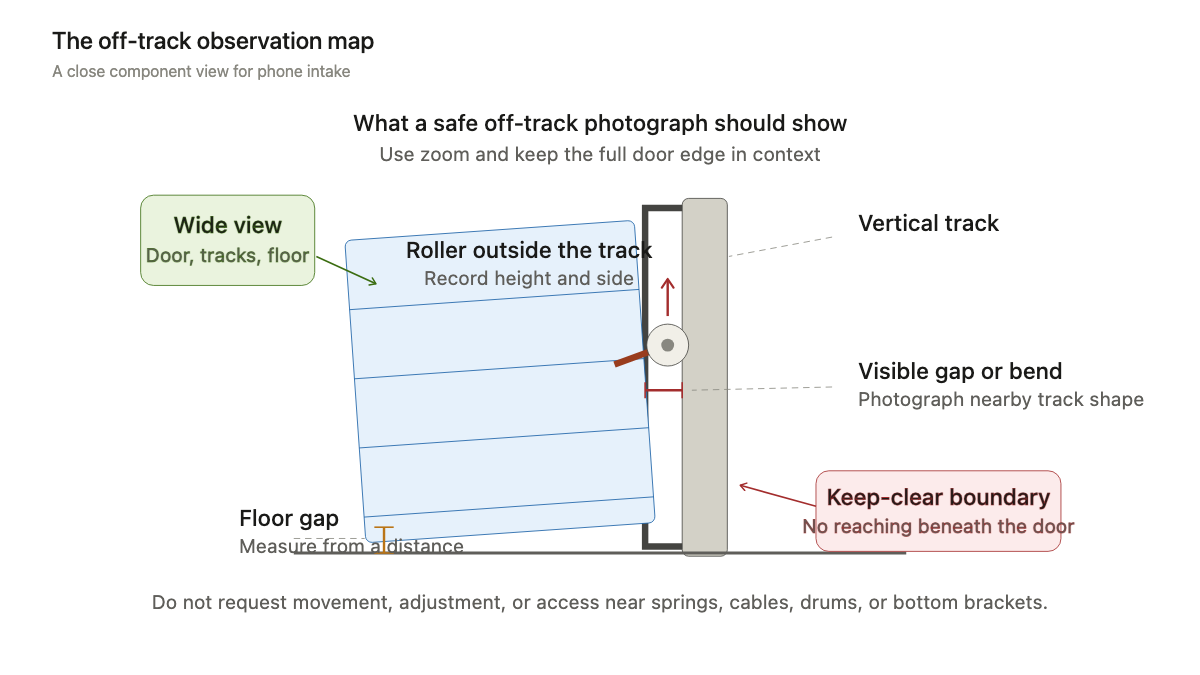
A wide photograph often answers the first dispatch question faster than a long description. Ask for one image from well inside the garage, if that position is safe, showing the whole door and both tracks. A second image can show the displaced roller and nearby track from a normal standing position. The caller should use zoom instead of stepping under the door or reaching around damaged hardware.
Set clear limits. Do not ask for a close-up of a bottom bracket, cable drum, spring, or any part that requires the caller to pass beneath a crooked section. Do not request a video of the door moving. If the only route to the photo crosses the opening, record “photo unavailable due to door position” and move on.
The wide image should answer four questions: where the door stopped, whether it sits level, how many rollers appear outside the track, and whether a vehicle or stored item blocks access. The detail image should show the nearby track shape and the visible roller without cropping away all context. A tight picture of one wheel can hide the bent jamb bracket or separated panel beside it.
Photographs help the technician choose tools and plan access. They do not support a promise that the job needs only a roller or track adjustment.
Separate the off-track call from a cable call
A crooked door and a loose cable can appear together. If the caller sees a slack, frayed, looped, or broken braided steel cable, record that condition and use the company’s cable-safety workflow. DASMA warns that worn cables can break and says cable replacement belongs with a trained technician due to high spring tension.
The office should not tell the caller to place a cable back on a drum, loosen a bottom fixture, clamp a track, pull an emergency release, or lift the low corner. Those are physical interventions around a damaged system. Even a familiar opener-release instruction may be wrong for a door that is crooked, unsupported, or caught between track positions.
Use the cable call triage guide when cable condition is the caller’s main observation. Use the broader garage door emergency intake guide when the door will not secure, impact damage is extensive, or the caller cannot identify which component changed. This page owns the displaced-roller and damaged-track intake.
Route urgency by instability and exposure
A trapped vehicle can make the caller feel urgent, but it does not tell you whether the door is stable. Ask first about people and the physical opening. Is anyone beneath or next to it? Does the door appear to be moving, sagging, or separating? Is the opening accessible to children, pets, customers, tenants, or pedestrians?
A partly open, crooked door with displaced rollers needs prompt escalation under the company’s service policy. The keep-clear instruction should be recorded in the work order. A fully open door may create a property-access problem even when it appears level. A fully closed door with one visible roller outside the track may be less exposed, but nobody should operate it while waiting for assessment.
The opener’s safety system deserves separate attention. CPSC rules for automatic residential garage door openers address entrapment protection, including external devices such as photoelectric sensors on covered models. That protection does not make a mechanically damaged, off-track door safe to cycle. Avoid telling a caller that the sensors will protect them while testing it.
Confirm whether the garage has another entrance. Ask about a side door, interior house door, gate code, shared parking area, loading bay, or building manager. If a vehicle is inside, note its position. Do not ask the caller to drive beneath a suspended section.
Give the technician a scene, not a guess
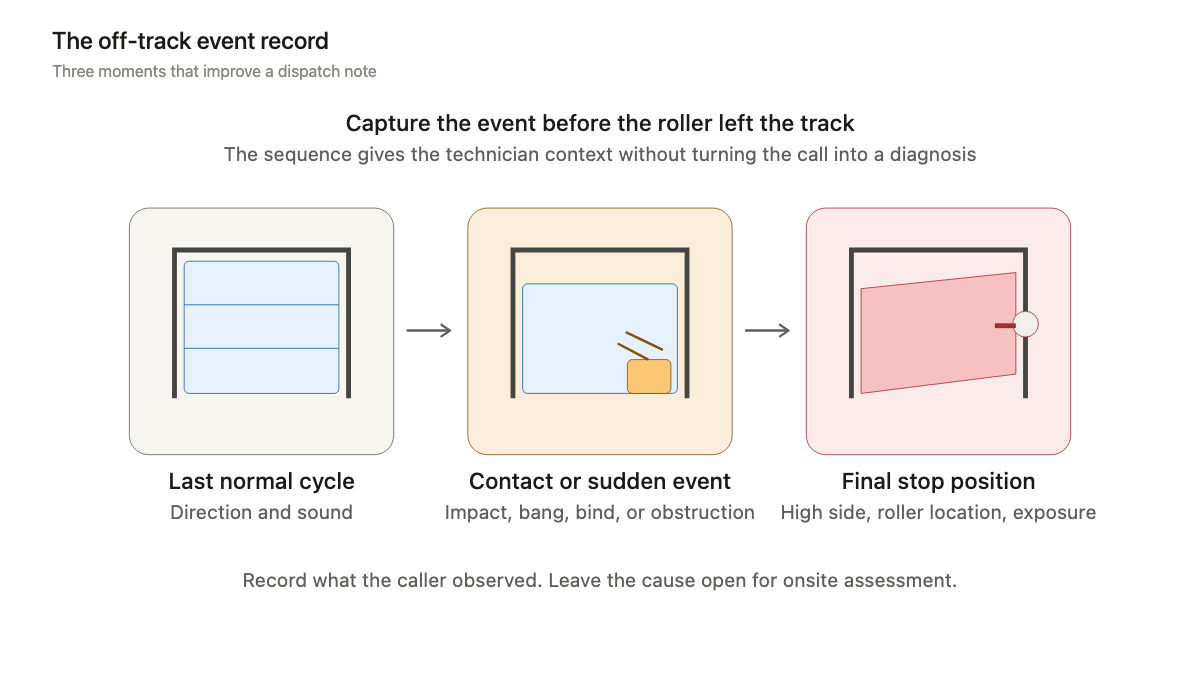
A useful off-track work order lets the technician picture the opening before leaving the shop. Capture the service address, caller’s location, residential or commercial use, door position, high and low sides, roller locations, track condition, cables visible from a safe distance, recent impact, opener behavior before the stop, and access constraints.
Include the photographs and label their viewpoint. Add the door or opener brand only if the label is safely readable. Never send a caller under the door to find a model number.
A concise note might read:
Double-width residential sectional door stopped while closing. Bottom edge rests on the slab at left and is about eight inches high at right. Caller sees the middle right roller outside the vertical track and a bend near that location. No loose cable observed from a distance. Door contacted a plastic trash bin just before it stopped. Minivan is inside, and an interior house door provides technician access. Caller was told to stop operation and keep people and pets away. Wide and detail photos attached.
That record preserves what the caller saw, what happened first, and how the technician can enter. It does not promise which part will be replaced.
Set expectations without boxing in the repair
Tell the caller that the visit will assess the door, tracks, rollers, cables, brackets, sections, opener connection, and balance as applicable to the system. The technician can explain the repair scope after checking why the roller left the track. If your company charges a diagnostic or service-call fee, give the approved amount and state what the fee covers.
Avoid three promises: that the technician will simply put the roller back, that no other component needs attention, and that the door will be usable immediately after one adjustment. A bent track, damaged roller stem, loose mounting point, cable issue, or struck panel can change the work once the door is supported and inspected.
An AI receptionist can follow the same approved intake after hours, provided the script keeps the safety boundary firm and escalates unstable-door calls under company policy. The technology should collect observations, photographs, exposure, and access. Repair judgment stays with the technician.
The best final instruction is short: leave the door where it stopped, keep the opening clear, and wait for the technician through the safe entrance already recorded in the ticket.