“The bottom panel is dented. Can you replace only that piece?” The caller expects a yes or no. The office cannot answer yet because a replacement section has to match the installed door, remain available from the manufacturer, and make sense for the condition of the entire assembly.
A useful garage door panel replacement call captures five facts early: whether the door is stable, which section is damaged, the maker and model if known, the door’s size and appearance, and what the caller expects from the color match. Get those facts before quoting a section, promising a supplier match, or placing the call into a routine estimate slot.
Individual section replacement is possible for many doors. It is never automatic. Amarr says availability depends on the model still being in production and the door not being a custom design. Clopay asks dealers to identify the model, section size, color, and exact section position before ordering.
Separate the section request from a safety call
Start with the door’s present condition, not the dent. Ask whether it is fully open, fully closed, partway through travel, or crooked in the opening. Find out whether the damage happened after a vehicle impact, storm, attempted break-in, or normal wear. Then ask whether the door moved after the event and whether its movement changed.
A caller may describe a shallow dent while the section is folded at the edge and binding against the track. Another may report a dramatic scrape across the face of a door that still sits level and stable. The office should record what the caller sees without deciding that the damage is cosmetic or structural.
Stop routine photo gathering when the door is hanging unevenly, off track, visibly folded around a hinge, or near a loose cable or damaged bottom bracket. Route those details through the company’s garage door emergency intake procedure. Do not ask the caller to run another cycle for a video.
The safety boundary comes from the hardware around the sections. Amarr’s support guidance assigns springs, cables, and red fasteners in high-tension areas to trained professionals. Clopay’s damaged-section guidance sends major damage to a professional dealer for evaluation. A receptionist does not need to classify the failure to follow that boundary.
Identify the exact section that was damaged
Garage doors are built from horizontal sections, even though callers often call each one a panel. Ask them to count the sections from the floor upward while the door is closed and viewed from a safe position. Record whether the damaged piece is the bottom, a middle section, or the top section with the opener attachment and any windows.
Position matters. So does the pattern. A long-panel design, short raised panels, flush face, carriage overlay, windows, decorative hardware, or a wood-look finish can change what must be sourced. Ask for a full exterior photo that includes the entire door and opening. A tight photo of one dent cannot show the section count or design.
Then capture the door width and height if the customer already knows them from an invoice or original proposal. Do not coach someone to measure a damaged moving door. An approximate description such as “single-car door” helps with initial routing, but it is not an order dimension.
A clean first record includes:
- Current door position and whether it sits level
- Cause and time of the damage, if known
- Bottom, middle, or top section involved
- Number of sections and whether the damaged section has windows
- Door maker, model, serial number, and installation year when available
- Door width, height, material, insulation, pattern, and exterior color when known
- One full-door photo, one damage photo, and a safe identification-label photo
- Any change in travel, new gap, rubbing, loose hardware, or cable concern
The office should keep “unknown” as an acceptable answer. A complete uncertainty is better than a guessed model number that sends the supplier search in the wrong direction.
Ask for photos that answer different questions
Each photo should have a job. The full-door view identifies the design and section arrangement. The damage view shows whether the impact reaches a joint, edge, hinge area, window frame, or neighboring section. The identification label may provide model, serial, size, production, or order information, depending on the manufacturer.
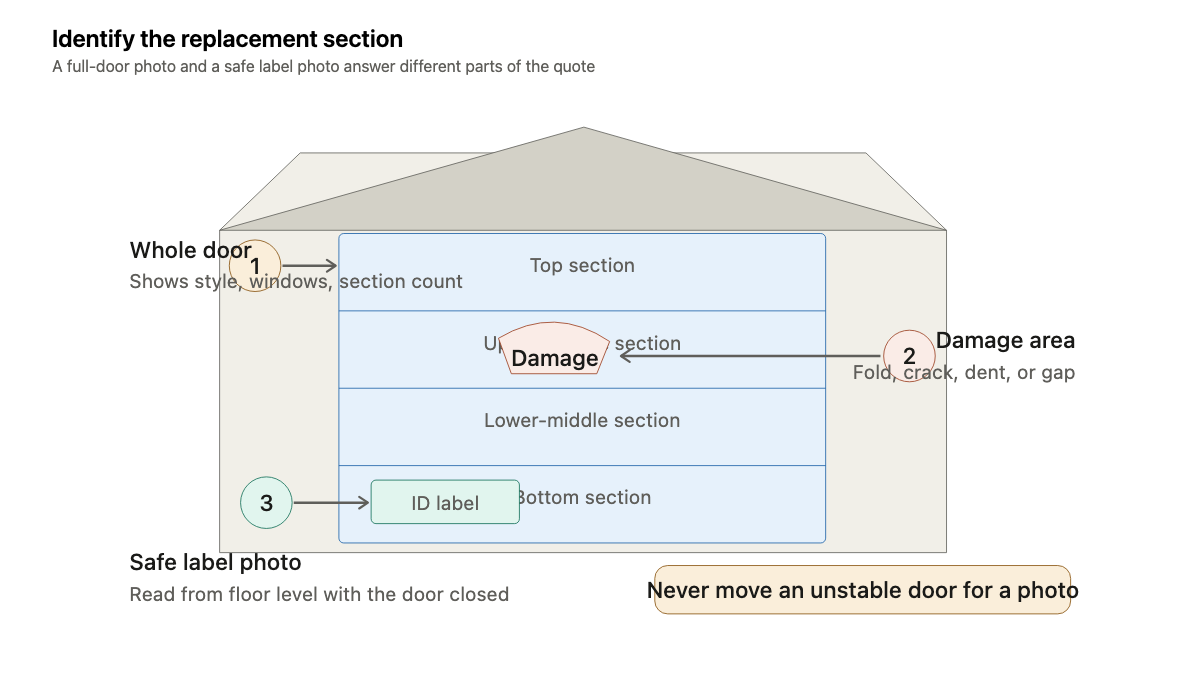
Clopay’s panel replacement guide says its replacement-section lookup needs the door model, section size, color, and whether the section is at the top, bottom, or middle. It also describes a serial-number label on the interior bottom section of newer Clopay doors. Other manufacturers put labels elsewhere, so ask only what the customer can see. Do not give a universal label location.
Set one firm rule for the photo request: the caller should stay on the floor and leave the door in its current safe position. No ladder. No hand near a hinge, roller, cable, spring, or bottom bracket. If the label cannot be read safely, the technician can identify the door onsite.
For damage, ask for one straight-on image and one angled image from several feet away. The angle can reveal a fold, separation, or depth that disappears in a head-on shot. A ruler held against a damaged operating section is a bad request because it puts a hand beside moving joints and gives a false sense that dent size alone settles the repair.
Treat availability as a supplier question
A matching section may exist, but the receptionist should never promise it from a photograph. The manufacturer, model family, design, section height, construction, and production status all matter. Custom designs narrow the choices further.
Use careful language: “We will identify the door and check whether the correct section is available.” That sentence commits the shop to useful work without committing the supplier to inventory.
If the label is gone, the dealer may need the original invoice, installer name, building records, inside and outside photos, section profile, and onsite measurements. Keep the call moving. Book the appropriate assessment under company policy, then attach every photo and document to the same customer record.
A discontinued model does not mean the office should improvise a substitute. The technician or estimator may compare section replacement with a complete-door option after inspecting the opening and hardware. If the inquiry becomes a full replacement conversation, move it into the new garage door consultation intake with the original damage record attached.
Explain color matching before it becomes a complaint
The color printed on an old order can be correct and still fail to look identical beside a new factory section. Years of sunlight, rain, cleaning, road salt, coastal air, and surface wear can change the older finish. Amarr warns that color variations can occur over time. Clopay also includes fading and finish condition among the factors to assess when considering individual panels.
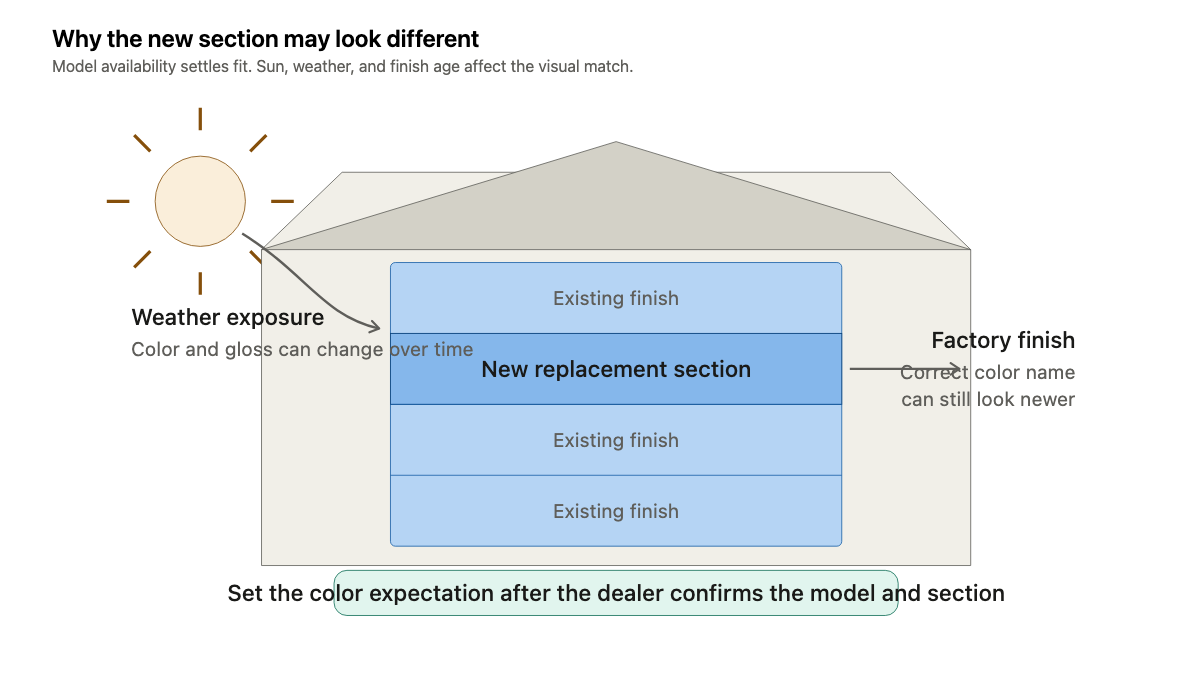
Ask how important an exact visual match is to the caller. This is especially useful when the door faces the street, sits beside a second matching door, or has a custom finish. Record whether the customer wants the least disruptive repair, the closest available match, or a broader replacement comparison. Do not tell them which choice is best before the dealer confirms the available section and sees the existing finish.
Avoid promising that paint will erase the difference. Materials and factory coatings vary, and manufacturer care instructions can be product-specific. The right response is plain: “A new section may look different beside the sections that have been outdoors. We will confirm the product and finish options before the work is approved.”
Build a work order the estimator can use
The handoff should preserve observations, documents, and unknowns. It should also tell dispatch whether the appointment is a routine estimate or a safety-sensitive inspection.
A useful note might read:
“Double residential sectional door, four sections, installed before current owner purchased the home. Vehicle backed into lower-middle section yesterday. Door is closed and appears level; customer has not operated it since impact. Section has a horizontal fold near right edge and a gap at the joint. No loose cable reported. Full exterior, angled damage, and interior label photos attached. Label shows Clopay name and serial image; model not yet confirmed. Exterior is faded tan. Customer wants section availability and full-door comparison if the finish cannot be matched.”
That note gives purchasing a starting point, tells the estimator what remains uncertain, and keeps the customer’s appearance concern attached to the technical request.
An AI receptionist can collect the same section, label, photo, and color questions after hours. The script needs a hard stop for unstable doors and high-tension hardware, plus a handoff path when the caller reports changed movement.
The best panel-replacement call ends with one concrete promise: the shop will identify the door, review the damage, and check the correct options. The supplier and onsite inspection settle the rest.