A caller says, “The lock is original to the house, and the key suddenly spins.” She has a brass knob in one hand, two old keys in a kitchen bowl, and a front door that still closes but no longer locks. The office could book this as a routine lock repair. That ticket would hide nearly everything the locksmith needs to know.
An antique lock repair consultation should establish five things before scheduling: whether the property is secure now, what object the lock belongs to, what the caller can observe without taking it apart, which keys or loose pieces still exist, and whether the shop wants the item reviewed on site, at a bench, or by a restoration specialist. Age alone does not identify the mechanism.
Separate urgent access from planned restoration
Start with the opening, not the antique label. Ask whether the door, gate, cabinet, trunk, or furniture piece is open or closed. Can the property be secured? Is anyone locked out or locked in? Is the hardware on a required exit, a shared building entrance, or an occupied business?
A customer locked outside a house needs the shop’s emergency lockout intake. A door that cannot latch or lock may need same-day security work even when the decorative hardware will receive a slower bench repair later. Record any safe alternate entrance and who controls it.
Then ask what happened immediately before the change. Did the key turn normally yesterday? Did the knob come off? Did the bolt stop retracting? Did a key break? Did a painter, carpenter, tenant, mover, or previous locksmith remove the trim? A broken fragment in the keyway belongs in the broken-key workflow, with the antique hardware details attached.
Do not promise that original operation can be restored during the first visit. The immediate job may be inspection, temporary security under company policy, careful removal, or documentation for later shop work.
Identify the object before naming the lock
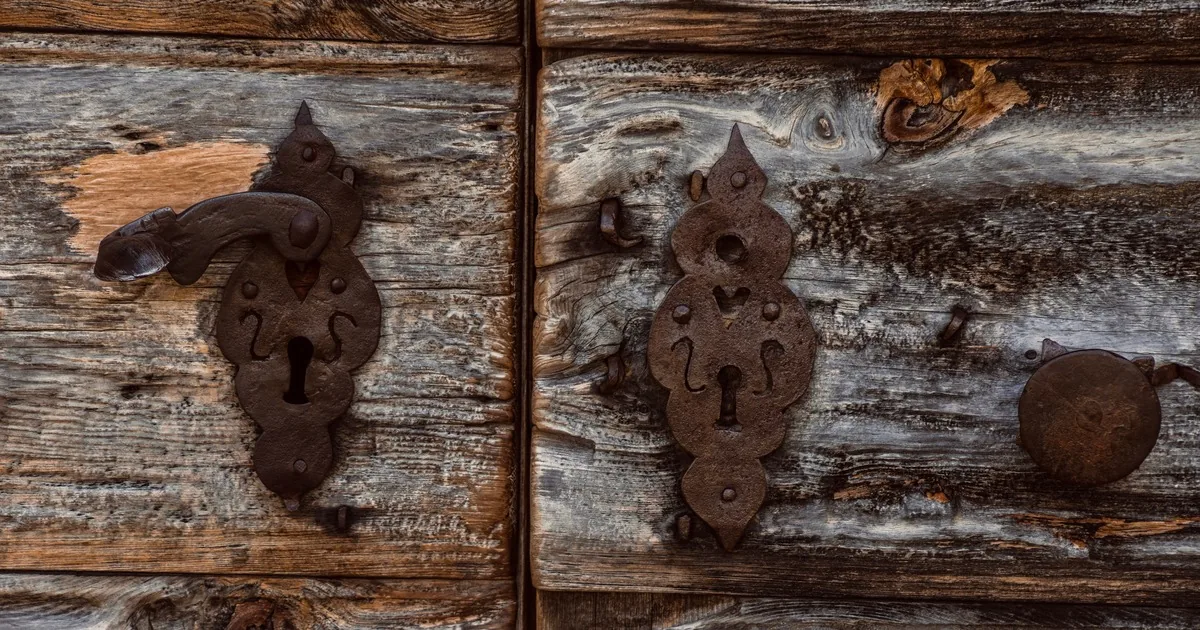
“Skeleton-key lock” describes several very different calls. The key may operate a full mortise case inside a door edge, a rim lock mounted on the door surface, a small cabinet lock, a warded furniture lock, an old gate lock, or hardware added long after the object was made.
Ask what the lock is installed in and what that object is made of. For a building door, record exterior or interior location, wood or metal construction, approximate door thickness if the shop requests it, and whether the opening appears to have fire, egress, landmark, apartment, or commercial requirements. The office should flag those conditions for qualified review without promising compliance.
Request a focused photo set through the shop’s approved process:
- the whole door or object, with enough context to identify its use;
- both sides of the trim, knob, handle, or keyhole;
- the door edge and faceplate while the door is already open;
- any maker’s name, patent marking, number, or logo;
- every key, loose screw, spring, spindle, knob, plate, and broken piece laid out separately;
- previous holes, filler plates, fresh damage, or modern hardware near the old lock.
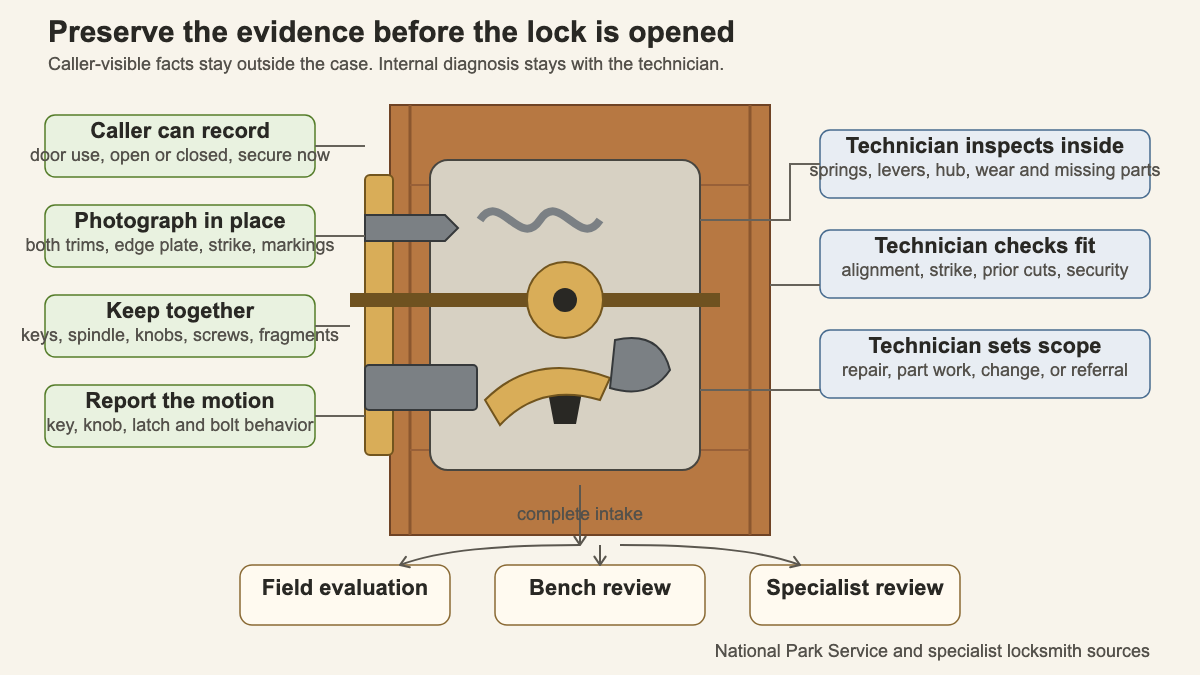
No one should remove paint, pry trim, back out screws, open the case, or force the key for the sake of intake. Photos document the current evidence. They do not prove the lock’s age, maker, completeness, or internal failure.
Preserve keys, screws, and loose parts
Small parts decide whether a restoration consultation begins with evidence or a scavenger hunt. Ask the caller to keep every piece, including bent keys, mismatched screws, washers, escutcheons, knobs, spindles, rosettes, faceplates, and fragments that look too damaged to reuse. Put them in a labeled container for that opening. A double-door entry with two similar locksets needs two separate containers.
Record where each part came from and who removed it. “Brass spring found on the floor after knob fell off” is useful. “Extra hardware” is not. If the customer has several old keys, photograph each key separately beside a simple scale, then label which ones currently enter or turn. Do not tell the caller to file, bend, grind, or test a key in several locks.
Greenwich Locksmiths lists antique door and furniture lock repair, missing-key work, skeleton-key fitting, duplication, shop service, and on-site service among its specialties. That range explains why object type and key status belong at the top of the record. A missing furniture key is a different appointment from a prewar apartment entry that will not secure.
Prior work matters too. Ask whether anyone sprayed lubricant or cleaner into the case, drilled the cylinder, replaced a knob, painted over the faceplate, changed the door, or installed another lock above it. Get the product name and date when a chemical was used. The technician can decide what matters after inspection.
Treat historic value as a project constraint
Some callers use “antique” to mean old-looking. Others are responsible for a documented historic entrance, an original interior door, a family heirloom, or custom decorative hardware that cannot be replaced from a catalog. Ask what the caller wants to preserve: operation, visible finish, original material, matching hardware across several doors, a period appearance, or the physical key.
The National Park Service’s treatment guidelines place identification, documentation, protection, and repair before wholesale replacement when a feature contributes to a historic property. The guidance also favors evidence-based replacement when deterioration makes repair impossible. Those principles support a careful intake. They do not establish the rules for every property.
Ask whether the building is designated, lies in a historic district, carries a preservation easement, or has an owner, architect, conservator, board, or agency reviewing changes. Record the answer and the reviewing contact. Local requirements vary, so the office should never promise that removal, drilling, replacement, or a security upgrade is permitted.
A repair goal can conflict with another requirement. The owner may want the original escutcheon retained while the opening also needs reliable egress, key control, accessibility, or fire-door performance. That conflict belongs with the qualified professional who can inspect the whole opening. Reception’s job is to make it visible before work is sold.
Choose field, bench, or specialist review
The service location follows the object and risk. A built-in entry lock may require an on-site inspection because the locksmith needs to see door alignment, the strike, trim relationships, prior modifications, and current security. A removable cabinet lock may be suitable for shop review if the customer can bring the entire drawer, door, or lock under the shop’s intake policy. A high-value or documented historic assembly may need a restoration specialist before anything is removed.
Safety Locksmith & Hardware describes vintage mortise restoration that included careful disassembly, cleaning, and calibration. Greenwich Locksmiths also describes making unavailable parts for some projects. These are examples of specialist capability, not promises that any given shop can perform the same work. The dispatcher should confirm the company’s real bench tools, fabrication partners, shipping policy, service area, and insurance boundaries before offering a route.
For an on-site visit, capture parking, stairs, elevator access, building hours, contact at the property, and authorization to work on the opening. For a shop appointment, state exactly what the customer should bring and how parts should be packaged. Do not advise shipping a lock, rare key, or irreplaceable trim until the receiving specialist has approved the method and address.
Keep replacement estimates separate from repair review. A photo may show that modern hardware was added, but it cannot reveal every internal part or confirm that a compatible replacement will fit without altering the door. If the caller wants a modern cylinder, keypad, or rekeyed system, link the consultation to the shop’s rekey and lock-change intake while preserving the antique-hardware question as its own decision.
Close with a bounded appointment promise
Read the record back in plain language. A useful summary sounds like this:
“Front entry of an owner-occupied 1910 house. Door is closed and can be secured with a separate deadbolt. The lower mortise lock’s key turns without retracting the latch. Both knobs, the spindle, two keys, and three loose screws are present. No one has opened the case. Photos show both trims, the door edge, faceplate markings, and strike. The owner wants the visible brass hardware retained if repair is feasible. This appointment is for on-site evaluation; repair method, parts, price, and completion date remain subject to inspection.”
That promise is narrow enough to keep. An AI receptionist can collect the same approved fields after hours and route the record to the right reviewer. It should not identify a rare mechanism, declare a part original, quote unseen restoration work, or tell the caller to dismantle the case.
When the technician opens the job, the old keys and loose brass pieces should already be accounted for. The door’s security state should be clear. Most of all, the customer should know whether the next visit is an emergency repair, a field evaluation, or the first step toward careful bench work.