A parent calls because a bathroom door is locked and a three-year-old is on the other side. Another caller cannot open an empty home office after a privacy button was pressed by accident. Both say, “We’re locked out of a room.” They should not enter the same dispatch queue.
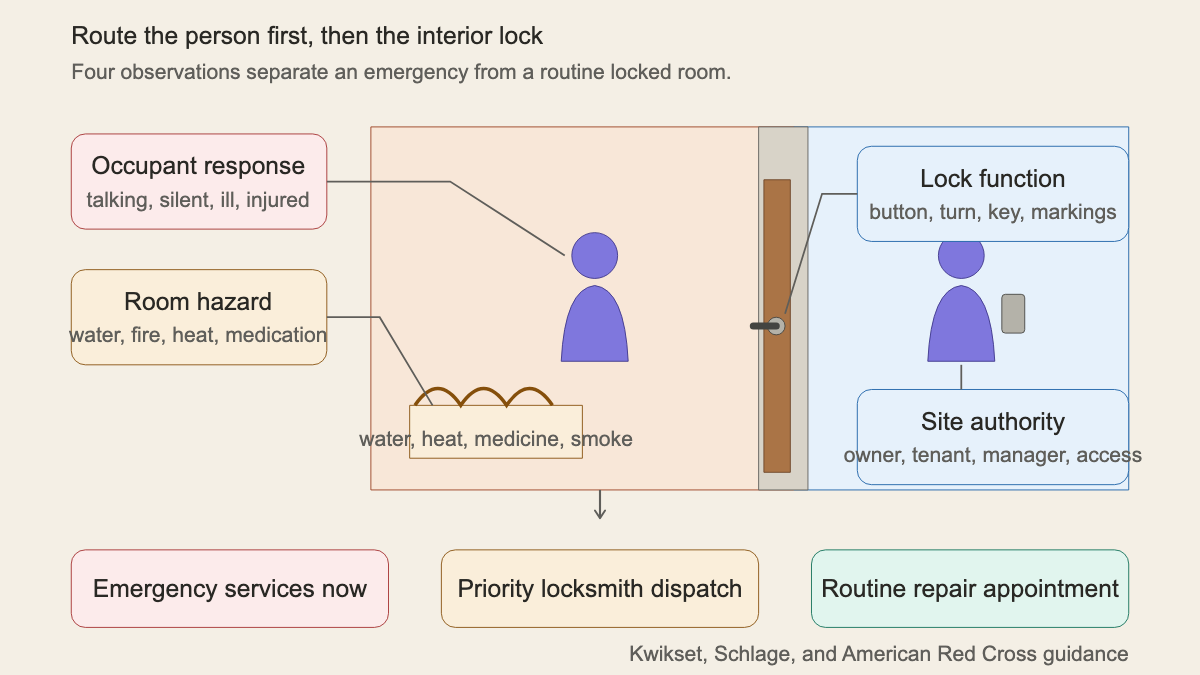
For an interior door lockout, ask about the person behind the door first. Then identify the room, any immediate hazard, the lock’s visible controls, property authority, and access to the site. A person who may be injured or in danger needs emergency help. An empty locked room with no active hazard can usually follow the shop’s normal locksmith or repair schedule.
Ask about the person before the lock
Start with one direct question: “Is anyone behind the door?” If the answer is yes, get the person’s age, whether they are responding normally, and what the caller can hear. Ask whether the person reports pain, trouble breathing, a fall, dizziness, or another medical concern. For a child or vulnerable adult, find out who is present with them and whether the caller can maintain voice contact.
Silence is information, but it is not a diagnosis. A toddler may be quiet. A person could be asleep, unable to hear, or unable to respond. Reception should not reassure the caller that everything is fine based on a locked door and no noise.
Ask about immediate conditions inside or near the room. Is water running into a tub or sink? Is there smoke, a burning smell, unusual heat, broken glass, medication, a firearm, a hot appliance, or an animal that could present a danger? Does the person behind the door have a known medical need that makes delay unsafe?
The American Red Cross describes emergency action as checking the scene and person, calling the local emergency number when indicated, and providing appropriate care. A locksmith office is not a medical triage line. If the caller reports a person in possible danger, direct them to emergency services under company policy. Do not let a technician’s estimated arrival time delay that call.
Name the room and the door
Once immediate danger has been addressed, record the exact room. “Interior door” could mean a bedroom, bathroom, home office, storage closet, mechanical room, apartment common room, or a private office inside a commercial suite. Each setting changes the likely hardware, who may authorize service, and what could be at risk behind the door.
Ask whether the door is wood, metal, glass, or another material. Is it hinged, sliding, folding, or pocket-style? Does it sit in a house, apartment, hotel, school, clinic, office, or assisted-living property? Record the floor, unit, room label, and best route from the building entrance.
Get the door’s current position and symptom in plain language. Is it fully closed? Does the knob or lever move? Does it return after being released? Does the latch sound as if it moves? Is the door rubbing the floor or frame? Did the problem begin after a slam, painting, carpet work, hinge adjustment, hardware replacement, or a child playing with the button?
Keep lockout and repair scope separate. A technician may restore access, then find a loose spindle, damaged latch, shifted strike, or door-alignment problem that needs additional work. The office should promise an assessment and authorized service, not a specific repair based on a phone description.
Identify the function without coaching a bypass
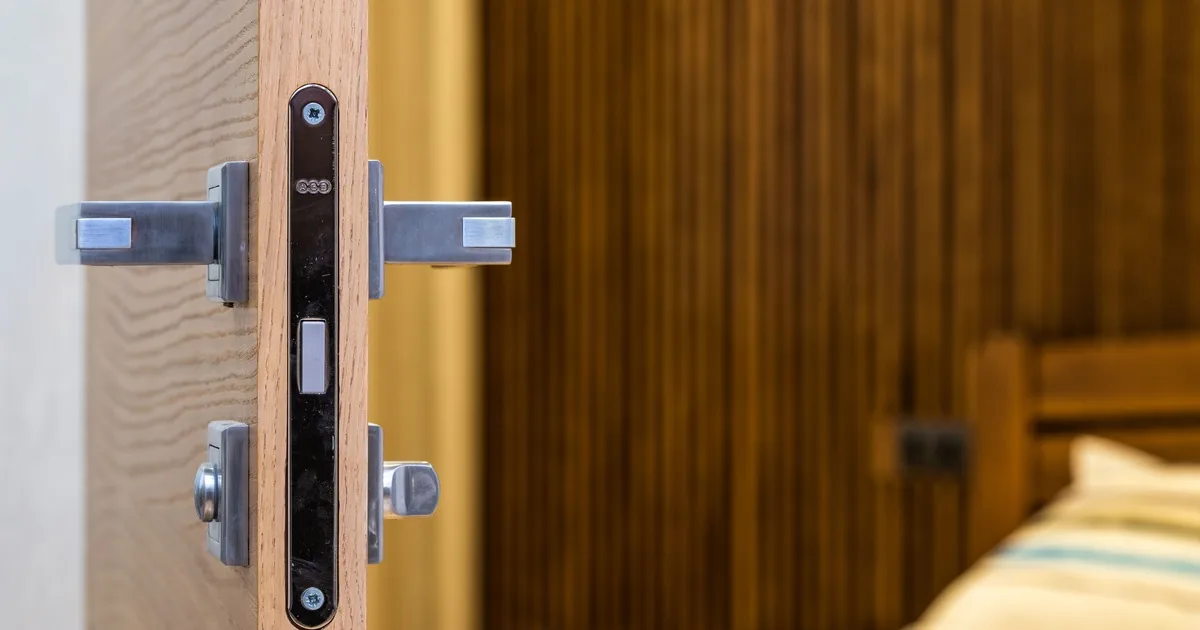
Ask the caller to describe both sides of the hardware if both sides can be viewed safely. Useful details include a round knob or lever, an inside push button, a small turn control, a keyed cylinder, a pinhole, a slotted release, a separate deadbolt, and any visible brand or model marking. A wide photo of the complete door and a close photo of the lock face can help, provided the caller covers people, documents, access codes, and other private information.
Residential bed-and-bath hardware is often a privacy function. Kwikset describes its bed-and-bath products as locks operated from the inside that can be released from outside with an emergency key. Schlage publishes a separate procedure for its FC21 and the emergency pin tool supplied for that product family. Those two examples show why “there is a hole on the knob” is not enough to give instructions.
Do not turn the call into a generic opening tutorial. Similar-looking locks may use different release features, and some interior doors carry keyed entry hardware, institutional hardware, access control, or a damaged mechanism. Reception should identify the product when possible, consult verified manufacturer instructions only when shop policy allows, or leave the opening method to the technician.
Tell the caller to stop if a key is bending, a lever is coming loose, the door is flexing, or an improvised tool is damaging the finish. Do not suggest drilling, prying, climbing through a window, removing glass, defeating access control, or forcing a door around a person. A cheap hollow-core door can still splinter badly, and the person behind it may be standing close to the opening.
If the key turns but the latch or bolt does not release, use the narrower key-turns intake guide for the motion details. Attach the occupant and room-safety information from this article to the same ticket.
Confirm authority and site access
An interior room sits inside a larger property. Ask for the service address, caller’s name, callback number, relationship to the property, and the person who can approve work. A homeowner calling about a bedroom has a different authorization path from an employee calling about a locked records room or a hotel guest calling about a connecting door.
For rentals, offices, schools, care facilities, and managed buildings, record the property manager, facilities contact, landlord, or on-site supervisor. Ask whether that person will be present and whether the locksmith must check in at a desk, loading entrance, security station, or gate. Note parking restrictions, elevator hours, alarm procedures, and any requirement for a certificate of insurance or vendor registration.
The phone call can collect the story. The technician still follows the shop’s policy for identification, authority, and approval at the site. If ownership or permission is disputed, do not improvise a workaround. Route the call to the designated reviewer.
Keep billing authority separate from access authority. A tenant may lawfully provide access to the apartment while a property manager controls alterations to the door. An office employee may be inside the suite but lack permission to replace a lock on a records room. Record both names when they differ.
The broader emergency lockout intake guide covers arrival coordination, identity, and dispatch for exterior access. Use it when the caller cannot enter the property at all. This interior workflow assumes the caller can reach the locked room safely.
Choose the route and set the promise
By the end of the call, place the job in one of three routes. Possible danger to a person goes to emergency services first, with locksmith support coordinated only under the shop’s policy. A safe occupant or time-sensitive room with a verified caller may qualify for priority dispatch. An empty room with no active hazard can be booked as routine lockout or repair service.
Read the ticket back. A useful note sounds like this:
“Second-floor bathroom inside an occupied single-family home. Four-year-old is behind the closed door, speaking normally with a parent, and no water, smoke, injury, medication concern, or other active hazard is reported. Parent owns the home and will meet the technician. White wood hinged door has a silver lever with an inside push button and a small outside opening. No brand is visible. Lever moves but does not retract the latch. Caller was told to contact emergency services immediately if the child stops responding or any danger appears. Entry method, damage risk, repair scope, and completion time require on-site assessment.”
That note preserves what the office knows and what it does not. An AI receptionist can gather the same approved fields after hours, but emergency language, uncertainty, and disputed authority should trigger a human or emergency escalation path.
The most useful first question remains the simplest one: “Is anyone behind the door?” Everything else follows from that answer.
Sources
- Kwikset: Bed and Bath Products
- Schlage: FC21 Emergency Pin Tool
- American Red Cross: Check, Call, Care
- Answara: What Locksmiths Should Ask on Emergency Lockout Calls